When you apply for a loan — especially a mortgage — lenders look at more than your credit score. One of the most important numbers they calculate is your debt-to-income ratio (DTI): the share of your monthly income that already goes toward debt payments. It is a blunt but effective measure of how much room you have to take on more, and it quietly gates how much a lender will offer you. Understanding it puts you in control before you ever fill out an application.
What DTI actually measures
Your DTI is simple arithmetic: add up your required monthly debt payments and divide by your gross (pre-tax) monthly income. If you earn $6,000 a month before taxes and your debt payments total $1,800, your DTI is 30%. Lenders use it to answer a basic question: if we add this new loan, can this person realistically keep up? A lower ratio signals more breathing room and less risk.
Note that DTI uses gross income, while your actual paycheck is smaller after taxes and deductions. That is one reason a loan you "qualify" for on paper can still feel tight in real life — your budget runs on take-home pay, not gross.
Front-end vs back-end DTI
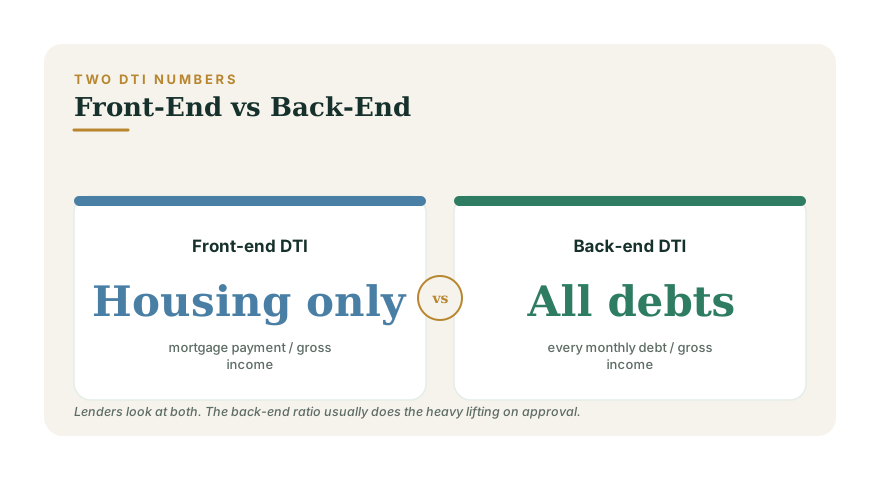
Lenders usually calculate two versions of the ratio, and the distinction matters most when you are buying a home:
- Front-end DTI counts only your housing costs — the projected mortgage payment including principal, interest, property taxes, and insurance — divided by gross income. It answers: how much of your income would housing alone consume?
- Back-end DTI counts all your monthly debt payments — housing plus car loans, student loans, credit card minimums, and other obligations — divided by gross income. This is the broader, more important number, because it captures everything you owe.
Lenders typically care more about the back-end ratio, since it reflects your total obligation load. Many follow guidelines that favor a back-end DTI at or below the low-to-mid 40s percent, with stronger approvals at lower levels — but exact limits vary by loan program and lender, and some allow higher ratios with compensating strengths like a large down payment or excellent credit.
How DTI gates a mortgage approval
Here is where DTI becomes concrete. When you apply for a mortgage, the lender does not just check whether you can afford the home you want — it checks whether your total debt picture leaves room for the payment. Two people with identical incomes and credit scores can get very different approvals if one carries a big car loan and credit card balances and the other does not. The one with more existing debt has a higher DTI and will be approved for a smaller mortgage, or asked to pay down debt first.
This is why DTI often becomes the real ceiling on what you can borrow — not your income alone, and not your credit score. If you are house-hunting, your existing debts are silently shrinking your budget. The home-buying process, including where DTI fits, is mapped out in The First-Time Homebuyer Roadmap.
Concrete ways to lower your DTI
Because DTI is a ratio, you can improve it from either side — shrink the debt or grow the income. The fastest levers:
- Pay down high-balance revolving debt. Credit card balances carry high minimum payments relative to other debt, so clearing them moves your DTI quickly. The payoff strategies in How to Actually Pay Off Credit Card Debt apply directly.
- Avoid new loans before a big application. Financing a car or opening a new line of credit in the months before a mortgage application raises your DTI at the worst possible time. Hold off until after you close.
- Pay off a small loan entirely. Eliminating a loan removes its full monthly payment from the calculation — sometimes more impactful than chipping away at a larger one.
- Increase documented income. A raise, a stable side income, or adding a co-borrower's income can all lower the ratio, though lenders want income that is verifiable and consistent.
- Don't confuse DTI with credit utilization. They are different numbers that both matter; see How Credit Scores Are Actually Calculated for how utilization affects your score separately.
Know your number before the lender does
The worst time to learn your DTI is in the middle of a mortgage application. Calculate it now, and if it is higher than you would like, you will know exactly which debts to target first. The Home Affordability Calculator factors your DTI into what you can realistically borrow, and the Mortgage Readiness assessment flags whether your ratio is ready for prime time — both worth running well before you start touring homes.