Saving for a goal a year or two away — a wedding, a car, a house down payment, a big trip — is a different job from saving for retirement, and using the wrong tool for it can be a costly mistake. The instinct, after hearing that "investing builds wealth," is to put goal money into stocks for the higher return. For short-term goals, that instinct is wrong, and the reason is one idea: your time horizon decides where the money should live.
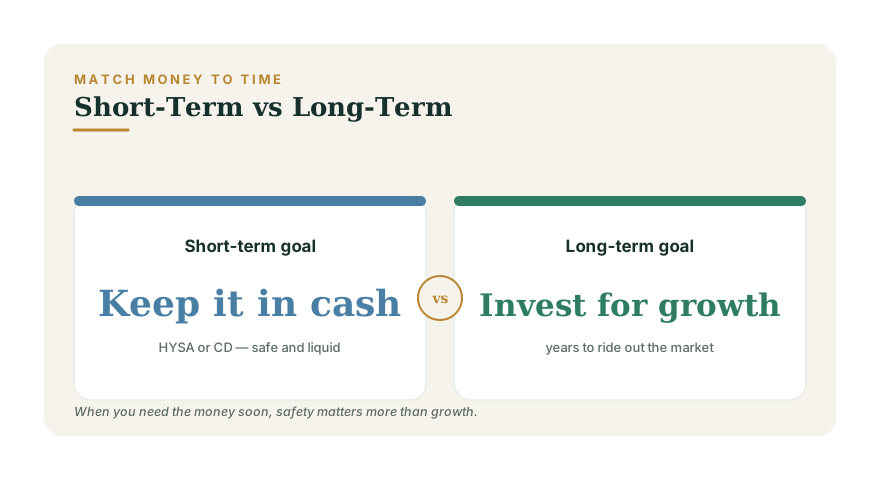
Horizon-based saving: the core rule
The single most important decision for any savings goal is matching the account to when you need the money. The rough framework:
- Short term (under ~3 years) — keep it in cash: a high-yield savings account or a CD. Safety and access matter more than return.
- Medium term (~3–7 years) — a blend of cash and conservative investments, depending on how flexible the date is.
- Long term (7+ years) — invest for growth; you have time to ride out the market's ups and downs.
This article is about the first bucket. The full goal-setting framework, including how to sort every goal by horizon, is in How to Set Financial Goals That Actually Stick.
Why short-term money does not belong in stocks
The stock market delivers strong returns over long periods, but those returns are anything but smooth. In any given year the market can fall sharply, and it can stay down for a while before recovering. Over decades, that volatility averages out. Over two years, it does not — you might simply be in one of the down stretches when your deadline arrives.
Picture saving for a house down payment you will use in 18 months. You invest it, and a few months before closing the market drops 25%. Now you must either delay the home you were ready to buy or sell at a loss and come up short. The potential extra return from investing a short-term goal is small; the potential damage from a badly timed drop is large and concrete. That asymmetry is why the answer is cash. (It is also why market timing cannot rescue you — no one can reliably predict the dip.)
The high-yield savings account: the default home
For most short-term goals, a high-yield savings account (HYSA) is the right place. It is federally insured, fully liquid, and pays far more than a traditional big-bank account — meaning your goal money earns a real, if modest, return while staying completely safe and accessible. There is no lock-up, so if your timeline shifts or the goal changes, your money is right there. For a goal whose date is flexible or uncertain, an HYSA is hard to beat.
CDs: lock in a rate for a known date
If your goal has a firm date — you know you need the money in exactly 12 or 24 months — a certificate of deposit (CD) can be a better fit. A CD typically pays a higher, fixed rate in exchange for leaving the money untouched until the term ends. Because the rate is locked, it cannot fall before your goal arrives. The trade-off is the early-withdrawal penalty, so only use a CD for money you are confident you will not need before the term is up. The full comparison of cash accounts is in Savings, Money Market, or CD: Where Should Cash Live?
Sinking funds: save in advance, on purpose
A sinking fund is the technique that ties short-term saving together. Instead of letting a known future expense ambush your budget, you save toward it a little at a time, in advance. Know your car insurance bill is due in six months? Set aside one-sixth of it each month. Planning a $3,000 vacation a year out? Save $250 a month into a labeled bucket. When the expense arrives, the money is already there — no scramble, no credit card, no derailed budget.
The practical setup: give each goal its own labeled savings bucket (many banks let you create several inside one HYSA), then automate a monthly transfer into each. This turns a vague intention into a funded plan, and it is the core idea behind sinking funds. It also keeps short-term goals from quietly draining the emergency fund you built for true surprises.
Put it together
For a short-term goal: figure out exactly when you need the money, keep it in cash rather than stocks, use an HYSA for flexible timelines and a CD for fixed ones, and fund it steadily through an automated sinking fund. Done this way, the money is there when the day comes — safe, predictable, and stress-free. To set a target and track your progress toward it, use the Net Worth Tracker or sketch the plan at the planning hub.