An online bank has no branches. It exists as an app and a website, and that single fact changes its economics. Without thousands of physical locations to staff and maintain, an online bank has far lower overhead — and it tends to pass those savings back to you as higher interest and lower fees. A traditional bank gives up some of that yield in exchange for things you can only get in person.
What online banks do better
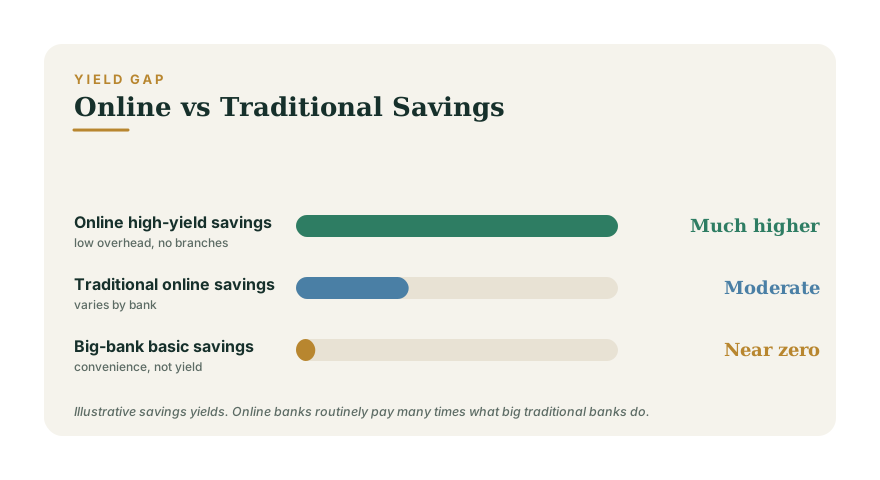
The headline advantage is yield. A high-yield savings account at an online bank can pay many times what a basic savings account at a large traditional bank pays — the difference between earning a few dollars a year and a few hundred on the same balance. Online banks also tend to charge fewer fees: no monthly maintenance charge, no minimum-balance penalty, and often reimbursement for out-of-network ATM fees. For an emergency fund or any cash you are not spending soon, this is real money. The mechanics of squeezing the most from these accounts are covered in high-yield savings, CDs, and how to build a CD ladder.
What traditional banks do better
Branches still matter for some things. A traditional bank lets you deposit cash, get a cashier's check or notary, talk to a person about a problem, and access a wide range of in-person services. If you run a cash business, frequently handle physical money, or simply value being able to walk in and sort something out face to face, a brick-and-mortar bank earns its keep. Traditional banks also bundle more products — mortgages, wealth management, business accounts — under one roof.
The biggest practical gap for online banks is cash. Most have no easy way to accept a cash deposit, so if you regularly receive cash, you will need a workaround or a second account.
The best move: use both together
You do not have to choose. The most common smart setup is a deliberate split:
- Keep checking and cash deposits at a traditional bank (or a credit union) for everyday convenience and in-person access.
- Keep savings and your emergency fund at an online high-yield bank where the same dollars earn far more.
- Link the two so you can transfer money between them in a day or two.
This gives you branch access when you need it and a strong yield on the cash you are not touching. The only real cost is the one-to-two-day transfer time between institutions, which is why the online account is ideal for savings rather than the money you spend this week. Set up automatic transfers so the right amount flows to savings every payday without you thinking about it — see automating your finances.
FDIC insurance covers both
People sometimes assume an online-only bank is riskier because they cannot visit it. It is not, as long as it is FDIC-insured. Federal deposit insurance applies the same way whether the bank has a thousand branches or none — your deposits are protected up to the standard limit per depositor, per insured bank, per ownership category. Before opening any online account, confirm the institution is FDIC-insured (or, for a credit union, NCUA-insured). Many fintech apps are not banks themselves; they partner with insured banks, so check exactly which insured institution holds your money and how the coverage flows through.
How to choose your online bank
When comparing online banks, look past the advertised rate to the fine print: any minimum balance to earn the top yield, how transfers work, ATM access and reimbursement, and how easy it is to reach a human if something goes wrong. A slightly lower rate at a bank with great service and fast transfers often beats the highest rate at a clunky one.
If you are still weighing a credit union as a third option, the trade-offs are laid out in credit unions vs banks. Whichever you choose, the payoff is concrete: move your emergency fund to a high-yield account and the extra interest is found money. Run your cash balances through the emergency fund calculator to see how much you should be holding and how much that cushion could be earning.