The sandwich generation has a memorable name for a draining reality: supporting your own children and your aging parents at the same time, often while working full time. The financial pressure is real, but the deeper challenge is emotional — every dollar you direct toward one generation can feel like a dollar taken from another, or from yourself. Doing this well is less about a clever strategy and more about a clear order of priorities and a few uncomfortable conversations held early.
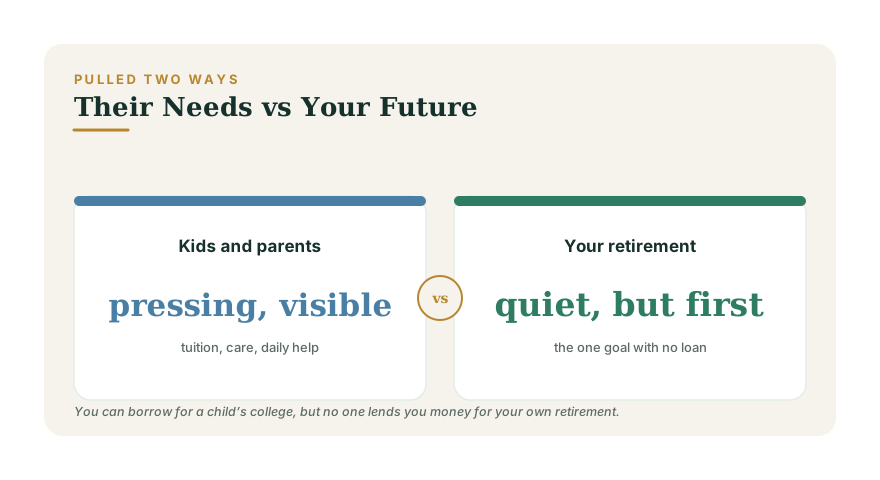
Competing demands, finite resources
The squeeze is the defining feature: tuition or childcare on one side, a parent's medical bills or care costs on the other, and your own career and savings in the middle. Trying to fully fund everyone's needs at once usually means underfunding the one goal that cannot be financed later — your retirement. The instinct to put everyone else first is admirable and, financially, often a mistake. Sequencing is what makes it survivable.
Protect your own retirement first — this is not selfish
The most important rule sounds harsh: fund your own retirement before you pay for a child's college or subsidize a parent. The logic is unsentimental. Your children can borrow for school, earn scholarships, or attend a cheaper option. There is no loan for retirement. If you shortchange your future to help today, you risk becoming a financial burden on those same children later — the opposite of helping them.
So keep capturing your employer match, keep your retirement contributions going, and decide what is genuinely left over for everyone else. The case for putting your own future ahead of college funding is the same argument explored across financial planning in your 50s, the decade most sandwich-generation caregivers land in. Run your own numbers in the retirement planner before you commit dollars elsewhere.
Coordinate care — and your parents' finances — before a crisis
The most expensive caregiving outcomes come from scrambling during an emergency. Get ahead of it. Have an honest conversation with your parents about their finances, wishes, and resources while everyone is healthy — awkward, but far cheaper than guessing later. The how-to is in How to Talk to Parents About Their Finances.
Two big questions to settle: how will care be paid for, and who will provide it? Long-term care is the single largest financial risk most aging parents face, and the options — savings, a long-term care policy, or eventually Medicaid — should be understood in advance. Start with long-term care insurance explained. If you have siblings, agree early on how care responsibilities and costs will be shared, in writing, to prevent resentment later.
Get the documents in place — for them and for you
If a parent becomes unable to manage their own affairs and no legal documents exist, the family faces a slow, expensive court guardianship process. Avoid it by helping your parents put in place a durable power of attorney (for finances) and a healthcare directive (for medical decisions) while they still can. The details are in Power of Attorney and Healthcare Directives. While you are at it, make sure your own documents — will, powers of attorney, guardian for your kids — are current too, since you are now the linchpin for two generations.
Set boundaries, on money and on yourself
Generosity without limits quietly wrecks the giver. Decide in advance how much you can give without endangering your own stability — a fixed monthly amount, a one-time gift, or help in kind rather than cash — and communicate it kindly but clearly. Boundaries are not coldness; they are what let you keep helping over the long haul instead of burning out and helping no one. Watch for caregiver costs that hide in plain sight too: reduced work hours, lost promotions, and your own neglected health all carry a price.
A sustainable middle
You cannot pour from an empty cup, and you cannot fund a retirement that you skipped. Secure your own future first, coordinate care and documents before a crisis forces them, set honest limits, and then give what you genuinely can. Use the Financial Wellness Score to confirm your own foundation is solid before you stretch it for the people you love.