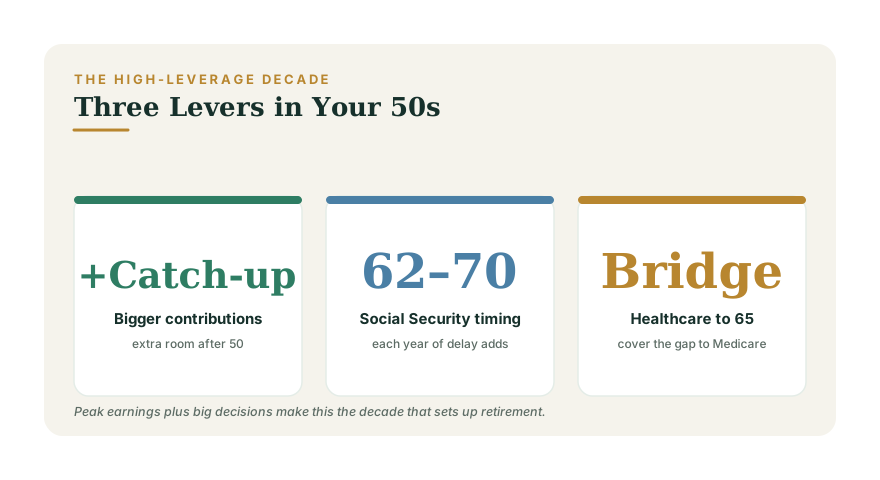
Your 50s are the decade where retirement stops being abstract. You can usually see the finish line, your earnings are often at their peak, and the kids may be getting cheaper. It is also the decade with the highest leverage: a handful of decisions about saving, healthcare, Social Security, and your home will shape the next forty years. Here is where to focus.
Use catch-up contributions while you can
Once you turn 50, the tax code lets you contribute extra — "catch-up" amounts — above the normal limits to your 401(k) and IRA, and there are additional catch-up provisions in your early 60s. If your earnings are peaking and major expenses are easing, this is the moment to push your savings rate hard. Every dollar you shelter now has roughly a decade or two to compound, and it does so during your highest-tax years, so the upfront deduction is especially valuable.
This is also the time to honestly check where you stand against where you want to be. Compare your balance to rough benchmarks in Retirement Savings by Age, and run a real projection — including catch-up contributions and a target retirement date — with the Retirement Planner. If you are behind, your 50s are the best remaining window to close the gap.
Plan the healthcare bridge to Medicare
Medicare does not start until 65, so anyone hoping to retire earlier faces a "bridge" problem: how to get health coverage for the gap years without an employer plan. This is one of the most underestimated costs of an early retirement, and it deserves explicit planning. Options include an ACA marketplace plan (where a deliberately managed retirement income can keep you eligible for subsidies), COBRA for a stretch, or a working spouse's plan.
An HSA, if you have a high-deductible plan, becomes a powerful tool here — money saved now can pay those bridge-year medical costs tax-free. Get a realistic sense of the numbers in Healthcare Costs in Retirement and the lead-up in Medicare Basics Before 65, so the gap years are funded on purpose, not discovered by surprise.
Get Social Security timing right
You cannot claim until 62, but claiming early permanently reduces your benefit, while delaying past full retirement age, up to 70, permanently increases it — by a meaningful amount for each year you wait. This is one of the few financial decisions with a guaranteed, inflation-adjusted return, so it is worth real thought rather than a default.
The right answer depends on your health, your savings, whether you are still working, and especially spousal and survivor benefits, which can make one spouse's delay protect the other for life. Your 50s are the time to learn the levers — see Social Security Claiming Strategies — and to model the trade-offs with the Social Security Optimizer so you arrive at 62 with a plan instead of an impulse.
Think clearly about downsizing
For many people the house is the largest asset and a large monthly cost. The 50s are when downsizing moves from idle thought to real option, especially once children leave. Selling a larger home can cut property taxes, insurance, maintenance, and utilities, free up trapped equity to invest, and simplify life. But it is as much an emotional decision as a financial one, and moving costs and a hot market can eat the savings, so run the actual numbers rather than the daydream.
Relatedly, aim to enter retirement with manageable debt. Paying off a mortgage before you stop working is not always optimal mathematically, but it lowers your required monthly income and the peace of mind is real for many households.
Start shifting from accumulating to protecting
For decades the job was to grow the pile. As retirement approaches, gradually reducing risk in the part of your portfolio you will spend first becomes prudent, so a downturn right before you stop working does not force you to sell at the bottom. This does not mean fleeing to cash — you may have thirty more years of life, and you still need growth — but it does mean revisiting your asset allocation rather than leaving it on autopilot from your 30s. A common approach is to hold a few years of spending in safer assets while keeping the rest invested for the long haul.
This is also the decade to handle the unglamorous protective items: confirm your beneficiary designations are current (they override your will), make sure you have adequate disability coverage while you are still earning, and consider whether long-term-care risk belongs in your plan, since the cost of addressing it rises sharply with age.
Don't sacrifice your retirement for adult children
The 50s often arrive with competing demands: aging parents who may need help, and adult children with college debt, weddings, or down payments. Generosity is admirable, but there are loans for tuition and homes and none for your own retirement. Fund your future first, then help from a position of strength. Quietly draining catch-up years to subsidize others is one of the most common ways a strong 50s plan goes off the rails.
Tighten the plan and stress-test it
Your 50s reward planning more than any prior decade because there is still time to adjust but the stakes are now concrete. Max what you can, fund the healthcare bridge on purpose, decide your Social Security strategy early, and make the housing call with clear eyes. Pull it together and find any gaps with the Retirement Readiness assessment.