Direct indexing has moved from a service for the ultra-wealthy to something several major firms now offer at more modest account sizes. The idea is simple to state: instead of buying a single index fund that holds the S&P 500, you buy the underlying stocks directly — a large, representative slice of them — in your own brokerage account. You end up tracking the index closely, but you own the pieces rather than a wrapper around them.
The obvious question is why anyone would bother owning hundreds of positions when one low-cost fund does the same job. The answer is almost entirely about taxes and, secondarily, customization. Whether those benefits are worth the added complexity depends heavily on your tax bracket and account type.
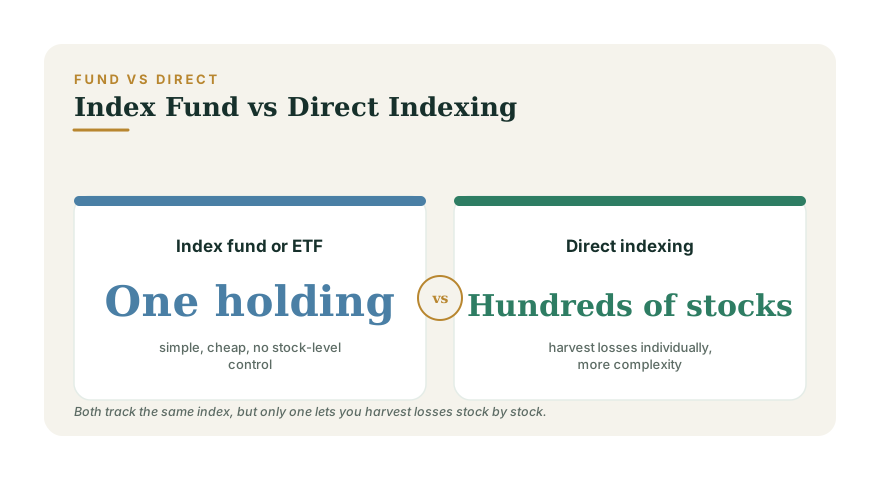
The core benefit: harvesting losses stock by stock
When you own an index fund, the fund is a single position. If the index is up for the year, you have a gain — even though some of the stocks inside it fell. You cannot reach in and sell just the losers. With direct indexing, you own each stock separately, so in almost any year some holdings are down even when the index is up. You can sell those losers to book capital losses, then buy something similar to stay invested. Those losses offset capital gains elsewhere and up to a limited amount of ordinary income each year, with the rest carrying forward. The IRS lays out the capital-loss rules on its investment income and capital gains pages. This is ordinary tax-loss harvesting taken to the individual-stock level, which can generate far more harvestable losses than a single fund ever could.
Watch the wash-sale rule
Harvesting only works if you respect the wash-sale rule, which disallows a loss if you buy a "substantially identical" security within 30 days before or after the sale. Good direct-indexing programs handle this automatically by replacing a sold stock with a different but correlated one, then rotating back later. Done carelessly, the losses you thought you booked get disallowed. The mechanics are the same trap covered in our tax-loss harvesting guide.
Customization is a smaller, real perk
Because you own the individual names, you can tilt the portfolio: exclude a sector you already have too much of, drop your own employer's stock to reduce concentration, or apply values-based screens. This is genuine flexibility a plain index fund cannot offer, though it should be a secondary reason, not the main one. Straying too far from the index reintroduces the active-versus-passive tradeoff you were trying to avoid.
The costs and complications
Direct indexing is not free lunch. Consider the drawbacks honestly:
- Fees. Management fees are typically higher than a plain index fund, though lower than they once were. Compare carefully, because small fee differences compound into real money over decades.
- Complexity. Your statements show hundreds of lots. Tracking cost basis, transfers, and gifting becomes more involved.
- It only helps in taxable accounts. Inside an IRA or 401(k), gains and losses are irrelevant to your annual taxes, so the harvesting benefit vanishes entirely.
- Benefit fades over time. As the market rises, more of your holdings show gains and fewer show losses, so harvesting opportunities shrink in later years.
Who it is actually for
Direct indexing makes the most sense for someone with a large taxable account, a high marginal tax rate, and a steady stream of capital gains to offset — for example, a high earner with concentrated employer stock or frequent gains from other investments. For a typical investor in a high bracket with a growing taxable balance, the harvested losses can add a modest but real amount to after-tax returns each year. For someone investing mostly inside retirement accounts, or in a low tax bracket, a plain index fund or ETF captures nearly all the benefit with none of the complexity.
Decide with the numbers, not the pitch
Direct indexing is a legitimate tool, but it is often sold harder than it deserves. Estimate your realistic annual gains, your tax bracket, and the fee difference before committing. If most of your investing happens in tax-advantaged accounts, you probably do not need it. To see how tax drag affects your outcomes and whether harvesting moves the needle for you, try the Capital Gains Estimator and the Tax Strategies tool, then confirm your overall approach with the Investor Profile assessment and the planning hub.