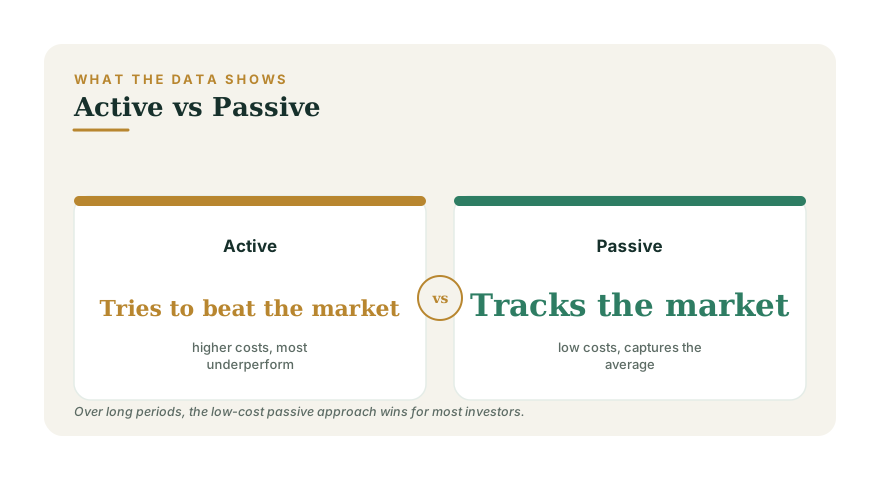
The investing world splits into two philosophies. Active investors — usually professional fund managers — try to beat the market by picking winning stocks and timing their trades. Passive investors give up on beating the market and simply buy the whole market through a low-cost index fund, accepting the average return. The active pitch is seductive: pay an expert, beat the index, win. The trouble is that decades of evidence keep pointing the other way.
The SPIVA scorecard: the inconvenient data
Every year, S&P Dow Jones Indices publishes the SPIVA report (S&P Indices Versus Active), which compares actively managed funds against their benchmark indexes. The finding is remarkably consistent across decades and across the world: over any meaningful stretch — five, ten, fifteen, twenty years — the large majority of active funds fail to beat their benchmark. The longer the period measured, the worse active managers look. Over fifteen-year windows, the share of active U.S. stock funds that beat their index routinely falls into the single digits to low teens, depending on the category.
This is not a knock on intelligence. Active managers are smart, hard-working people with research budgets and data. The problem is structural, and it is covered in depth in Why Professional Stock Pickers Fail.
Why most active managers lose
Three forces work against active management:
- Costs. Active funds charge more — research, trading, and manager salaries are not free, and that higher expense ratio is subtracted from your return every year. Passive index funds charge a tiny fraction as much.
- The market is the average. Collectively, all investors own the whole market, so before costs the average dollar earns the market return. After the higher costs of active management, the average active dollar must trail. This is arithmetic, not opinion.
- Trading and turnover. Active funds buy and sell frequently, which adds transaction costs and — in a taxable account — triggers taxable gains.
The tax drag almost nobody mentions
SPIVA usually compares pre-tax returns, which actually flatters active funds. In a taxable brokerage account, an active fund's frequent trading generates capital gains distributions that you owe tax on even if you never sold a share. Index funds trade far less, so they distribute far fewer taxable gains. After taxes, the gap between active and passive widens further. For a real-world investor in a taxable account, the tax drag can quietly turn a small pre-tax shortfall into a large after-tax one.
The winners don't stay winners
"Fine," the rebuttal goes, "I'll just pick the active funds that do beat the market." The catch is that past outperformance barely predicts future outperformance. Studies that track top-performing funds find that this year's stars are next year's also-rans with depressing regularity — winning streaks look a lot like luck, which is why funds warn that "past performance does not guarantee future results." Chasing last year's hot fund is itself a losing strategy, related to the broader truth that market timing doesn't work.
The narrow cases where active may help
The evidence is lopsided, not absolute. There are corners where active management has a more plausible case:
- Less-efficient markets. In niches with thin research coverage — some small-cap, emerging-market, or specialized bond segments — skilled managers occasionally find an edge that is harder to find in the heavily analyzed large-cap U.S. market.
- Specific bond strategies. Certain active bond funds have done relatively better against their benchmarks than active stock funds, partly because of how bond indexes are built.
- Tax-managed or risk-managed mandates. A few active strategies aim at goals other than raw return, such as minimizing taxable distributions or dampening volatility.
Even in these cases, low cost remains the single best predictor of which funds do better. A cheap active fund beats an expensive one far more reliably than an expensive one beats the index.
What this means for you
For the vast majority of investors, the sensible default is clear: build the core of your portfolio from low-cost, broadly diversified index funds, and treat any active fund as something that must justify its extra cost rather than something you assume is worth it. The burden of proof belongs on the active fund, not on the index. If you are just getting started, A Beginner's Guide to Index Funds walks through the mechanics.
This is not about giving up on good returns — it is the opposite. Choosing the passive default means you reliably capture the market's full return minus a tiny fee, instead of paying more for a coin-flip chance at beating it. The energy you would have spent picking and monitoring active funds is better spent on the things that actually move the needle: your savings rate, your asset allocation, and staying invested through downturns. When you are ready to assemble the pieces, the Portfolio Builder can help you lay out a low-cost, diversified mix you can actually stick with.