Most fund investors are used to open-end mutual funds and ETFs, where the price you pay tracks the value of what the fund holds. Closed-end funds break that rule in a way that fascinates income investors: they can trade for meaningfully less than their underlying assets are worth. A dollar of holdings for ninety cents sounds like a bargain, but the discount usually exists for reasons — and some of those reasons are warnings.
What makes a closed-end fund different
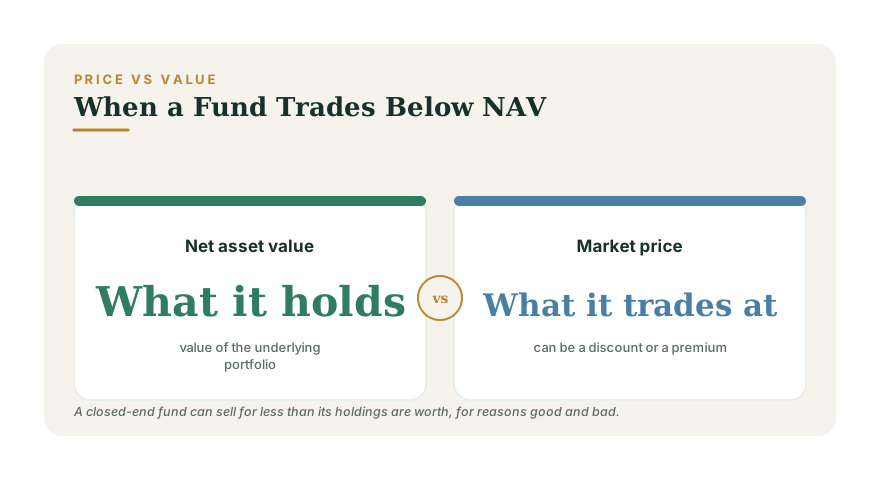
An open-end fund creates and redeems shares continuously, so its price stays pinned to its net asset value. A closed-end fund (CEF) issues a fixed number of shares in an IPO and then trades on an exchange like a stock. Because the share count is fixed, supply and demand set the market price independently of the value of the holdings. The result is that a CEF's market price can drift above its net asset value (NAV) — a premium — or below it — a discount. The SEC describes the structure and its risks on its investor education pages. This is fundamentally unlike the money-market and open-end funds covered in What Is a Money Market Fund?.
Why discounts and premiums happen
A discount can arise for benign reasons — investor sentiment, low trading interest, or a temporary mismatch of buyers and sellers. In those cases, buying at a discount can genuinely boost your yield and give you upside if the discount narrows. But discounts also reflect real problems: high fees, poor management, an unpopular strategy, or a distribution that is not sustainable. A premium, meanwhile, means you are paying more than the holdings are worth, which is rarely a good deal and can collapse quickly. The discipline is figuring out why a given fund trades where it does before assuming you have found value.
The leverage that supercharges everything
Many closed-end funds use leverage — they borrow to buy more assets, aiming to amplify income and returns. Leverage cuts both ways: it boosts yield and gains in good times and magnifies losses in bad times. A leveraged CEF can look like a high-yield miracle in a calm market and then fall far harder than an unleveraged fund when markets or interest rates turn against it. Leverage is a big reason CEF yields look so high, and a big reason their prices can be so volatile. Treat an unusually high yield as a question, not an answer — the same skepticism warranted by the high-yield dividend trap.
The distribution trap: return of capital
This is the most important thing to understand about CEFs marketed for income. A fund can advertise a rich "distribution rate," but part of that payout may be return of capital — literally giving you back your own money rather than paying you from earnings. Some return of capital is harmless (for example, passing through certain tax items), but destructive return of capital means the fund is liquidating itself to fund its distribution, slowly shrinking its NAV. You feel rich collecting the checks while the underlying value quietly erodes. This is why you must judge a CEF by total return, not yield, and read the fund's distribution breakdown carefully.
How to evaluate one sensibly
If you are drawn to closed-end funds, apply a checklist:
- Compare the discount to its own history. A fund trading at a wider discount than its typical range may be a better entry; one at an unusual premium is a caution.
- Check the distribution sources. Find out how much of the payout is income, capital gains, or return of capital, and whether that return of capital is destructive.
- Understand the leverage. Know how much the fund borrows and how sensitive it is to rising rates.
- Mind the fees. CEF expense ratios, especially with leverage costs included, can be high, and fees erode returns relentlessly.
A niche tool, not a core holding
Closed-end funds can occasionally offer real value — a solid portfolio bought at a genuine discount, throwing off sustainable income. But they demand more homework than an index fund and punish the investor who chases yield without reading the fine print. For most people they belong on the edges of a portfolio, if at all, with a plain index fund at the core. Weigh any CEF against simpler alternatives with the Opportunity Cost calculator and the Model Portfolios tool, and sanity-check your risk tolerance with the Investor Profile assessment and the planning hub.