Two investors compare notes. One brags that her stock pays a 7% dividend yield; the other quietly earned a 9% total return on a fund that yields almost nothing. Who did better? The second investor did — and the gap between what they each measured is one of the most common ways people misjudge an investment. The fix is learning to read total return instead of fixating on yield.
What yield measures — and what it misses
Yield is the income an investment pays out relative to its price, expressed as an annual percentage. For a stock it is the dividend; for a bond or savings vehicle it is the interest. Yield is real money, and it is useful. But it captures only the income side of an investment. It says nothing about whether the investment's price went up or down — and price changes are often far larger than the income.
Total return: the number that actually matters
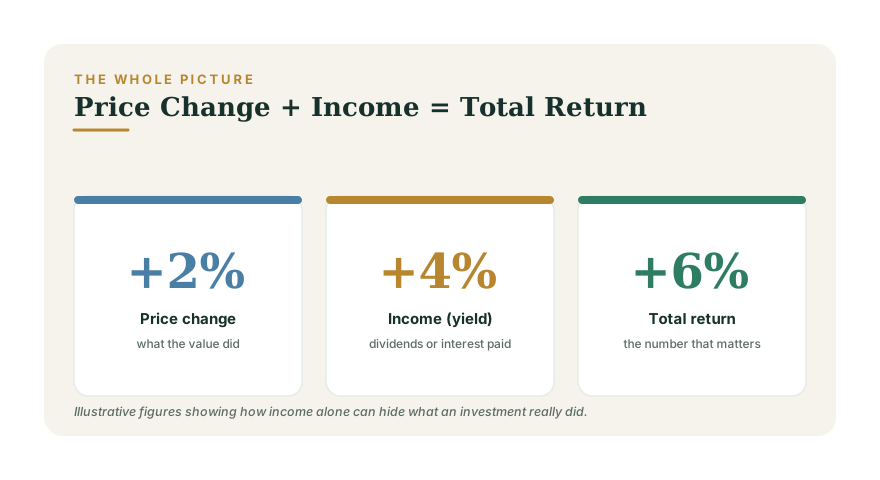
Your real reward from an investment is its total return, which combines two parts:
- Price change (capital gain or loss) — how much the value of the investment itself rose or fell.
- Income (yield) — the dividends or interest it paid you along the way.
Add them together and you get the full picture. A fund that gained 6% in price and paid 2% in dividends delivered an 8% total return. A high-yield stock that paid 7% in dividends but dropped 10% in price delivered a negative total return — you collected income while your principal shrank by more. Counting only the yield would have told you the opposite of the truth. This distinction is the heart of Dividend Investing vs Total Return.
Why chasing yield misleads
High yield is magnetic. A number like "8% yield" feels like a guaranteed paycheck, and investors reaching for income often buy the highest-yielding thing they can find. The problem is that an unusually high yield is frequently a warning sign, not a gift. Yield rises when a price falls, so a sky-high yield can mean the market expects trouble — a dividend that is about to be cut, or a company in decline. Reaching for yield can quietly load your portfolio with the riskiest assets while feeling conservative. The trap is laid out in The Dividend Trap: When High Yields Signal Danger.
For bonds the same logic applies through prices and interest rates: a bond's yield and its price move in opposite directions, and a high yield often compensates for higher risk or longer duration. The mechanics are covered in Understanding Bond Yields and Duration.
Income is not free money
A subtle point trips up many investors: a dividend is not a bonus on top of your investment — it is paid out of it. When a company pays a dividend, its share price typically drops by roughly that amount, because cash left the business. You did not get richer at that instant; you simply moved value from "price" to "cash in hand." That is exactly why you must look at price and income together. Spending the income feels like living off interest, but if the underlying value is eroding, you are slowly consuming your principal.
How to compare two investments honestly
When you weigh one investment against another, follow a few rules:
- Compare total returns, not yields. Always ask "what was the total return?" — and over a meaningful period, not a single good year.
- Use the same time frame and the same after-tax lens. A 5% return over one year and 5% over five years are wildly different. And income is often taxed differently from long-term price gains, so the after-tax total return can reorder the rankings.
- Don't ignore reinvestment. Published total-return figures usually assume dividends are reinvested. If you spend the income instead, your actual return will be lower than the headline number.
Putting it to use
None of this means income is bad — retirees in particular need cash flow, and a steady dividend can be part of a sound plan. The point is to judge any investment by the whole picture: price plus income, after taxes, over a real time horizon. A handy mental habit is to imagine selling a sliver of a high-total-return fund whenever you need cash; doing so often leaves you better off than chasing a high yielder, because you control the timing and the tax treatment instead of letting the dividend dictate them.
When you build or review a portfolio, focus on total return as the scorecard. You can pressure-test how different return assumptions play out over decades with the Wealth Simulator, which makes it easy to see why a couple of points of total return matter far more than a flashy yield.