A cash-out refinance replaces your existing mortgage with a new, larger one and hands you the difference in cash. If you owe $250,000 on a home worth $500,000 and refinance into a $350,000 loan, you walk away with roughly $100,000 (minus costs) and a bigger mortgage. It can be a smart way to fund something worthwhile at mortgage rates instead of credit-card rates — or an expensive way to reset your loan clock and pay interest for decades on a splurge. The difference is entirely in the math.
How a cash-out refinance works
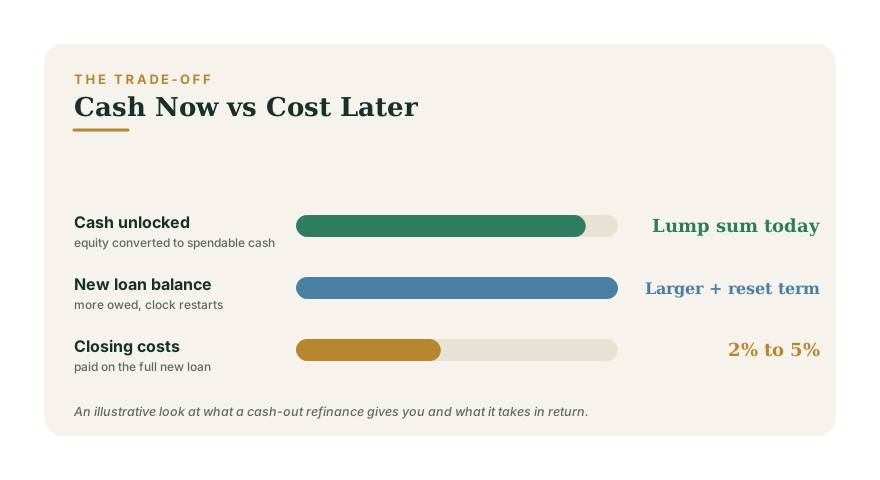
Unlike a HELOC, which adds a second loan on top of your first mortgage, a cash-out refinance replaces your original mortgage entirely. You get one new loan at today's rate, for a larger balance, with a fresh term. The cash comes from the equity you have built. Lenders typically let you borrow up to about 80 percent of your home's value, and they charge closing costs of roughly 2 to 5 percent of the new loan amount — a meaningful sum on a large mortgage. The general timing of any refinance is covered in When to Refinance Your Mortgage.
The rate reset is the whole game
The most important number is what happens to your interest rate. Many homeowners locked in unusually low mortgage rates in the early 2020s. If a cash-out refinance forces you to give up a 3 percent mortgage for a 6-plus percent one, you are not just borrowing the new cash at that higher rate — you are re-borrowing your entire existing balance at the higher rate too. That hidden cost often dwarfs the cash you extract. When your current rate is well below market, a HELOC that leaves your first mortgage untouched, described in HELOC Strategy in 2026, is usually the cheaper way to tap equity.
The break-even and total-cost math
Two calculations tell you whether a cash-out refinance is worth it:
- Break-even on closing costs. If refinancing lowers your rate, divide the closing costs by your monthly savings to see how many months until you come out ahead. If you will move before then, it is a loss. The method is spelled out in Refinance Break-Even Analysis.
- Lifetime interest on the cash. Spreading a lump sum over a fresh 30-year term can mean paying far more in total interest than the cash is worth. Borrowing $50,000 over 30 years at a high rate can cost you well over $50,000 in interest alone.
Run both with the Refinance Analyzer before you assume the low monthly payment means it is cheap.
Good reasons and bad reasons
A cash-out refinance can make sense when the money does real work: value-adding home improvements that also lift your cost basis (see Home Improvements and Cost Basis), consolidating high-interest debt you will not re-accumulate, or funding an investment with a return above your new mortgage rate. It rarely makes sense to fund vacations, weddings, cars, or everyday spending — you would be stretching a short-term purchase across a 30-year mortgage and risking your home for it. The rule of thumb: borrow against your home only for things that build wealth or that you clearly cannot afford to lose the home over.
Watch the term reset
Even at a similar rate, restarting the clock has a cost. If you are ten years into a 30-year mortgage and refinance into a new 30-year loan, you have added a decade of payments. You can blunt this by refinancing into a shorter term, though that raises the monthly payment. Always compare the total remaining interest on your current loan against the new one, not just the monthly payment, which can look better simply because the term got longer.
Decide with the numbers, not the pitch
Lenders market cash-out refinances aggressively because they are profitable to originate. Ignore the pitch and run your own math: the rate change, the break-even, the lifetime interest, and the term reset. If you already hold a low fixed rate, lean toward a HELOC instead. When the numbers genuinely favor a cash-out, it is a legitimate, low-rate way to fund something important. Model your scenario with the Refinance Analyzer and the Home Affordability Calculator, then check the fit with the Mortgage Readiness assessment and map it at the planning hub.