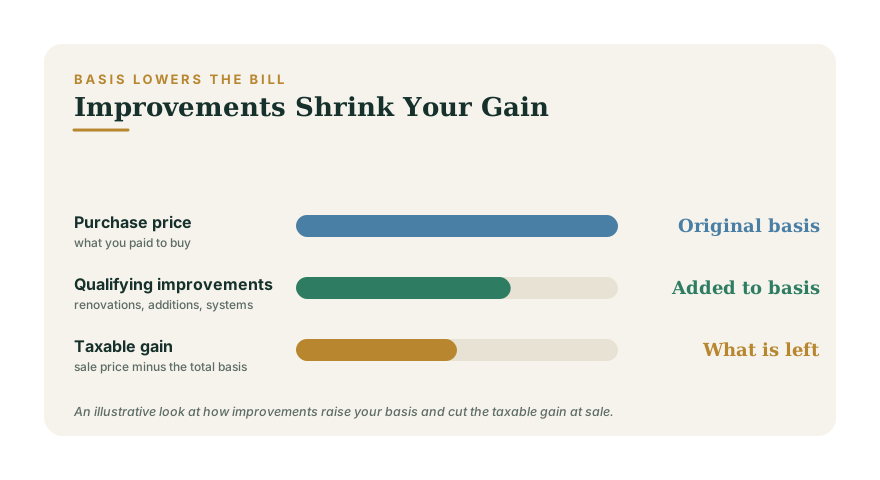
When you sell your home for more than you paid, the profit is a capital gain — and above a generous exclusion, it can be taxable. What many owners miss is that the profit is not simply sale price minus purchase price. It is sale price minus your cost basis, and every qualifying improvement you make over the years adds to that basis. A higher basis means a smaller taxable gain, which can mean thousands of dollars saved. The catch is that you have to keep the records, sometimes for decades, to prove it.
What cost basis is
Your cost basis starts as what you paid for the home, plus certain purchase costs like title fees and recording fees. Over time it goes up with capital improvements and can be adjusted by other events. When you sell, your gain is the sale price (minus selling costs like the agent commission) minus this adjusted basis. The broader concept applies to any asset and is explained in Understanding Your Cost Basis; for a home, improvements are the main lever you control. The IRS lays out how basis is figured and adjusted in its basis of assets guidance.
Improvements versus repairs — the crucial distinction
Only capital improvements add to basis. Routine repairs that simply maintain the home do not. The IRS draws the line at whether the work adds value, prolongs the home's life, or adapts it to a new use. A few examples:
- Improvements that count: a room addition, a new roof, a remodeled kitchen or bathroom, a new HVAC system, replacement windows, a deck or patio, a finished basement, new plumbing or wiring, and landscaping that is part of a larger project.
- Repairs that do not count: repainting, fixing a leak, replacing a broken window pane, patching the driveway, or general upkeep. These maintain rather than improve.
One nuance: a repair done as part of a larger renovation can sometimes be folded into the improvement. And an improvement you later replace — like an old roof swapped for a new one — should be removed from basis when the new one goes in.
The home-sale exclusion still matters
Before you worry about basis, remember the exclusion. If the home was your primary residence for at least two of the last five years, you can exclude a large amount of gain from tax — a threshold that is higher for married couples filing jointly than for single filers. Basis becomes most valuable when your gain exceeds that exclusion, which happens more often than people expect in high-appreciation markets or after a long ownership period. The full rules are in Tax Rules When You Sell Your Home.
Why records are everything
The tax savings are only as good as your documentation. If you claim $120,000 of improvements over twenty years but cannot substantiate them, the IRS can disallow the added basis and tax the gain as if you never made the improvements. Keep receipts, contracts, canceled checks, and before-and-after photos for as long as you own the home plus at least three years after you sell. A simple running log — date, description, cost — updated each time you complete a project saves a frantic search decades later. Store it with your home-sale paperwork so it is ready when you list.
Special situations that adjust basis
A few events change basis beyond improvements. Casualty losses and insurance reimbursements can reduce it. Depreciation you claimed for a home office or a rented portion (such as an ADU) reduces basis and is recaptured at sale. If you inherited the home, your basis is generally stepped up to its value at the prior owner's death, which can wipe out decades of gain — one of the most powerful provisions in the code. These interactions get technical, so a tax professional is worth consulting for anything unusual.
Track basis from day one
The homeowners who save the most on their eventual sale are not the ones who find a clever strategy at closing — they are the ones who quietly kept every improvement receipt for years. Start a basis log the day you buy, add each qualifying project as you go, hold the records well past the sale, and lean on the exclusion first. Estimate what your gain and tax might look like with the Capital Gains Estimator, weigh how a move fits your finances with the Home Affordability Calculator, and map the sale into your bigger picture at the planning hub alongside the Tax Health assessment.