Tax software has always been a guided interview: it asks questions, you answer, it fills in the forms. In 2026 that interview has an AI layer on top — it can read a photo of your W-2, pull documents automatically, answer plain-English questions as you go, and flag things that look off. For a straightforward return, filing has genuinely never been faster or cheaper. But AI has not changed the hard truth about taxes: the software is only as good as the information and judgment behind it, and it will confidently carry a mistake straight onto your return.
What AI tax tools do well
- Document import. Snap or upload a W-2 or 1099 and the software reads the numbers into the right boxes, cutting typos.
- Plain-English Q&A. Instead of hunting through help pages, you can ask "can I deduct my home office?" and get an answer in context.
- Error and audit-flag checks. The tool catches math mistakes and common mismatches before you file — the kind of slips detailed in Common Tax Filing Mistakes.
- Speed and cost. A simple return can be done in under an hour, and free tiers cover many filers — the landscape is mapped in TurboTax vs Free Alternatives.
What they cannot do
- Know what you did not tell it. The software cannot deduct a business expense you never entered or catch income you forgot. Garbage in, wrong return out.
- Exercise real judgment. Whether to itemize, how to handle a mixed-use asset, or which of two defensible positions is smarter — these call for judgment AI does not reliably have.
- Handle genuine complexity. Equity compensation, a small business, rental property, multi-state moves, or anything cross-border are exactly where cheap software oversimplifies. Stock comp alone, covered in RSUs Explained, routinely trips up both filers and basic tools.
- Give you someone accountable. If the AI-assisted answer is wrong, it is still your return and your penalty.
The confident-wrong-answer problem
The same failure that plagues general chatbots shows up in tax tools: an AI assistant can give you a fluent, authoritative answer that is simply incorrect for your situation. It might tell you a credit applies when your income phases it out, or miss a nuance that changes the result. This is the exact risk explored in Using AI Chatbots for Financial Advice, and it matters more here because the output goes to a government agency. When a tax answer surprises you or involves real money, verify it against the IRS or a professional before relying on it.
When to trust the software, and when to get a human
The dividing line is complexity, not income:
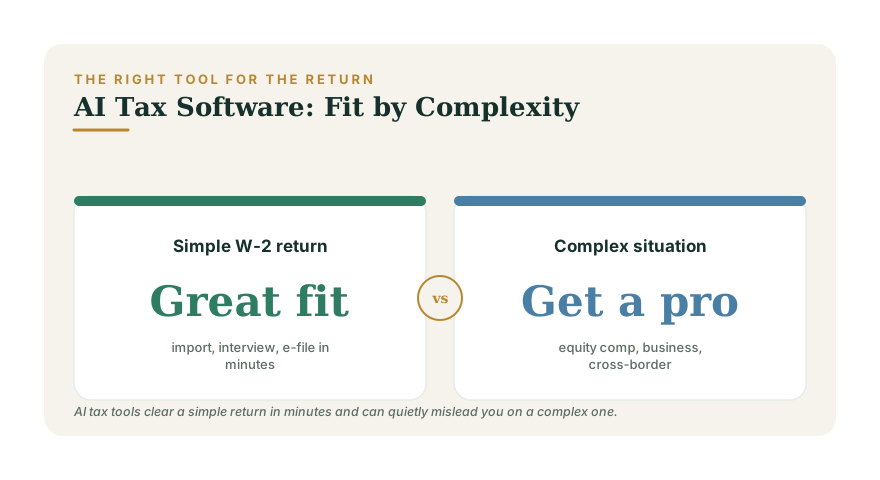
- Trust the software when you have a W-2, maybe some interest, the standard deduction, and a straightforward credit or two. AI-assisted filing is ideal here.
- Get a professional when you have equity compensation, a business or side income, rental property, a big life change, or any cross-border element. A good CPA or enrolled agent often saves more than the fee — and the underlying deductions are worth learning in Self-Employed Tax Deductions.
Protect your data
Tax software holds the most sensitive data you own — Social Security numbers, income, dependents. Use reputable providers, enable two-factor authentication, and be wary of any new "AI tax app" you have never heard of asking for full account access. The IRS and FTC both warn every filing season about fake tax tools and phishing built to harvest exactly this information.
The bottom line
AI tax tools have made filing a simple return faster, cheaper, and less error-prone — a real win for most people. What they have not done is replace judgment on complex returns or absolve you of responsibility for what gets filed. Use the AI to speed the easy parts, verify anything that surprises you, and hand genuine complexity to a professional. Estimate the moves that matter first with the Tax Strategies tool and the W-2 Optimizer, then check for gaps with the Tax Health assessment and plan the year at the planning hub.