In 2026, an AI chatbot is the new first stop for money questions. It is patient, it never makes you feel stupid, and it will explain a Roth conversion at midnight without an appointment. Used well, it is one of the best financial-literacy tools ever built. Used carelessly — as a substitute for advice tailored to your actual situation — it can steer you into expensive mistakes with total confidence. The trick is knowing which mode you are in.
What they genuinely get right
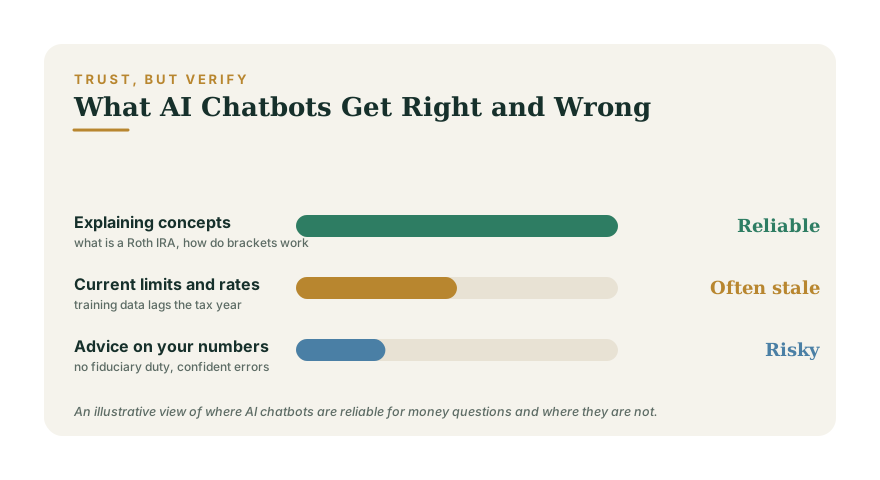
Chatbots excel at teaching. Ask what a 401(k) match is, how tax brackets actually work, or the difference between an ETF and a mutual fund, and you will get a clear, accurate, jargon-free answer instantly. They are also good at drafting: a budget template, a list of questions to ask an advisor, a script for negotiating a medical bill. For building the vocabulary of personal finance, they are superb — the same explaining job that articles like How Tax Brackets Really Work do, available on demand and infinitely patient.
Where they go dangerously wrong
- Stale numbers. Contribution limits, tax brackets, and standard deductions change yearly, and a model trained on older data may quote last year's figures with full confidence. Always verify a specific limit against the IRS directly.
- Confident fabrication. A chatbot can invent a rule, a form number, or a "strategy" that does not exist and present it as fact. This is not lying — the model has no idea it is wrong — which is exactly why it is dangerous.
- No knowledge of your whole picture. Advice that is right for a single 25-year-old is wrong for a married 55-year-old with stock options and a pension. The chatbot answers the question you asked, not the one you should have asked.
- No fiduciary duty and no accountability. A human advisor who is a fiduciary is legally bound to act in your interest — a concept explained in What Fiduciary Duty Actually Means. A chatbot owes you nothing and cannot be held responsible if its answer costs you money.
The specific-advice trap
The failure mode to watch is asking a general chatbot to make a decision on your numbers: "Should I do a Roth conversion this year?" or "Which funds should I buy?" It will answer, often persuasively, without knowing your marginal tax rate, your state, your other income, or your goals. That is not advice; it is a plausible-sounding guess. If you want portfolios run by software, a purpose-built robo is the safer version — see Are AI Robo-Advisors Worth It in 2026? — and if you want spending help, dedicated apps beat a chatbot, as covered in AI-Powered Budgeting Apps.
Privacy: do not paste your life into the box
Treat anything you type into a public chatbot as potentially stored and reviewable. Do not paste account numbers, Social Security numbers, full statements, or logins. General questions are fine; your raw financial identity is not. The Consumer Financial Protection Bureau has repeatedly warned that consumers should be cautious about sharing sensitive financial details with AI tools whose data practices are unclear.
How to use a chatbot well
- Use it to learn, not to decide. Ask it to explain options and trade-offs, then make the call with real, current data.
- Verify every hard number. Cross-check limits, deadlines, and rules against a primary source before acting.
- Ask it to show its reasoning. If it cannot explain why, be skeptical of the what.
- Escalate complexity to a human. Taxes, estate planning, and big irreversible moves deserve a professional.
The bottom line
An AI chatbot is a brilliant tutor and a terrible fiduciary. Let it teach you the concepts, draft your questions, and demystify the jargon — then verify the numbers and take real decisions to a tool built for the job or a human who is accountable. Turn the learning into action: run your own figures with the Retirement Planner and gauge where you stand with the Financial Wellness assessment, then build your plan at the planning hub.