More people are working into their late 60s and beyond — by choice or necessity — and doing so quietly changes how three big systems interact: Social Security, Medicare, and your taxes. The decisions are not hard, but they are easy to get wrong, and a misstep with Medicare enrollment in particular can cost you a lifelong penalty. Here is what working past 65 means for each.
Delaying Social Security boosts your check
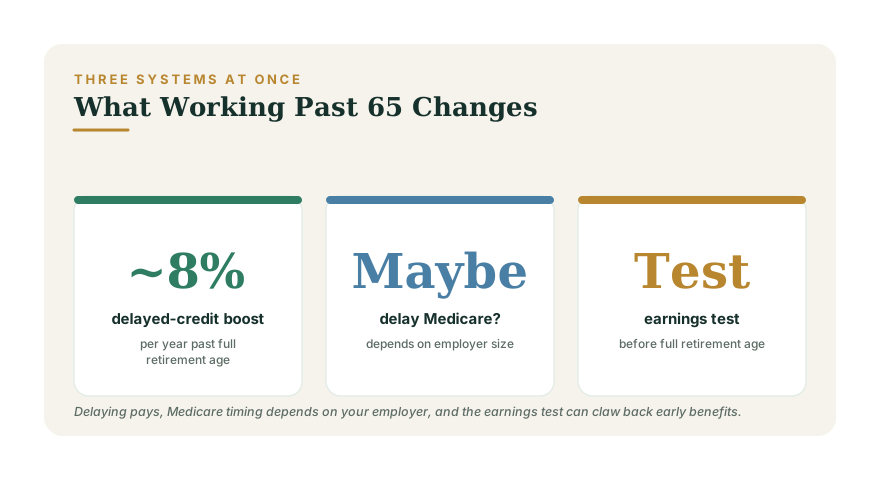
If you keep working, you often do not need to claim Social Security right away — and waiting pays well. From your full retirement age (66 to 67 for most people today) up to age 70, your benefit grows by roughly 8% per year in delayed retirement credits. That is a guaranteed, inflation-adjusted increase that is hard to match anywhere else, and it raises the survivor benefit for a spouse too. For many people who are still earning a paycheck, delaying to 70 is one of the most valuable moves available. The tradeoffs are weighed in Social Security Claiming Strategies.
There is no benefit to waiting past 70 — credits stop accruing — so 70 is the practical ceiling.
The earnings test, if you claim early while working
If you do claim Social Security before your full retirement age while still working, the earnings test applies. Earn above an annual limit and Social Security temporarily withholds part of your benefit — a set amount is held back for every few dollars you earn over the threshold. Two things soften this:
- The test disappears entirely at full retirement age. After that, you can earn any amount with no reduction.
- The withheld money is not lost. Once you reach full retirement age, your benefit is recalculated upward to credit back what was withheld.
Still, claiming early while earning a healthy salary often means giving up benefits temporarily for little gain — usually an argument to wait.
Medicare at 65: enroll or delay?
This is the decision with the sharpest penalties, and it hinges on the size of your employer:
- If you work for an employer with 20 or more employees and have creditable group health coverage, you can generally delay Medicare Part B without penalty and enroll later through a Special Enrollment Period when you stop working. Many people in this situation delay Part B to avoid paying its premium while covered at work, but often still take premium-free Part A.
- If your employer has fewer than 20 employees, Medicare usually becomes the primary payer at 65, and you typically need to enroll on time — delaying can leave you with coverage gaps and a permanent late-enrollment penalty that raises your Part B premium for life.
Confirm the rules with your benefits department before assuming you can wait. The foundations are in Medicare Basics Before 65. One more wrinkle: if you contribute to a Health Savings Account, enrolling in any part of Medicare (including Part A) stops your eligibility to contribute, so coordinate the timing carefully.
Taxes get more layered
Working past 65 stacks income sources, which has tax consequences worth anticipating:
- More of your Social Security may be taxable. Higher combined income from wages can push a larger share of any benefits you are taking into taxable territory.
- You still owe payroll taxes on your wages — there is no age at which Social Security and Medicare payroll taxes stop.
- IRMAA looms. A strong salary can raise your income above the Medicare surcharge thresholds, lifting your premiums two years later. See Medicare IRMAA: The High-Income Surcharge.
- You can keep contributing to a 401(k) or IRA as long as you have earned income, which can offset some of the extra tax.
Putting it together
Working past 65 is often a financial win: you earn longer, you can delay Social Security for a bigger check, and you may keep employer health coverage that lets you postpone Medicare premiums. The traps are administrative — missing a Medicare enrollment window, claiming Social Security early into the earnings test, or being surprised by IRMAA. Map out the timing a year ahead, and model how delaying benefits changes your lifetime income with the Social Security Optimizer and the Retirement Planner before you decide.