You have an extra few hundred dollars this month. Do you throw it at debt or put it in the market? It is one of the most common money questions, and the honest answer starts with a single comparison: the guaranteed return from paying off debt versus the expected return from investing. Paying down a loan at 9% is a risk-free 9% return — you can no longer be charged that interest. The trick is knowing where the line falls.
The core idea: a guaranteed return
Every dollar you use to pay off debt earns you exactly the debt's interest rate, guaranteed and tax-simple. Every dollar you invest earns an uncertain return that could be higher or, in a bad year, negative. So the comparison is not "debt payoff vs the stock market's best years" — it is a certain return against a probable one. A broad stock market portfolio has historically returned roughly 7% to 10% annually over long periods, but with real volatility and no guarantees in any given year. That historical range is what sets the threshold. This is fundamentally an opportunity-cost decision, and you can put dollar figures on both sides with the Opportunity Cost Calculator.
The rough threshold rate
For most people, a simple heuristic sorts the decision:
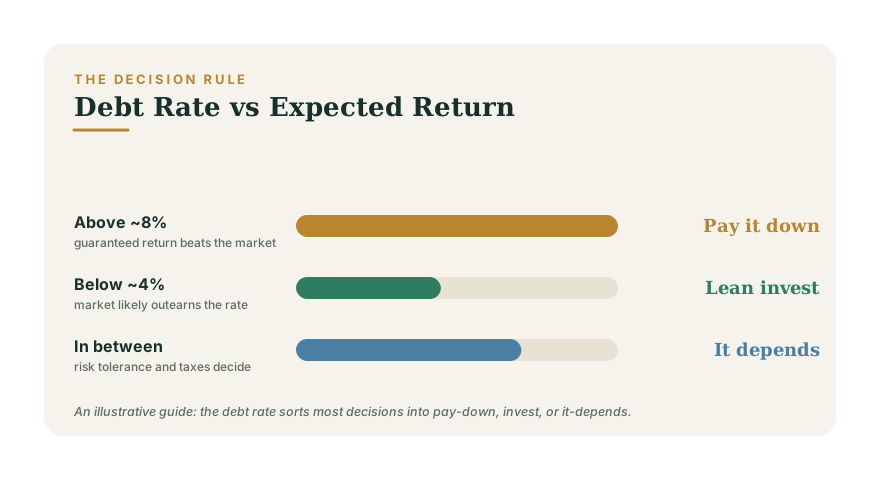
- Debt above roughly 8%: pay it down first. Credit-card debt at 20-plus percent, payday loans, and most personal loans clear this bar easily. Beating that rate reliably in the market is unrealistic, so retiring the debt is the better guaranteed return.
- Debt below roughly 4%: lean toward investing. A low fixed-rate mortgage or a subsidized student loan costs less than the market has historically returned, so investing the difference tends to build more wealth over time.
- Debt in the 4% to 8% middle: it genuinely depends. Here the expected edge is thin enough that your risk tolerance, taxes, and temperament decide.
These numbers are guidelines, not laws — the point is the framework, not the exact percentages. Which category your loans fall into overlaps heavily with Good Debt vs Bad Debt.
Where the pure math is wrong
The threshold answers the arithmetic, but three things override it:
- Always grab the 401(k) match first. An employer match is an instant 50% or 100% return that beats paying off almost any debt. Capture the full match before anything else — it is the exception that trumps the threshold every time.
- Emergency fund comes before extra debt payoff. Without a cash cushion, one setback sends you back to the credit card, undoing your progress at a punishing rate. A starter emergency fund is not optional.
- Behavior and peace of mind matter. If high debt keeps you up at night, paying it down faster than the math strictly requires is a legitimate choice. The guaranteed return is real, and reduced stress has value the spreadsheet ignores.
The tax and adjusted-rate wrinkle
Compare rates on an apples-to-apples basis. If your mortgage interest is deductible, its effective rate is lower than the stated rate, tilting toward investing. Investment returns in a tax-advantaged account like a 401(k) or Roth IRA are worth more than the same return in a taxable account, because you keep more of them. And on the debt side, a variable-rate balance is riskier than a fixed one — a rate that could climb argues for paying it off sooner. The Federal Reserve tracks how consumer borrowing rates move over time (federalreserve.gov), which matters when your debt is not locked in.
A practical order of operations
Put it together and the sequence for most people is: capture the full employer match, build a starter emergency fund, obliterate any high-interest debt above the threshold, then split extra dollars between low-rate debt and long-term investing according to your comfort. If your high-rate debt is the obstacle, lowering the rate first through a consolidation loan or balance transfer can move a balance from the pay-it-down bucket toward the invest bucket.
The bottom line
Compare the guaranteed return of paying off a debt to the uncertain return of investing: above about 8% almost always pay down, below about 4% lean invest, and in between let your risk tolerance and taxes break the tie — after grabbing the match and funding emergencies. Run both sides with the Opportunity Cost Calculator and the Debt Payoff Planner, then set your priorities at the planning hub. To see where you stand before you decide, take the Financial Resilience assessment.