You have probably heard the rule: a mortgage or a student loan is "good debt" because it builds toward something, while credit-card balances and car loans are "bad debt" because they buy things that lose value. It is a useful first sort, and it is not wrong exactly. But lean on it too hard and it starts to mislead, because the label looks at what you bought and ignores the two things that actually determine whether a loan helps or hurts: the interest rate, and what borrowing lets you do with the rest of your money.
The conventional framing, in its best light
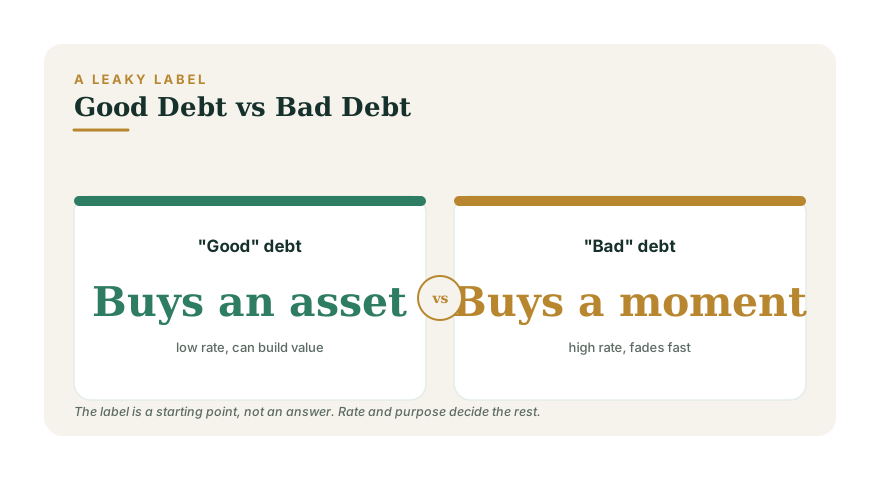
The classic story goes like this. "Good debt" is borrowing to acquire something that should grow in value or grow your income: a home that may appreciate, a degree that may raise lifetime earnings, a loan that starts a viable business. The interest is often lower, sometimes tax-advantaged, and the asset can outlast the loan. "Bad debt" funds consumption that depreciates the moment you own it — a vacation on a credit card, a depreciating car at a high rate, restaurant meals carried at 24% APR. There is a real signal here. As a quick gut check for whether a purchase deserves to be financed at all, it works.
Where the label leaks
The trouble starts when the category does the thinking for you. A mortgage is "good debt," but a mortgage you cannot afford, on a house bought at the top of your budget, is one of the fastest ways to end up financially stuck. A student loan is "good debt," but six figures borrowed for a degree that does not raise your earnings is just an expensive credit-card balance with a kinder name. Meanwhile, a modest car loan at a low promotional rate — nominally "bad debt" — can be perfectly reasonable, especially if the car is what gets you to a job.
The label describes the purchase. It says nothing about the price you paid to borrow, or whether the amount fits your life. Two people with identical mortgages can be in completely different positions depending on rate, term, and how much of their income the payment eats. That last point is measured by your debt-to-income ratio, which lenders care about precisely because the category of debt matters less than its weight on your budget.
Interest rate is the first thing that actually matters
Strip away the labels and the single most important number on any loan is its interest rate, because that rate is the guaranteed, risk-free return you earn by not carrying the debt. Paying off a balance at 22% is the equivalent of earning a guaranteed 22% — something no investment can promise. Paying down a 3% mortgage frees up far less, which is exactly why the math on early payoff is so different across loans.
A rough hierarchy that survives almost every situation:
- Double-digit debt (cards, payday, many personal loans) — this is the "bad" zone regardless of what it bought. Attack it. See How to Pay Off Credit Card Debt.
- Mid-single-digit debt (many auto loans, some student loans) — a judgment call that depends on your other goals and your tolerance for carrying a balance.
- Low-rate debt (a well-priced mortgage, subsidized loans) — often worth keeping while you invest the difference, because your money may earn more elsewhere.
Purpose still matters — just not the way the label suggests
Purpose matters because of what it implies about the rate and the payoff, not because some categories are virtuous. Borrowing to buy an appreciating or income-producing asset can make sense when the expected return clears the interest cost. Borrowing to fund consumption rarely does, because the thing is gone and the bill remains. The honest question is not "is this good debt or bad debt?" but "what am I paying to borrow, and does what I get back exceed that cost?"
This reframing also clears up the eternal argument about whether to pay down debt or invest. It is not a moral choice between responsible and irresponsible; it is a rate comparison. If the debt's rate is higher than what you can reliably earn investing, pay the debt. If it is lower, investing may win. We walk through that decision in Should You Pay Off Debt or Invest?.
A few nuanced cases
- 0% promotional financing on a real need can beat paying cash — if you have the discipline to clear it before the rate jumps, and the deferred-interest fine print does not bite.
- A reasonable mortgage is usually the closest thing to genuinely "good" debt, but only at a payment that leaves room to save and invest.
- A high-rate personal loan to consolidate cards can be smart or pointless depending on the new rate and whether you stop adding to the cards. More on that in Personal Loans: When They Make Sense.
A better mental model
Keep the good-debt instinct as a first filter — it is a fine reason to hesitate before financing a vacation. But make your actual decisions on two questions: what is the rate, and does this borrowing fit my budget and move me toward something worth more than it costs? Run your real numbers through the Debt Payoff Calculator to see which balances are quietly costing you the most, and let the rate, not the label, set your priorities.