Ask an Indian software engineer who spent five years in the US on an H-1B what happened to all the Social Security tax that came out of every paycheck, and you will often get a shrug. The honest answer, for many, is that it may never come back to them. Understanding why requires knowing what a totalization agreement is, and the uncomfortable fact that the US and India do not have one.
The problem: credits you may never use
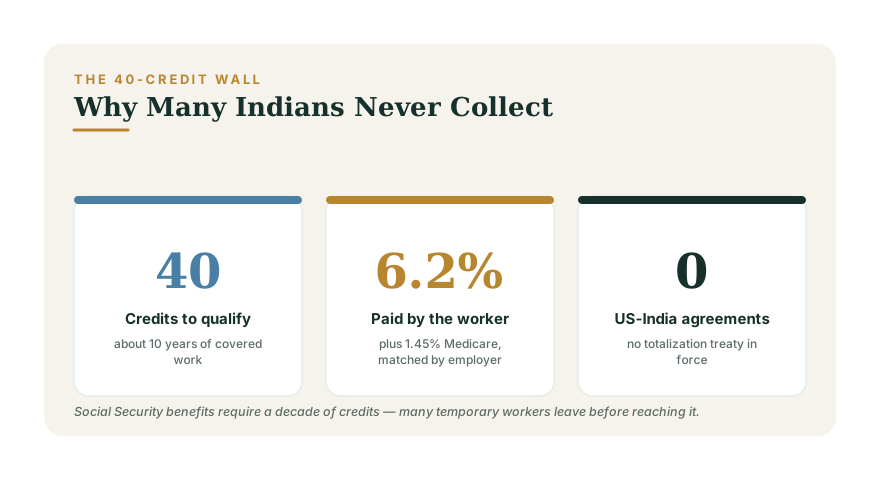
US Social Security retirement benefits are not automatic. You earn credits by working and paying in, and you generally need 40 credits — roughly ten years of covered work — to qualify for a retirement benefit at all (Social Security Administration, Work Credits). Meanwhile, every covered employee pays 6.2% of wages into Social Security plus 1.45% for Medicare, matched by the employer (Social Security Administration). A worker who spends five or six years in the US and then returns to India has paid in the whole time but leaves with fewer than 40 credits — short of the wall, with nothing to show for years of contributions.
What a totalization agreement does
The US has signed bilateral totalization agreements with a number of countries to fix exactly this situation. These treaties do two useful things. First, they prevent double social-security taxation, so a worker posted temporarily is not forced to pay into both countries' systems at once. Second, and more valuable for the departing worker, they let you combine (totalize) your coverage periods from both countries to qualify for a benefit you would otherwise miss — your Indian work years could help you clear the US threshold, and vice versa. The Social Security Administration maintains the list of countries with agreements in force (SSA, International Agreements).
The catch: India is not on the list
Despite years of discussion, the United States and India have no totalization agreement in force. India has long pushed for one, arguing that its temporary workers contribute billions to the US system without ever collecting. So far it has not happened. The practical result is stark: an Indian professional who works in the US for less than about a decade and leaves cannot totalize Indian service to qualify, and — unlike the situation under an agreement — generally cannot recover the contributions either. This is one of the largest hidden costs of a temporary US assignment for Indian nationals, and it rarely appears in any relocation package.
What you can actually do about it
You cannot single-handedly create a treaty, but you can plan around its absence:
- Know the 40-credit threshold and track your credits. Check your record on the SSA site. If you are close to qualifying, staying long enough to cross 40 credits changes the outcome entirely — a qualified worker can receive US benefits even living abroad, subject to some country rules.
- Treat the FICA tax as a sunk cost if you will leave early. Build your own retirement instead through a 401(k) and IRA, which travel with you — the mechanics for temporary workers are in Retirement Accounts for Visa Holders.
- Understand what happens to benefits if you do qualify and then leave. The broader picture for departing workers is in Social Security for Immigrants.
- If you are going home for good, fold this into the move. See Returning to India: A Financial Guide.
Plan as if the treaty will not arrive
A US-India totalization agreement may come eventually, but no financial plan should depend on it. If your US stint will be short, assume your Social Security contributions are the price of working here and pour your real retirement saving into portable accounts you control. If you are within striking distance of 40 credits, do the math on staying long enough to lock in a lifelong benefit. Run both scenarios with the Return-to-India Planner and the Retirement Planner, and pressure-test your setup with the Immigrant Financial Readiness check. Map the whole thing at the planning hub.