There is something deeply satisfying about a dividend landing in your account. It feels like getting paid just for owning something — money appearing without selling anything. That feeling is so powerful that many investors build entire strategies around maximizing dividend income. But the warm feeling hides a misunderstanding that can quietly cost you, especially in a taxable account.
Let's look at what a dividend actually is, why "total return" is the framing that matters, where the tax drag hides, and the situations where income investing genuinely earns its keep.
A dividend is not free money
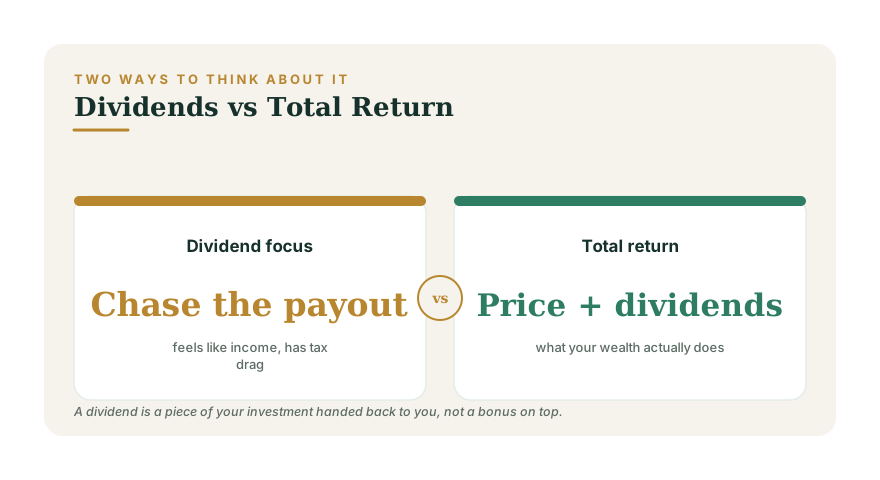
Here is the core fact most dividend enthusiasts miss: when a company pays a dividend, its stock price drops by roughly the amount of the dividend on the payment date. The money didn't come from nowhere — it came out of the company's value, which you already owned. You haven't gained anything; you've simply moved cash from one pocket (the share price) to another (your bank account).
Think of it like an ATM withdrawal from your own account. A $100 stock that pays a $3 dividend becomes a $97 stock plus $3 in cash. Your total is still $100. A dividend is not a reward layered on top of your investment — it is a partial, automatic sale of it.
Total return: the only framing that matters
Total return is the complete picture: the change in price plus any dividends, taken together. It answers the only question that matters — how much did my wealth actually grow? Two investments can deliver an identical 8% total return with completely different splits: one pays 4% in dividends and grows 4% in price, the other pays nothing and grows 8%. As long as the total is the same, you are equally wealthy. The split is just cosmetics.
Once you see this, a fixation on high dividends looks less like a strategy and more like a preference for a particular form of payout — and as we'll see, often a worse-taxed one. Focusing on dividends instead of total return can also push you toward concentrated, riskier holdings. Chasing the biggest yields is its own well-documented trap, covered in the high-yield dividend trap.
The hidden tax drag in taxable accounts
This is where dividend investing can actively cost you. In a taxable brokerage account, dividends are taxed in the year you receive them — every year — whether you wanted the cash or not, and whether or not you reinvest it. You have no control over the timing.
Compare that to growth that stays in the share price. If a company reinvests its profits instead of paying them out, that value compounds untaxed until you choose to sell — and you control exactly when that happens, including deferring it for years or decades. That deferral is enormously valuable: untaxed money keeps compounding. The mechanics of how those eventual sales are taxed are in the capital gains tax guide.
So in a taxable account, a high-dividend strategy can mean handing the IRS a slice of your return every single year that a total-return strategy would have let you defer. That is real, recurring tax drag. (In tax-sheltered accounts like an IRA or 401(k), this particular drag disappears, since nothing is taxed year to year.)
"But I want income in retirement"
Many people gravitate to dividends because they want their portfolio to pay them in retirement. That goal is completely valid — but dividends are not the only, or the best, way to get there. The alternative is a total-return approach to drawdown: build a diversified portfolio for the best total return, then create your own "paycheck" by periodically selling a small, planned amount.
The advantages are real. You control how much income you take and when, rather than accepting whatever dividends happen to be. You can harvest gains in low-income years and lean on other assets in high-income ones. And you aren't forced into riskier, higher-yielding stocks just to manufacture cash flow. We walk through this in the retirement drawdown strategy.
When income investing genuinely makes sense
None of this means dividends are bad — they're a normal, healthy part of total return, and several situations make an income tilt reasonable:
- Behavioral simplicity. Some retirees sleep better spending only the income their portfolio throws off and never touching the principal. If that discipline keeps you invested, the small tax cost can be worth the peace of mind.
- Tax-advantaged accounts. Inside an IRA or 401(k), the annual tax drag vanishes, so the case against dividends weakens considerably.
- You value certainty over optimization. A predictable payment, even if slightly less efficient, can be the right human choice.
The honest verdict: for most investors in the accumulation phase, especially in a taxable account, chasing dividends is a mild mistake — you're trading flexibility and tax efficiency for a comforting feeling. Optimize for total return, hold tax-inefficient income assets in sheltered accounts when you can, and create the income you need on your own schedule. To pressure-test how an income or total-return approach plays out over your retirement, try the retirement planner.