If you have ever heard a commentator say "energy is leading the market this quarter" or "investors are rotating into defensives," they are talking about sectors. The stock market is conventionally divided into eleven of them, and there is a long-standing theory that different sectors take turns leading as the economy moves through its business cycle. Understanding this map is genuinely useful — even if, as we will see, the practical lesson it teaches is mostly "don't try to time it."
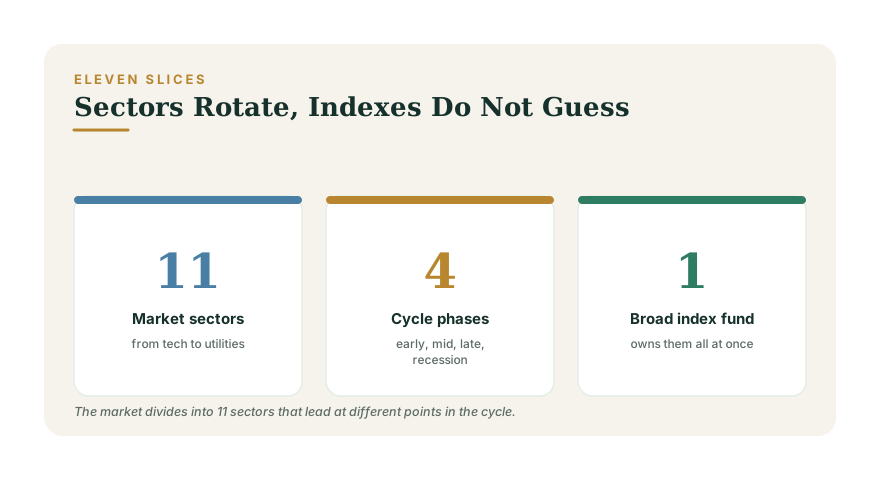
The 11 sectors
Under the widely used classification system, every public company falls into one of eleven sectors:
- Information Technology — software, hardware, semiconductors.
- Health Care — drugmakers, insurers, device and equipment companies.
- Financials — banks, insurers, asset managers.
- Consumer Discretionary — things people buy when they feel flush: cars, travel, retail.
- Consumer Staples — things people buy regardless: food, household goods, toiletries.
- Communication Services — telecom, media, internet platforms.
- Industrials — machinery, aerospace, transportation, construction.
- Energy — oil, gas, and increasingly renewables.
- Utilities — electricity, water, and gas providers.
- Materials — chemicals, metals, mining, packaging.
- Real Estate — property owners and REITs.
Cyclical vs defensive
A simpler way to group them is by how sensitive they are to the economy. Cyclical sectors — discretionary, industrials, materials, financials, technology — swing hard with economic growth: they boom when times are good and slump when they are not. Defensive sectors — staples, utilities, health care — hold up better in downturns, because people keep buying groceries, electricity, and medicine no matter what. This split is the backbone of the rotation theory.
How the rotation is said to work
The classic story maps sectors onto four phases of the business cycle:
- Early cycle (recovery). Coming out of a downturn, interest rates are low and growth is reaccelerating. Economically sensitive sectors — consumer discretionary, financials, industrials, real estate — are thought to lead.
- Mid cycle (expansion). Growth is steady and broad. Technology and industrials often do well; leadership is less concentrated.
- Late cycle (slowing growth, rising inflation). The economy runs hot. Energy and materials, plus defensive staples, tend to come into favor as investors grow cautious.
- Recession (contraction). Growth falls. Defensive sectors — utilities, staples, health care — typically hold up best, because their demand barely flinches.
It is a tidy narrative, and it captures something real about how the economy works.
Why you probably should not trade on it
Here is the catch. Knowing this map and profiting from it are very different things. To win by rotating sectors, you have to correctly identify which phase the economy is in right now — something that is usually only obvious in hindsight — and you have to act before the rest of the market does. The market is forward-looking, so by the time a phase is widely recognized, prices have often already moved. The historical patterns are also averages with big exceptions; any single cycle can defy the script entirely. Betting your portfolio on phase-by-phase timing is a close cousin of stock-market timing, and it tends to fail for the same reasons covered in Why Market Timing Doesn't Work.
Concentrating in a single sector also strips away diversification. A sector or thematic fund can leave you badly exposed if your timing is wrong or the theme cools off — a risk the sector-rotation pitch tends to gloss over.
Why a broad index spares you the guessing
Now the good news. A single broad-market index fund holds all eleven sectors at once, weighted by their size in the economy. When leadership rotates — and it always does — you already own whichever sector is winning, because you own them all. You never have to predict the phase, time the entry, or pay the costs and taxes of jumping in and out. The rotation happens inside your fund automatically, and you capture the market's overall return without the stress or the high odds of guessing wrong. This is one of the quiet superpowers described in A Beginner's Guide to Index Funds.
The takeaway
Sectors and the business cycle are worth understanding — they explain why headlines shift and why parts of your portfolio zig while others zag. But understanding the rotation is mainly an argument for broad diversification, not for trying to ride it. The professionals who do this for a living, with full-time research teams, struggle to beat a simple index by rotating sectors; a part-time investor reading the same headlines everyone else has already priced in has even worse odds.
Own the whole market, let the sectors take turns, and spend your energy on the decisions you can actually control: how much you save, how your money is split between stocks and bonds, and how calmly you hold through the inevitable rough patches. To see how a diversified mix fits your goals and timeline, start with the Model Portfolios tool.