One of the most consequential facts in personal finance is that not all income is taxed the same way. A dollar of salary, a dollar of bank interest, and a dollar of profit from a stock you held for two years can each face a wildly different tax rate. Understanding which bucket your money lands in — and how to nudge it toward the cheaper bucket — is one of the highest-leverage things an investor can learn.
Ordinary income: the default, higher-rate bucket
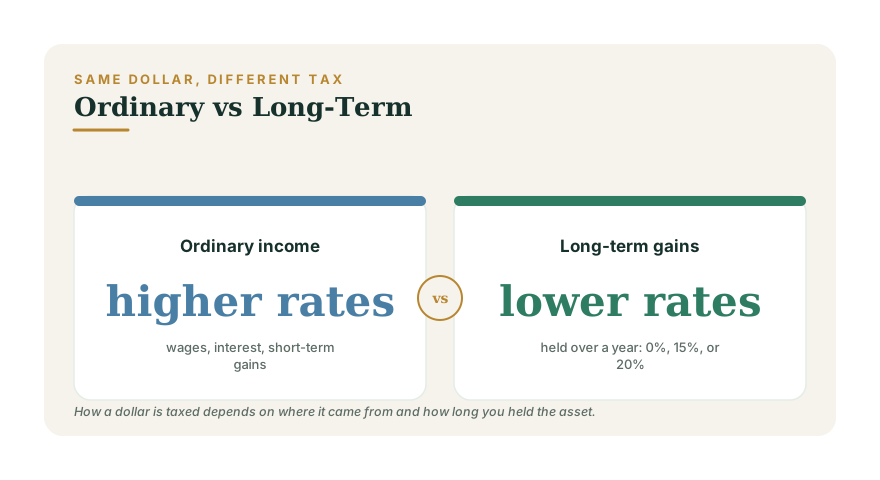
Ordinary income is taxed at the regular progressive tax brackets — the ones that climb as you earn more. It includes your wages and salary, self-employment income, bank and bond interest, and short-term investment gains. These are the rates most people picture when they think of "income tax," and they top out well above the capital-gains rates. If brackets are fuzzy, How Tax Brackets Really Work covers how marginal rates actually apply.
Capital gains: the reward for holding
A capital gain is the profit when you sell an asset — stocks, funds, crypto, real estate — for more than you paid. The tax depends entirely on how long you held it:
- Short-term capital gain — asset held one year or less. Taxed as ordinary income, at your full marginal rate. There is no discount.
- Long-term capital gain — asset held more than one year. Taxed at the special long-term rates of 0%, 15%, or 20%, depending on your taxable income.
That one-year line is enormous. Two identical $10,000 profits can be taxed completely differently based solely on whether you sold on day 364 or day 366. This is a core reason long-term, buy-and-hold investing is so tax-efficient, and why frequent trading quietly bleeds returns to taxes. The full mechanics live in the Capital Gains Tax Guide.
The 0% long-term bracket nobody talks about
Here is the opportunity most people have never heard of: long-term capital gains are taxed at 0% as long as your total taxable income stays below a threshold. For many single filers and especially married couples, that threshold is comfortably into middle-class territory.
This creates a real planning move sometimes called tax-gain harvesting: in a low-income year — early retirement before Social Security and required distributions kick in, a sabbatical, a gap year, a year of low business income — you can deliberately sell appreciated investments and pay zero federal tax on the gain, then immediately rebuy to reset your cost basis higher. Done within the limit, it is free basis step-up. Few opportunities in the tax code are this clean, and they only exist for long-term gains.
How income type changes your bill
Because the buckets stack, the same gross income can produce very different tax bills depending on its mix. Imagine two people who each "made" $80,000. One earned it all as salary (ordinary rates). The other earned $50,000 in salary and $30,000 as long-term gains — that second person likely pays meaningfully less, because a big slice of their income rides the lower capital-gains schedule. You cannot turn a paycheck into a capital gain, but where you have a choice — how long to hold, which account to sell from — the type of income you create is partly yours to control.
Where you hold matters as much as what you hold
Inside a tax-advantaged account — a 401(k), IRA, or Roth — none of this applies while the money stays put: there is no annual capital-gains tax at all, which is a big part of why filling those accounts first is so valuable. See the tax-advantaged account lineup. In a taxable brokerage account, the gains rules above are fully in play, and your broker will send you the forms that report it all — covered in The 1099 Forms You Might Receive, Explained.
Make the rules work for you
Two practical takeaways: hold investments longer than a year before selling whenever you reasonably can, and pay attention to low-income years when the 0% bracket is in reach. To estimate the tax on a planned sale, run it through the Capital Gains Calculator before you click sell, and check your broader picture with the Tax Health assessment.