Most bonds pay a fixed amount, which means inflation quietly eats their value — the dollars you get back buy less than the dollars you lent. Treasury Inflation-Protected Securities, or TIPS, are the US government's direct answer to that problem. They are Treasury bonds whose principal rises with inflation, so the purchasing power of your investment is preserved rather than eroded.
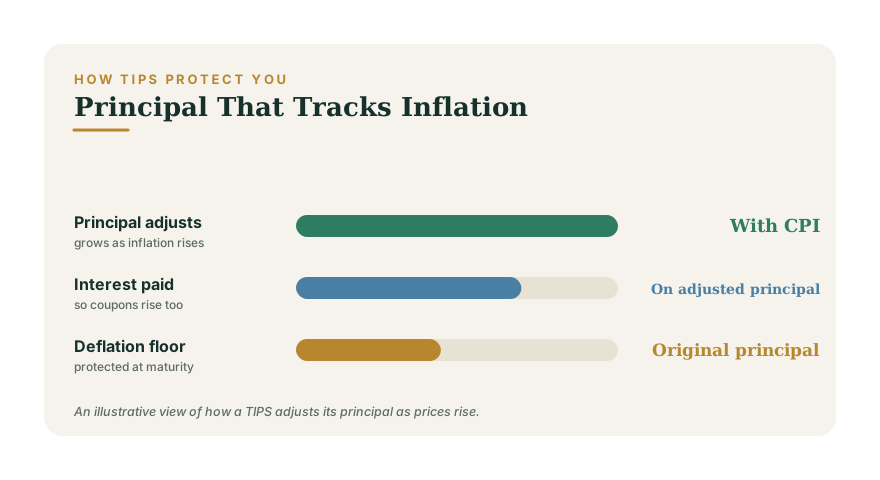
How TIPS actually work
A TIPS starts with a set principal and a fixed coupon rate. What makes it special is that the principal is adjusted with the Consumer Price Index, published by the Bureau of Labor Statistics. When inflation runs at 3%, your principal rises by roughly 3%. Because the fixed coupon rate is applied to that growing principal, your interest payments rise too. At maturity you receive the inflation-adjusted principal. You are buying protection of your purchasing power, backed by the full faith and credit of the US Treasury. You can buy them directly from the government at TreasuryDirect or through a fund. For the broader family of government debt, see Treasury Bills, Notes, and Bonds.
The deflation floor
What if prices fall? TIPS include a helpful protection: if there is net deflation over the life of the bond, you still receive at least your original principal at maturity. Your principal can drift down during the bond's life if deflation occurs, but the government guarantees you will not get back less than you originally invested when the bond matures. That floor makes them a genuinely conservative holding.
Real yield vs nominal yield
The quoted yield on a TIPS is a real yield — a return above and beyond inflation. A regular Treasury quotes a nominal yield that includes expected inflation. The gap between the two is roughly the market's inflation expectation, sometimes called the breakeven rate. If actual inflation comes in higher than that breakeven, the TIPS wins; if inflation is lower, the plain Treasury wins. In other words, you are not guaranteed to beat a regular bond — you are guaranteed to keep pace with inflation. Because TIPS are bonds, they also carry interest-rate risk, so a TIPS can still fall in price when real rates rise, per the mechanics in Understanding Bond Yields and Duration.
The tax trap: phantom income
This is the surprise that catches people. In a taxable account, the annual increase in your TIPS principal is treated as taxable income in the year it accrues — even though you do not receive that money until the bond matures. This so-called phantom income means you can owe tax on gains you have not yet collected. The straightforward fix is to hold TIPS in a tax-advantaged account like an IRA, where the phantom income is not taxed each year. This is a clean example of why asset location matters.
TIPS vs I Bonds
Individual investors often weigh TIPS against I Bonds, the other inflation-linked government security. The key differences: I Bonds are bought only through TreasuryDirect with an annual purchase limit, defer their tax until you cash out, and cannot lose value, but they lock you up for a year and penalize early redemption. TIPS trade freely, have no purchase limit, and can be held in any account, but expose you to price swings and the phantom-income tax. The two are compared in more depth in I Bonds and TIPS, Explained.
Where TIPS fit
TIPS are most useful for investors who specifically want to defend purchasing power — retirees living off a portfolio, or anyone worried that a fixed-income allocation will be hollowed out by inflation. They are not a growth engine and they will not always beat nominal bonds; their job is stability of real value. Hold them in a retirement account to sidestep the phantom-income tax, size them as one slice of your bond allocation, and use the Model Portfolios tool and the Lifetime Wealth tool to see how an inflation-protected sleeve changes your plan. Then check your overall mix with the Investor Profile assessment and the planning hub.