The Saver's Credit, officially the Retirement Savings Contributions Credit, is one of the best-kept secrets in the tax code. It gives lower- and moderate-income workers a tax credit simply for putting money into a retirement account — effectively a government match on top of any match your employer offers. Despite being genuinely valuable, it is one of the most overlooked credits available, in part because the people who qualify often do not realize they do.
How the credit works
When you contribute to a qualifying retirement account — a traditional or Roth IRA, a 401(k), a 403(b), and several others — the Saver's Credit gives you back a percentage of what you contributed, up to a contribution cap, as a credit against your taxes. Because it is a credit, it reduces your tax bill dollar for dollar, on top of any deduction you might already get for a traditional contribution. That stacking is what makes it so powerful, and why understanding credits versus deductions matters here.
The income tiers
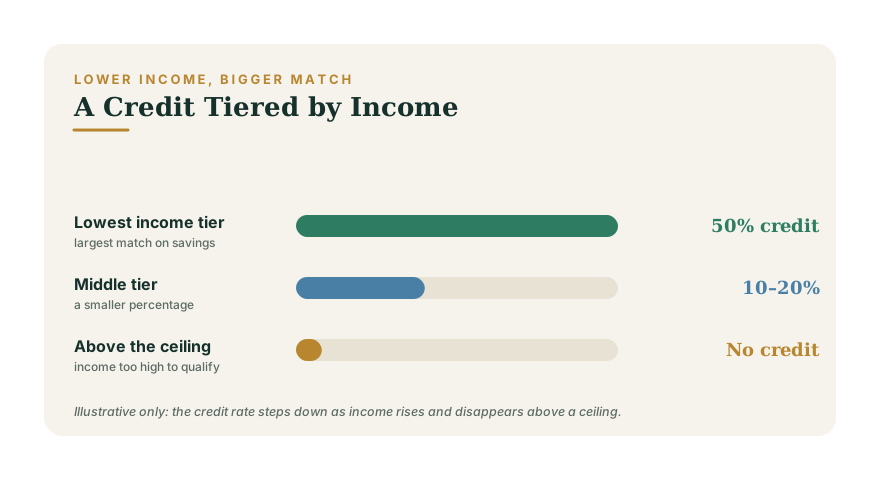
The credit is deliberately aimed at people with modest incomes, so the percentage you receive depends on your adjusted gross income and filing status. The structure is tiered:
- At the lowest income tier, you can earn a credit equal to a large percentage of your contribution — the most generous match.
- At middle tiers, the percentage steps down.
- Above a ceiling, the credit disappears entirely.
The income limits are higher for married couples filing jointly than for single filers, and they are adjusted each year. Because the tiers are based on AGI, contributing to a traditional account can sometimes lower your AGI just enough to bump you into a higher credit tier — a small move with an outsized payoff.
Who qualifies
Beyond the income limits, there are a few conditions. You must be 18 or older, you cannot be a full-time student, and you cannot be claimed as a dependent on someone else's return. That student exclusion is why many young workers who would otherwise qualify do not — but it also means a non-student in their early twenties working a modest-paying job may be an ideal candidate. The dependent condition ties back to the rules in The Rules for Claiming Dependents.
Why it is so widely overlooked
Several things conspire to keep this credit invisible:
- The people who qualify often think they can't afford to save. The credit feels irrelevant to someone who believes retirement contributions are out of reach — yet even a small contribution can trigger it.
- It is buried. Unless your tax software prompts you or you know to look, the credit never surfaces.
- The student exclusion confuses people. Many assume their age or job rules them out without checking the actual tests.
The result is that a credit designed to help exactly the people who need encouragement to save goes unclaimed by a large share of those eligible.
A powerful combination for low earners
For a working household with modest income, the Saver's Credit can stack with the Earned Income Tax Credit, making the act of saving for retirement nearly free or even net-positive in the year you contribute. If you are deciding between account types first, Roth vs Traditional IRA walks through that choice — and either type can qualify you for the credit.
A note on the contribution itself
The credit is a bonus, not the whole reason to save. The contribution itself is what builds your future, and the credit makes the first dollars in easier to justify. Even a small, automatic monthly transfer into an IRA can both grow over decades and trigger the credit each year you remain eligible.
Check whether you qualify this year
Because eligibility depends on your income tier and a handful of conditions, it is worth a quick check any year your income is modest. Use the Retirement Planner to size up a contribution you can sustain, and run the Tax Health assessment to make sure the Saver's Credit and any other breaks you are owed are not slipping past you.