If saving were purely a math problem, everyone who understood it would do it. Most people do understand it — and most still find it hard. That is the clue: the obstacle is not knowledge, it is psychology. Once you see the specific mental wiring working against you, you can stop blaming yourself and start designing a system that works with your brain instead of against it.
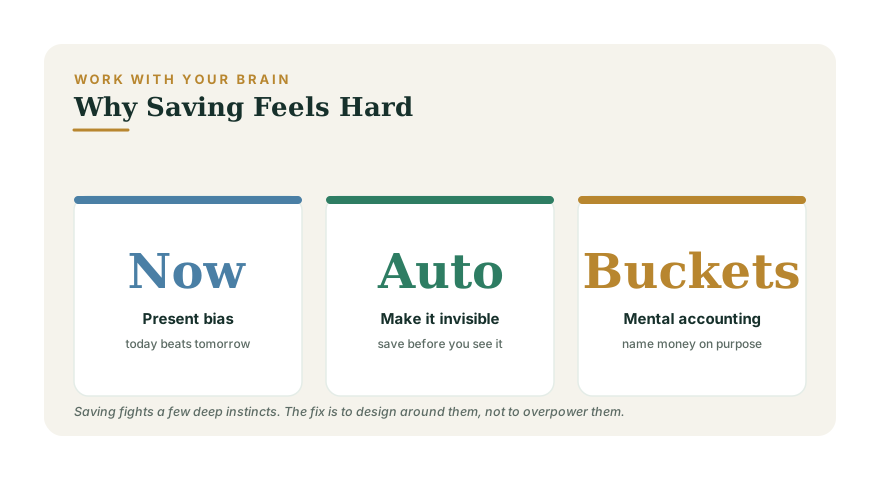
Present bias: why tomorrow keeps losing
The core reason saving is hard has a name: present bias. Humans systematically overvalue rewards we can have right now and discount rewards that arrive later. A coffee today feels concrete and pleasant; the same dollars compounding into retirement security feel abstract and distant. Your future self — the one who benefits from saving — is, to your brain, almost a stranger.
This is not a character flaw. It is a deeply built-in instinct that once helped our ancestors survive. But in a modern economy it quietly sabotages saving, because every act of saving asks present-you to give something up for future-you, and present-you almost always wins a fair fight. The trick, then, is to stop making it a fair fight.
Make saving automatic so willpower never has to show up
The most powerful idea in personal finance is also the most boring: automate it. If saving requires a monthly decision — to log in, to transfer, to resist spending the money first — present bias gets a vote every single time, and over a long enough stretch it will eventually win. Automation removes the decision entirely.
Set up an automatic transfer to savings or investments on payday, before the money ever sits in your checking account. This is the heart of paying yourself first: saving happens first, and you build your spending around what is left. Better still, raise your retirement contributions automatically each year, or whenever you get a raise, so your future self gets the increase before lifestyle creep can claim it. The full mechanics are in automating your finances.
Make saving invisible
Present bias is triggered by what you see. Money sitting in your checking account looks spendable, so it tends to get spent. The countermeasure is to keep savings out of sight. Open a savings account at a separate bank — ideally a high-yield online one — so the balance does not show up next to your spending money and is a few clicks away rather than instantly available.
Out of sight really is out of mind here, and that works in your favor. Money you do not see, you do not miss; money you do not miss, you do not spend. The mild inconvenience of moving it back is a feature, not a bug — it is the same friction that helps defeat impulse spending, just pointed in the opposite direction.
Use mental accounting for good
Economists like to point out that money is fungible — a dollar is a dollar, no matter what label you put on it. Strictly true, but human brains do not work that way. We treat money differently depending on the mental bucket it sits in, a quirk called mental accounting. We will guard a "vacation fund" while casually overspending from a general balance, even though it is all the same money.
This quirk is usually framed as a bias, but you can deliberately exploit it. Give your savings named goals: "Emergency Fund," "House Down Payment," "Trip to Italy." A named, purpose-driven bucket is psychologically much harder to raid than an anonymous balance, because spending from it feels like stealing from a specific dream. Many banks let you create multiple labeled sub-accounts for exactly this reason. The same instinct that makes mental accounting irrational makes it a fantastic motivational tool when you use it on purpose.
Make progress visible and rewarding
Present bias gives spending an unfair advantage because spending delivers an instant reward and saving delivers a delayed one. So engineer some instant rewards into saving. Watching a goal bar climb from 40% to 60% gives your brain a small, immediate hit of progress. Celebrate milestones. Pick goals that genuinely excite you, not just the ones you think you should have. Tracking your overall net worth over time turns the slow, invisible work of saving into a number you can watch move — one of the most reliable sources of money motivation there is.
Design beats discipline
The lesson running through all of this: do not try to out-willpower your own psychology, because over years you will lose. Instead, set the system up once — automatic, invisible, named, and visibly rewarding — so that saving becomes the default and spending requires the effort. To put it into motion, set a target and a monthly amount with the Emergency Fund Calculator or the Retirement Planner, automate the transfer, and then let your design do the saving so you do not have to.