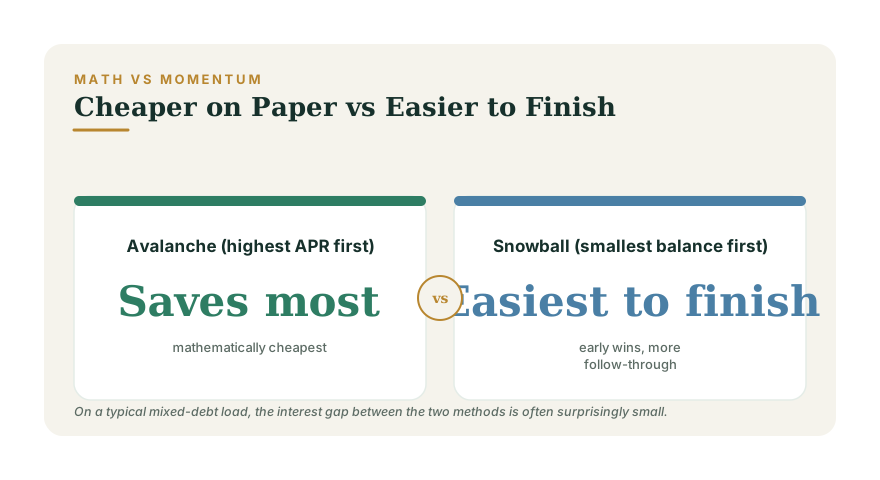
There are two famous ways to pay off multiple debts, and the internet argues about them like it is a moral question. The avalanche method says attack the highest interest rate first because that is mathematically cheapest. The snowball method says attack the smallest balance first because knocking out a whole debt early gives you a win that keeps you going. Both camps are right about something, and the honest answer depends less on the math than on whether you will actually stick with the plan.
The honest truth: the best method is the one you finish
A debt payoff plan only works if you stay on it for months or years. A plan that is 5% cheaper on a spreadsheet but that you abandon after three months is worse than a slightly more expensive plan you actually complete. This is the part the math-purist crowd misses. Paying off debt is not an optimization problem you solve once. It is a behavior you sustain, and sustaining it is the hard part.
How each method works
- Avalanche. Make minimum payments on everything, then throw every extra dollar at the debt with the highest interest rate. When it is gone, roll that money to the next-highest rate. You pay the least total interest because you are always killing your most expensive debt first.
- Snowball. Make minimum payments on everything, then throw every extra dollar at the smallest balance, ignoring the interest rate. When it is gone, roll that money to the next-smallest. You clear whole accounts quickly, which feels like progress and builds momentum.
Follow the math: the gap is usually modest
People assume avalanche saves a fortune. Often it does not. Say you have three debts:
- Credit card: 2,000 dollars at 24% APR
- Personal loan: 6,000 dollars at 12% APR
- Car loan: 9,000 dollars at 6% APR
That is 17,000 dollars total, and suppose you can put 600 dollars a month toward debt above the minimums. With avalanche you hit the 24% card first; with snowball you also hit the 2,000 dollar card first, because here the smallest balance happens to be the highest rate too. In that case the two methods are identical. The gap only appears when your smallest balance is not your highest rate.
Now flip it so the snowball order differs. On a typical mixed load, choosing snowball over avalanche might cost you somewhere in the range of 100 to 500 dollars in extra interest across the whole payoff, sometimes a bit more on larger balances. On a 17,000 dollar payoff that takes a couple of years, a few hundred dollars is real money, but it is not life-changing. It is roughly the cost of a single nice dinner per year of payoff to get a method that keeps you motivated.
Follow the behavior: motivation is not a weakness
Researchers who have studied real borrowers, not spreadsheets, have repeatedly found that people who attack the smallest balance first are more likely to stay with the plan and pay off all their debt. The early win of fully eliminating an account is a genuine psychological lever. It is not a character flaw to need momentum. It is how most humans actually sustain hard, multi-year effort. A method that keeps you in the game is doing real work, even if a spreadsheet cannot price it.
So the choice is a trade. Avalanche buys you a modest, guaranteed interest savings. Snowball buys you a higher chance of finishing. The right answer depends on the size of the interest gap and on how much you personally need visible wins.
It also helps to remember why early wins matter so much in practice. Debt payoff usually takes one to three years, and the middle stretch is where people quit. The grind feels endless, the balances barely move from month to month, and there is no finish line in sight. Snowball front-loads a sense of completion that carries you through that valley, while avalanche can leave you grinding on one large high-rate balance for many months before a single account ever disappears. If you have abandoned plans before, that difference is not trivial, it is the whole game.
How to choose: a simple decision rule
- Calculate the gap first. List your debts and run both orders. If the extra interest from snowball is large (because you have a small balance at a low rate and a large balance at a punishing rate), lean avalanche.
- If the gap is small (a few hundred dollars), pick snowball if you have ever quit a financial plan before. The follow-through is worth more than the savings.
- If you are disciplined and motivated by math, pick avalanche. You will save the most and you will not need the dopamine of an early payoff.
- Either way, automate the payments. The biggest predictor of success is removing the monthly decision, not the method you chose.
- Never let the debate stall you. The worst method is the one you keep researching instead of starting. Both beat doing nothing by a mile.
The honest recommendation
Run the numbers on your actual debts. If avalanche saves you a large, meaningful amount, take the savings. If the gap is modest and you know yourself to be the kind of person who needs early wins to keep going, take the snowball without guilt, because the version you finish beats the version you abandon. There is no wrong choice between two methods that both end with you debt-free.
Map your debts, their rates, and your monthly surplus in your plan, model the payoff timeline with the tools, and if you are dealing with a deeper hole, read our guide on climbing out in the articles. Then pick a method today and start.