Credit card debt is one of the most expensive forms of borrowing most households will ever carry, and it is built to be sticky. Minimum payments are set low on purpose, so a balance can sit there for years while interest quietly doubles what you owe. The encouraging part is that the path out is not a secret — it is a short, repeatable process. You do not need a windfall or perfect discipline; you need a plan and the willingness to stop digging.
First, stop adding new charges
No payoff strategy works if the balance keeps growing. Before anything else, take the cards out of daily rotation. Switch your spending to a debit card or cash for now, remove the card numbers saved in your phone and browser, and pause any subscriptions that auto-bill to the card. This is not forever — it is for the duration of the payoff. Trying to pay down a balance while still charging to it is like bailing a boat without plugging the leak.
If your spending outruns your income every month, the debt is a symptom, not the disease. Build a simple plan you can actually follow first; How to Build a Budget That Actually Works shows how to free up the cash that will fund your payoff.
Avalanche vs snowball: pick the order that fits you
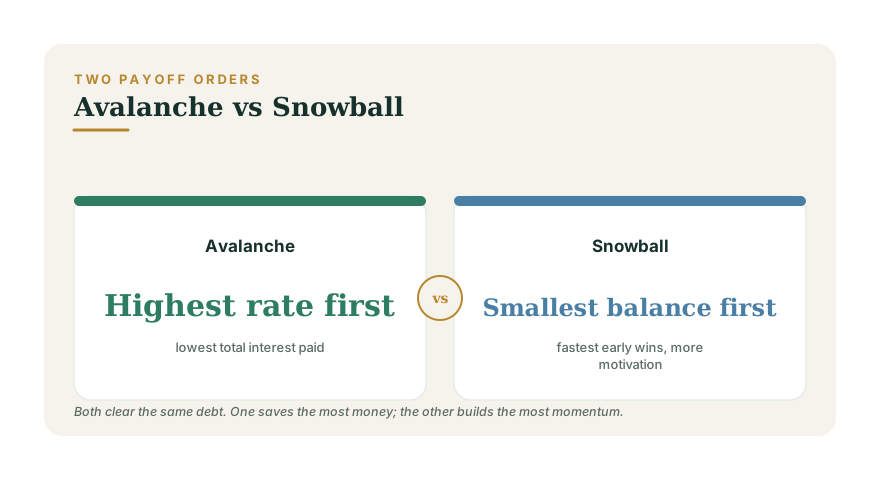
Once you are no longer adding to the pile, the question is which debt to attack first. There are two well-known orders, and both work — you make minimum payments on everything and throw every spare dollar at one target.
- Avalanche — pay extra on the card with the highest interest rate first, then roll to the next highest. This costs you the least total interest and gets you debt-free fastest on paper.
- Snowball — pay extra on the smallest balance first regardless of rate. You clear whole accounts quickly, and each "paid off" win delivers a hit of motivation that keeps you going.
The math favors avalanche; human behavior often favors snowball. If the rate gaps between your cards are small, the difference in cost is minor and the motivation of snowball may matter more. If one card carries a punishing rate, avalanche saves real money. We break the tradeoff down further in Debt Avalanche vs Snowball: Which One Actually Wins.
Balance-transfer cards: a real tool with a real trap
A balance-transfer card offers a promotional 0% APR for a set window — often 12 to 21 months — on debt you move over from another card. Used deliberately, it is genuinely powerful: with no interest accruing, every dollar you pay goes straight to the principal, which can shave months off your payoff.
The traps are specific and worth memorizing:
- The transfer fee — usually 3% to 5% of the amount moved, charged up front. On a large balance that is not trivial; factor it into whether the deal pays off.
- The cliff at the end — when the promo window closes, the rate jumps to a normal (high) APR on whatever balance remains. The plan only works if you pay the whole balance before the deadline. Divide the balance by the number of promo months and treat that as a non-negotiable payment.
- New purchases — spending on the new card often does not get the 0% rate, and your payments may be applied in ways that leave new purchases accruing interest. Use it for the transferred balance only.
And critically: a balance transfer moves debt, it does not erase it. If it frees up the old card and you start charging again, you have simply doubled your problem. For the full mechanics, see The Fine Print Behind 0% APR Offers.
Build a realistic payoff plan
A plan that assumes you will throw $800 a month at debt while living on noodles will collapse by week three. A durable plan is built on a number you can actually sustain. List every card with its balance, minimum payment, and rate. Decide your order (avalanche or snowball). Then find the largest extra payment you can commit to every single month without setting yourself up to fail — and automate it so it happens before you can spend the money elsewhere.
Understanding why this works helps you stick with it: minimum payments are engineered so the issuer earns interest for years. Paying even a modest amount above the minimum, consistently, breaks that cycle. See Who Actually Pays Credit Card Interest for why the math tilts so hard against minimum-only payers.
When the balance is too big to outrun
If the total debt is so large that even an aggressive plan would take many years, or if the interest is growing faster than you can pay, it may be time to look at structured options — but be careful, because the "help" industry is full of expensive products and outright scams. Know the difference before you sign anything; The Traps Hiding Inside Debt Consolidation covers what to watch for.
Put a date on the calendar
Debt payoff is mostly about turning an overwhelming pile into a single monthly number with a finish line. Map your real numbers, choose your order, and watch the balance fall with the Debt Payoff Calculator — seeing the payoff date move closer each month is, for most people, the most motivating part of the whole process.