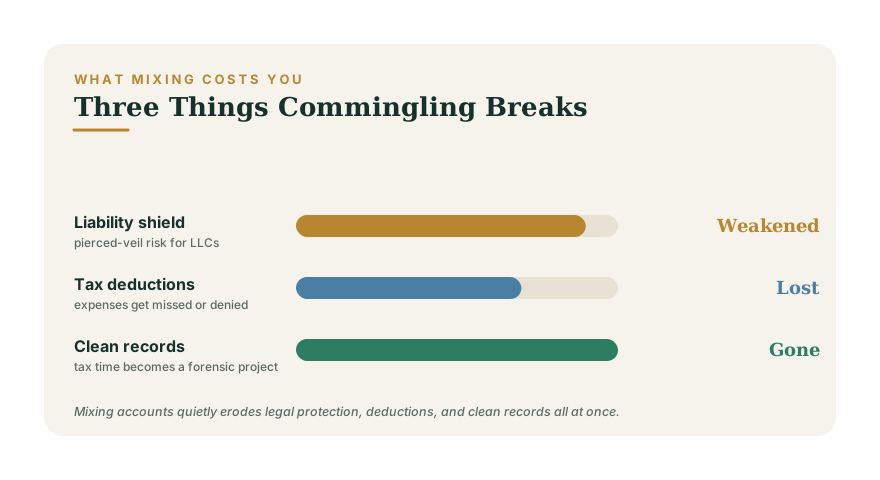
Ask a hundred accountants for the most common small-business mistake and you will hear the same answer again and again: owners run everything through one account, paying for groceries and software and client lunches from the same pile of money. It feels harmless and efficient. It is neither. Commingling — mixing business and personal funds — quietly erodes your legal protection, your deductions, and your sanity at tax time.
The liability reason — and why it is the scariest
If you formed an LLC or corporation, you did it for the liability shield: the legal wall that keeps your personal assets safe if the business is sued. That shield depends on treating the business as a genuinely separate entity. When you pay personal bills from the business account and vice versa, you blur the line — and a court can decide the business was never truly separate from you.
This is called piercing the corporate veil, and commingling funds is one of the most common reasons it happens. The result is the nightmare scenario: a lawsuit reaches past the business and takes your home and savings, exactly the outcome the LLC was supposed to prevent. You can read more about why people form these entities in LLC vs S-corp, but the short version is that the protection only holds if you respect the separation.
The tax reason — missed deductions and denied ones
Commingling also costs you money directly at tax time. When business and personal transactions are tangled in one account:
- You miss deductions. Legitimate business expenses get lost in the noise of personal spending, and unclaimed deductions mean a higher tax bill.
- You cannot defend what you do claim. If the IRS questions a deduction, "it is somewhere in this account that also paid my rent and bought my groceries" is not a defense. Poor separation can get otherwise valid deductions disallowed.
- You overpay someone to untangle it. Accountants charge by the hour, and reconstructing mixed accounts is slow, expensive work.
Clean separation is the prerequisite for capturing every write-off you are owed — the kind catalogued in business banking and bookkeeping basics.
The mechanics: how to actually separate
The fix is concrete and takes an afternoon to set up:
- Open a dedicated business checking account. Every dollar of business income goes in; every business expense comes out. This single account is the backbone of the whole system.
- Get a business credit or debit card. Use it for all business purchases, and never for personal ones. The statement becomes an automatic expense log.
- Pay yourself deliberately. Money moves from business to personal only through a defined transfer — a draw or a payroll salary — not by swiping the business card at the grocery store. The right method for your structure is in how to pay yourself from your business.
- Reimburse, do not blur. If you must pay a business cost with personal money in a pinch, record it and reimburse yourself from the business account, rather than letting it sit as a mixed transaction.
Avoiding commingling once you are set up
The accounts only help if you maintain the discipline. The habits that keep the line clean:
- One card per purpose. Keep the business and personal cards physically separate so you do not grab the wrong one.
- No "I will sort it later" purchases. The moment you pay for something, it should come from the correct account. Untangling later is exactly the work you are trying to avoid.
- Run draws on a schedule. Transferring yourself a regular amount removes the temptation to dip into the business account for personal spending.
Clean records make tax time a non-event
When business money lives in its own account all year, your tax preparation transforms. Your records are essentially already done — the business statement is the ledger. You hand your accountant clean numbers instead of a tangle, you claim every deduction with confidence, and an audit, should one ever come, is met with organized records instead of panic.
Separation is not extra work; it is the move that removes work, protects your assets, and lowers your taxes all at once. If you do nothing else this week, open the business account. To see how your separated business income flows into your full tax and financial picture, start with the self-employed tax hub.