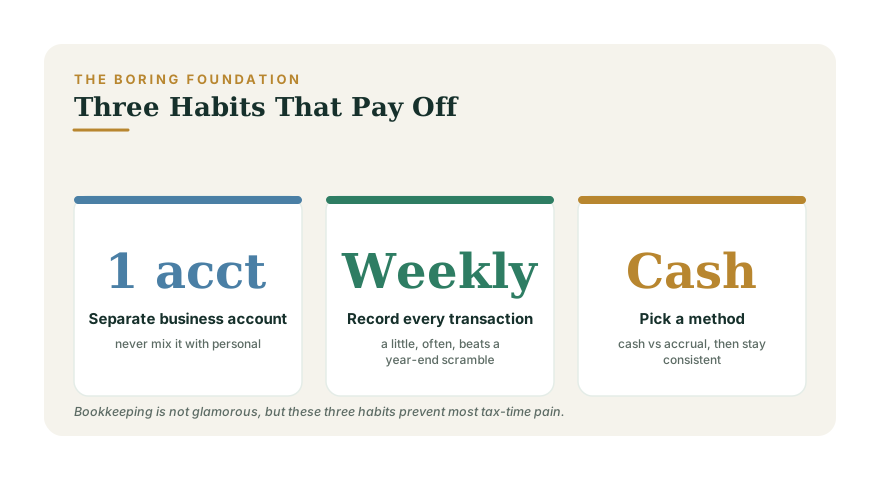
Most small businesses do not fail their bookkeeping in some dramatic way. They fail it quietly — by mixing personal and business money, by letting receipts pile up, and by trying to reconstruct a year of activity the week before taxes are due. The foundation is unglamorous but genuinely simple: one dedicated account, and a habit of recording what moves through it.
Why a separate business account matters
The first move for any business — even a side hustle — is to open a dedicated business checking account and route all business income and expenses through it. This is not bureaucracy for its own sake. A clean separation does three things at once: it makes bookkeeping trivial (your statement is most of your records), it protects the liability shield if you have an LLC, and it makes a tax audit far less stressful.
When personal and business money mingle in one account — a problem called commingling — every benefit reverses. The deeper reasons, including the legal risk, are laid out in why and how to separate business and personal finances. For now, the rule is simple: business money lives in the business account, full stop.
What bookkeeping actually is
Bookkeeping is just the disciplined recording of money in and money out, sorted into categories. That is it. Done consistently, it answers the questions that matter: Am I profitable? Which expenses are growing? How much do I owe in taxes? Done sporadically, it becomes a panicked year-end reconstruction where you miss deductions and guess at numbers.
The categories you choose — software, supplies, contractor payments, travel, home office — line up with the deductions you can claim, which is why good books and a low tax bill go together. A primer on what is deductible is in self-employed tax deductions.
Cash vs accrual: the one accounting choice you need to make
Early on you pick a method, and the two options are straightforward:
- Cash basis records income when the money actually lands and expenses when you actually pay them. It is simple, it matches your bank account, and it is what most small service businesses and freelancers use.
- Accrual basis records income when you earn it and expenses when you incur them, regardless of when cash changes hands. It gives a truer picture of a business that bills clients, carries inventory, or has long projects — but it is more work.
For most solo and small operations, cash basis is the sensible default. Larger businesses, those with inventory, or those past certain revenue thresholds may be required to use accrual. The important part is to pick one and stay consistent, because switching methods has tax consequences.
Tracking income and expenses without misery
The goal is a system you will actually keep up with. A few habits do most of the work:
- Record weekly, not yearly. Fifteen minutes each week to categorize the week's transactions beats a soul-crushing all-nighter in April.
- Capture receipts as they happen. Snap a photo with your phone the moment you spend; a shoebox of faded paper helps no one.
- Reconcile monthly. Once a month, match your books to your bank statement so errors surface while they are still small.
- Set aside taxes as money comes in. Self-employment means no employer withholding, so move a slice of each payment into a tax bucket. How much, and how to smooth irregular pay, is covered in how to pay yourself from your business.
Tools that fit the size of the business
You do not need enterprise software to keep clean books. A careful spreadsheet works for a true side gig. As volume grows, dedicated bookkeeping software pulls transactions straight from your business account, lets you categorize with a tap, and produces the reports your tax preparer wants. Many owners eventually hand the monthly work to a bookkeeper and reserve their own time for the actual business — a reasonable trade once the records are voluminous.
The payoff
Clean books are not about being tidy for its own sake. They lower your tax bill by surfacing every legitimate deduction, they tell you whether the business is actually working, and they turn tax season from a crisis into a non-event. Start with the separate account and a weekly recording habit, and the rest follows. To see how your business income flows into your overall tax picture, run it through the self-employed tax hub.