"Pay yourself" sounds like the easiest part of running a business — just move money to your personal account, right? Not quite. How you pay yourself depends on how your business is taxed, and getting it wrong can mean an audit, a surprise tax bill, or both. Here is how the two methods work and how to handle the taxes that no employer is withholding for you.
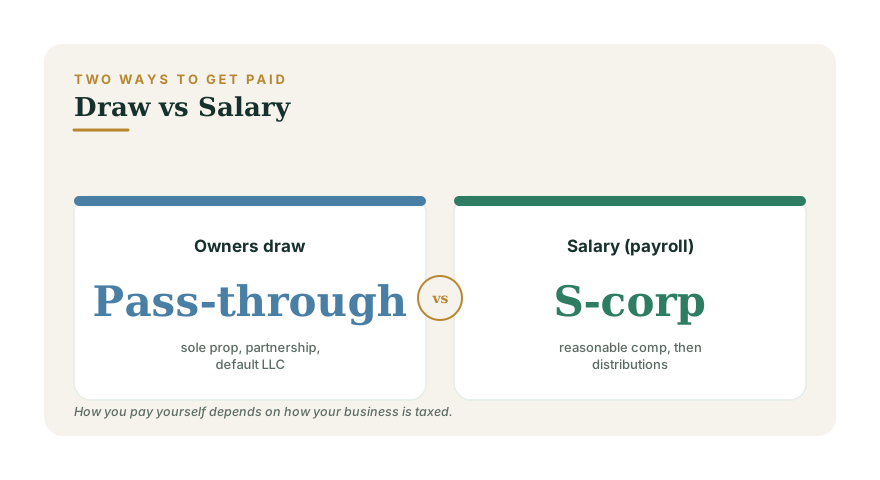
Owners draw vs salary
There are two fundamentally different ways an owner takes money out, and which one applies to you is determined by your business structure:
- Owners draw. If you are a sole proprietor, a partner, or a default (pass-through) LLC, you pay yourself by simply transferring profit from the business to your personal account — a "draw." There is no payroll, no withholding. You are taxed on the business's profit, not on what you happen to draw, so taking more or less out does not change your tax bill.
- Salary. If your business is taxed as an S-corp (or a C-corp), you must put yourself on formal payroll, with taxes withheld from each paycheck, just like any employee. This is required, not optional, for an S-corp owner who works in the business.
The reason this distinction exists ties directly to the S-corp payroll-tax strategy explained in LLC vs S-corp. A pass-through owner cannot take a "salary"; an S-corp owner cannot just take a casual draw.
Reasonable compensation: the S-corp tightrope
For an S-corp, the salary number is not arbitrary, and it is where owners get into trouble. The IRS requires that an owner-employee be paid reasonable compensation — roughly, what you would have to pay someone else to do your job — before taking the rest as distributions. This rule exists precisely because distributions escape payroll tax, so there is a temptation to pay yourself a tiny salary and take everything else as a distribution.
That temptation is a trap. Lowball your salary and you risk the IRS reclassifying your distributions as wages, with back payroll taxes and penalties attached. Set a reasonable salary by looking at what comparable roles pay in your industry and region, the time and skill the work demands, and what your business can support. When in doubt, err toward the defensible number — the payroll-tax savings on an aggressive salary are not worth an audit.
Setting aside for taxes — because no one is withholding
This is the part that ambushes new owners. As an employee, your employer withheld taxes from every paycheck. As a business owner taking draws, nothing is withheld — the full tax bill, including self-employment tax, is yours to pay, and the IRS wants it throughout the year, not in one April lump.
The fix is a simple discipline: every time money comes into the business, immediately move a percentage into a separate tax savings account. A common starting estimate is to set aside somewhere in the range of 25% to 35% of profit for combined federal income tax, self-employment tax, and state tax — your exact rate depends on your bracket and state. Because the IRS expects payment as you earn, you generally pay this in quarterly estimated taxes; the schedule and how to calculate each payment are in quarterly estimated taxes explained. Treat that tax account as untouchable — the money in it was never really yours.
Smoothing irregular income
Business income rarely arrives in tidy, equal monthly amounts. A great month followed by a lean one makes it tempting to spend the windfall and then scramble. A better approach is to pay yourself a steady "salary" even when the business income is lumpy:
- Keep a buffer in the business account — a few months of operating costs — so the business can pay you consistently through the dry spells.
- Decide on a fixed monthly amount to transfer to your personal account, based on your average income, not your best month.
- Let the good months refill the buffer rather than inflate your personal spending.
This turns a roller-coaster into a paycheck, which makes personal budgeting possible. The same principle applies to anyone with uneven earnings — the techniques in budgeting on an irregular income apply directly.
Keep the records clean
None of this works without good books. Whether you draw or run payroll, every transfer to yourself should be recorded, and your tax set-asides should be visible in your accounts. That is one more reason the business banking and bookkeeping basics come first — paying yourself correctly is a downstream benefit of separating your money and recording it consistently.
The bottom line
Match the method to your structure — draw for pass-throughs, salary for S-corps. Set a reasonable salary if the IRS requires one. Move a quarter to a third of every dollar into a tax account before you spend anything. And pay yourself a smooth amount so irregular business income does not become an irregular personal life. To estimate your set-aside and quarterly payments, start with the self-employed tax hub.