Stock options are one of the most common — and most misunderstood — forms of employee pay. An option is not stock; it is the right to buy a set number of shares at a fixed price later. Used well, options can be meaningful wealth. Used carelessly, they can hand you a tax bill on money you never actually pocketed. The whole subject becomes manageable once you learn four words and how two kinds of options are taxed.
The four words: grant, vest, strike, exercise
Grant is the day the company gives you options — say, 4,000 of them. Vesting is the schedule on which they become yours to use, commonly over four years with a one-year cliff: nothing for twelve months, then a chunk vests, then the rest drips in monthly. The strike price (or exercise price) is the fixed price you can pay per share, set at the stock's value on the grant date. Exercising is the act of paying that strike price to actually buy the shares.
The value of an option comes from the spread — the gap between the current share price and your strike. If your strike is $10 and the stock is worth $40, each option lets you buy a $40 share for $10. If the stock sits at or below your strike, the option is "underwater" and worth nothing until the price recovers.
ISOs vs NSOs: the tax fork
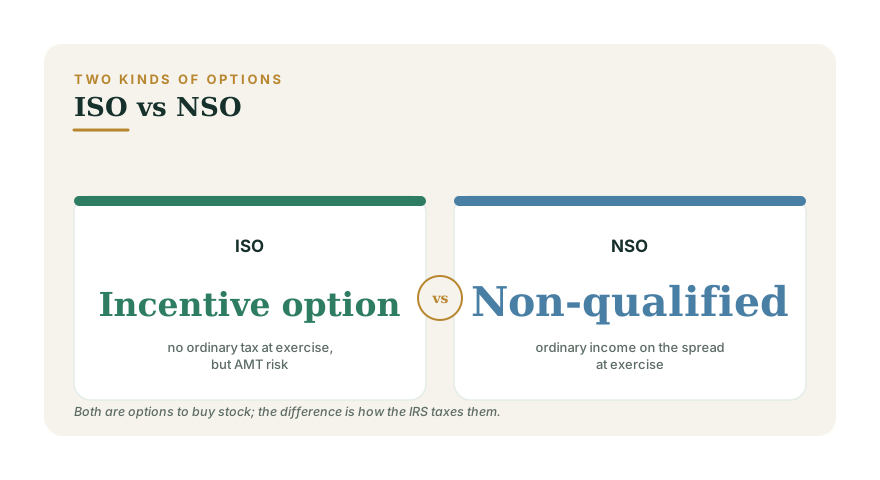
There are two flavors. Incentive Stock Options (ISOs) get favorable tax treatment but only under specific conditions. Non-qualified Stock Options (NSOs) are simpler and far more common, especially at larger companies.
With an NSO, the moment you exercise, the spread is taxed as ordinary income — exactly like salary — even though you have not sold a single share. Your employer reports it on your W-2 and withholds taxes on it. The good news is your cost basis resets to the current price, so future gains are measured from there.
With an ISO, exercising triggers no regular income tax. If you then hold the shares long enough — at least one year after exercise and two years after grant — the entire gain qualifies for lower long-term capital gains rates. That is the prize ISOs dangle: turning compensation into capital gains.
The AMT trap on ISOs
Here is the catch that surprises people. While ISO exercise escapes regular income tax, the spread counts as income under the Alternative Minimum Tax, a parallel tax system. Exercise a large block of ISOs while the stock is way above your strike, and you can owe a substantial AMT bill in April on a paper gain — shares you still hold and have not sold. If the stock then falls, you have paid tax on value that evaporated.
This is not a reason to fear ISOs; it is a reason to plan the timing. Many people exercise in smaller batches across years, or run the numbers before year-end, to stay under the AMT threshold. Because the AMT interaction is genuinely tricky, read Understanding the Alternative Minimum Tax before you exercise a big ISO grant, and consider modeling the bill first. Our equity compensation calculator can help you sketch the numbers.
The risk nobody warns you about: concentration
Even when options pay off, they create a quiet danger. Both your paycheck and a growing slice of your net worth now ride on one company's stock. If the business stumbles, you can lose your job and watch your equity sink at the same time — a double hit. This is concentration risk, and it is why disciplined people sell some shares after exercising and redeploy the proceeds into a diversified portfolio rather than betting everything on their employer. The case for broad index funds applies doubly when one stock already dominates your balance sheet.
A sane way to approach options
- Know your numbers: how many options, your strike, your vesting schedule, and ISO vs NSO.
- Treat exercising as a financial decision, not a deadline panic — model the tax first.
- For ISOs, watch the AMT before exercising a large in-the-money block.
- Once you own shares, decide deliberately how much single-stock risk you are willing to carry.
Options can be a real wealth builder, but only if you treat the tax and concentration questions as seriously as the upside. Fold your equity into the bigger picture with the planning hub before you make an irreversible move.