Most people treat the W-4 as a piece of new-hire paperwork to rush through, then spend years either celebrating a big refund or dreading a surprise bill — without realizing both are symptoms of the same fixable thing. The W-4 is the dial that controls how much tax comes out of every paycheck. Understanding it is one of the highest-leverage, lowest-effort money skills there is.
How withholding actually works
Every payday, your employer estimates the income tax you will owe on that paycheck and sends it to the IRS on your behalf. By year's end, you will have prepaid a chunk of your annual tax bill in small installments. At filing time, you settle up: compare what you truly owed against what was withheld. The W-4 you submitted is what tells your employer how aggressively to withhold. It is a set of estimates, not a tax bill — which is exactly why it can be off.
Why a giant refund is not a win
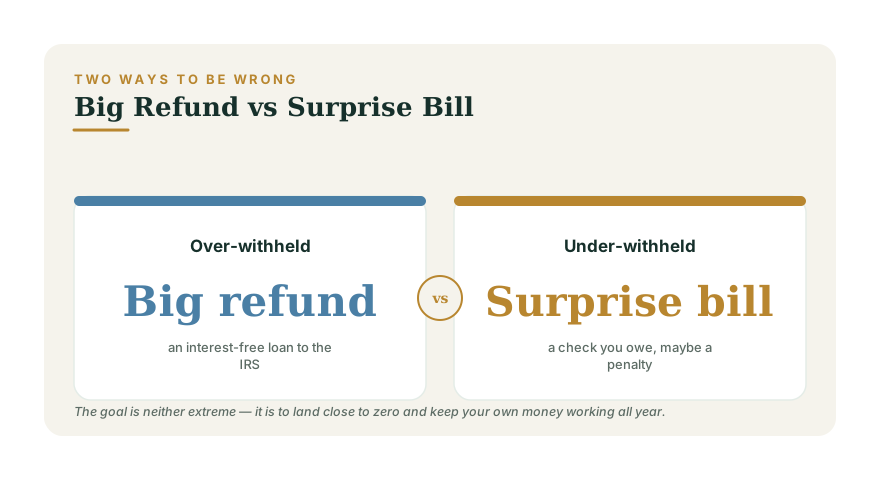
A large refund feels like found money, and the industry happily encourages that feeling. But a refund is not a gift; it is the government returning your own money that it held, interest-free, for up to a year. If you got a $3,600 refund, that was roughly $300 a month of your pay you could have had all along — saved, invested, or used to pay down debt. The ideal outcome is not a big refund. It is a small one, or a small bill: a sign your withholding closely matched reality and you kept your money working for you the whole year.
How the modern W-4 is built
The current W-4 no longer uses the old "allowances" system. Instead it asks about your actual situation:
- Step 1 — your name and filing status (single, married filing jointly, head of household).
- Step 2 — whether you have multiple jobs or a working spouse. This is the step people skip, and skipping it is the number-one cause of under-withholding for two-income households.
- Step 3 — dependents and the credits you expect, which reduce withholding.
- Step 4 — fine-tuning: extra income without withholding, deductions beyond the standard, or an extra flat dollar amount to withhold each check.
The form does the math for you, but only if you give it accurate inputs. The amount actually withheld shows up later in Box 2 of your W-2.
When to adjust your W-4
You are not stuck with the W-4 you filed on day one. You can submit a new one to your employer anytime, and you should after any of these:
- You got married or divorced, or your spouse started or stopped working.
- You had a child or your dependents changed.
- You got a significant raise, a second job, or steady side income.
- You bought a home or had a big change in deductions.
- You got a refund or bill last year that was bigger than you would like.
Avoiding a surprise bill
Under-withholding is the more painful error: not only do you owe a lump sum, but if you underpaid by enough, the IRS can add an underpayment penalty. The two common causes are two-income marriages (each job withholds as if it were your only income) and untaxed side income. For the latter, you can either make estimated payments or simply add an extra amount in Step 4 of your W-4 to cover it. Mismatched withholding is also one of the most common tax-filing mistakes, and the easiest to prevent.
Dial it in
The practical move is to check your withholding once a year — and again after any big life change — rather than discovering the gap in April. Estimate your numbers, adjust Step 4 up or down, and aim to land near zero. The W-2 Optimizer helps you see how a W-4 change moves your paycheck and your year-end result, and the W-2 Tax Checkup flags whether yours is currently set too high or too low.