US taxes confuse almost everyone, but for non-citizens there is an extra layer: before you can figure out what you owe, you have to figure out which set of rules applies to you. That comes down to a single, surprisingly consequential question — are you a resident or a nonresident for tax purposes? Note that phrase. Your tax residency is a separate concept from your immigration status, and the two do not always line up.
Getting this right matters because the two categories are taxed very differently. Resident aliens are generally taxed like US citizens — on their worldwide income. Nonresident aliens are usually taxed only on income connected to the United States, often using different forms and rates.
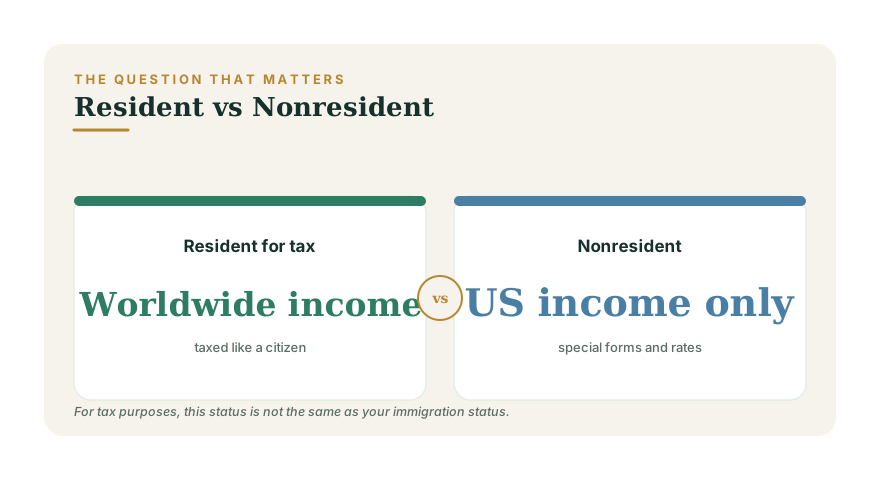
Resident vs nonresident for tax
You are generally treated as a resident alien for a tax year if you meet either of two tests: you hold a green card at any point in the year (the "green-card test"), or you are physically present in the US enough days to meet the substantial presence test. Green-card holders are essentially taxed like citizens; our guide to the green card and tax residency covers that path in detail.
If you meet neither test, you are a nonresident alien, taxed only on US-source income and certain US-connected business income. Many people are nonresidents in their first year or two in the country and become residents later — and some are "dual-status" in the transition year, treated as a nonresident for part of the year and a resident for the rest.
The substantial presence test
The substantial presence test counts the days you are physically in the US. The rule is met if you were present at least 31 days in the current year and a weighted total of 183 days across a three-year window, counting:
- All of your days in the current year, plus
- One-third of your days in the prior year, plus
- One-sixth of your days in the year before that.
If that weighted total reaches 183, you are typically a resident for tax purposes. There are important exceptions: certain visa categories, including many students and scholars, can be "exempt individuals" whose days do not count for a period of years. That is why an international student can spend years in the US and still file as a nonresident. The mechanics matter, so it is worth confirming your own day count carefully.
What worldwide income means
This is the part that catches newcomers off guard. Once you are a resident alien, the US generally taxes your worldwide income — not just what you earn in the US, but rental income from a property back home, interest from a foreign bank account, dividends from foreign investments, and capital gains, wherever they arise. Many people assume only US earnings count; for tax residents, that is not how it works.
Worldwide income also brings worldwide reporting. Foreign bank and investment accounts can trigger disclosure requirements such as the FBAR and FATCA filings, which are separate from your income tax return and carry their own penalties for being missed. And foreign mutual funds can fall into a punishing category called a PFIC, which we explore from the opposite angle in retirement accounts for visa holders.
Tax treaties can change the math
The US has income tax treaties with many countries, and these can meaningfully reduce double taxation. A treaty might exempt a portion of a student's or researcher's income, lower the withholding rate on certain dividends or interest, or assign the right to tax specific income to one country rather than both. To claim a treaty benefit you usually have to do so affirmatively — for example, by giving your employer or broker the right form and citing the relevant treaty article. If your home country has a treaty with the US, it is worth checking what it offers before you assume you owe full US rates.
Avoiding double taxation
Even without a treaty, the US tax code offers relief from being taxed twice on the same income. The foreign tax credit lets you offset US tax with income tax you already paid to another country, and the foreign earned income exclusion can shelter a band of foreign wages for people who qualify. These are technical, and the right choice depends on your numbers and your home country's rates, so this is an area where professional advice often pays for itself.
Where to go from here
Start by pinning down your status: run the substantial presence test honestly, check whether your visa makes you an exempt individual, and find out if your country has a US tax treaty. Because the stakes are high and the rules shift with each year you spend here, a quick read on your overall situation helps. The Tax Health assessment can flag gaps, and the broader Immigrant Financial Readiness check ties your tax status to the rest of your US financial setup.