When a stay in the US ends, many people assume they must sell everything and start over back home. That is rarely necessary and often costly. Your US investment accounts can frequently stay open and keep working for you as a nonresident — but the tax treatment shifts the moment you stop being a US tax resident, and a few rules can bite if you are not aware of them. Here is what actually changes.
Can you keep a US brokerage as a nonresident?
Sometimes yes, sometimes no — and the answer depends on your brokerage, not on the law. Some US brokers are happy to keep accounts open for nonresidents who have moved abroad, updating your tax forms and address. Others restrict or close accounts once you no longer have a US address, partly because of foreign regulations on soliciting investors. The practical step is to ask your broker before you leave what their policy is for nonresident clients in your destination country. If they will not keep you, you may need to transfer assets to a broker that serves international clients, ideally before your move rather than scrambling afterward.
This is closely tied to your retirement accounts. The same "will they keep me?" question applies to a 401(k) or IRA left behind, which we cover in retirement accounts for visa holders.
Withholding on dividends and interest
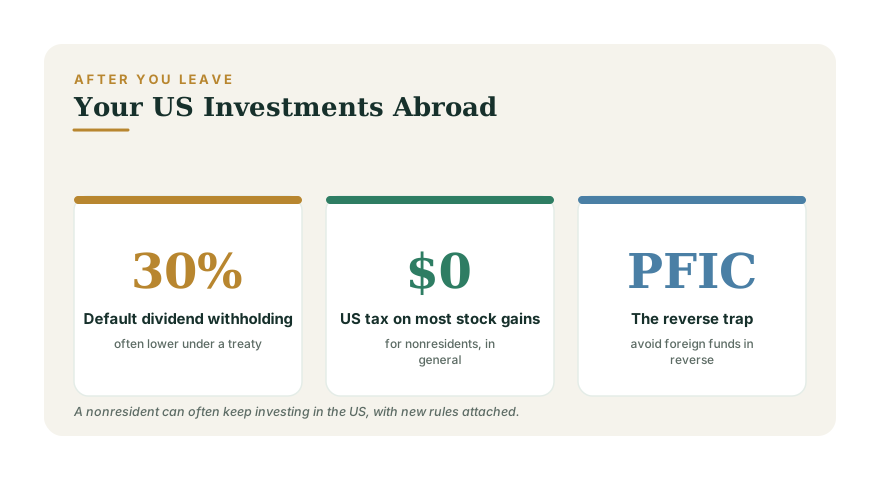
Once you are a nonresident alien, US-source investment income is taxed differently. Dividends from US stocks and funds are generally subject to a flat withholding tax — the default rate is 30%, deducted at the source before the money reaches you. The good news: if your home country has a tax treaty with the US, that rate is often reduced, sometimes to 15% or lower. To get the treaty rate, you typically must give your broker the correct tax form (commonly a W-8BEN) certifying your foreign status and treaty eligibility — without it, you default to the full 30%. Most US-source interest paid to nonresidents, by contrast, is often exempt from US tax under "portfolio interest" rules.
The surprising part: capital gains
Here is a genuinely favorable quirk. For most nonresident aliens, capital gains on the sale of US stocks and securities are generally not subject to US tax at all (real estate is a notable exception with its own rules). The US largely leaves it to your home country to tax those gains. This is the mirror image of how worldwide income works while you are a resident — a concept we unpack in US taxes as a non-citizen. It does not mean the gains are tax-free overall: your new country of residence will very likely tax them. But it changes where, and sometimes how much, you pay.
The PFIC issue in reverse
While living in the US, you were warned away from foreign mutual funds because of the punishing PFIC (Passive Foreign Investment Company) tax regime. After you leave, the trap flips. If you become a US tax resident again later — or if family members remain US persons — buying ordinary mutual funds and ETFs in your home country can make those funds PFICs from the US perspective, recreating the same penalty in reverse. US-domiciled funds avoid this, which is one reason some cross-border families keep a US brokerage holding US-listed funds rather than rebuying local equivalents abroad. Anyone with a continuing US tax connection should weigh this before reshuffling into foreign funds.
Moving funds home wisely
When you do repatriate money, a few practical points save real money:
- Mind the exchange rate and transfer fees. Large international transfers through a bank can carry poor exchange rates and hidden margins; specialized transfer services are often cheaper. Compare the all-in cost, not just the advertised fee.
- Time large sales thoughtfully. Since your home country will likely tax the gains, coordinate the timing of selling investments with your new tax year and rules.
- Keep good records. Document your cost basis and the value of holdings on the date you change tax residency; some countries "step up" or reset basis on arrival, and you will need the figures.
- Watch reporting on both sides. The US may still require some filings, and your home country will want to know about foreign accounts. Do not let an account fall into a reporting gap.
Plan the exit, do not improvise it
The worst outcomes come from leaving in a hurry — a forced account closure, a fire sale, a wire at a terrible rate. Map the move months ahead: confirm what your broker allows, file the right W-8 forms, understand your dividend withholding and your home country's rules, and sequence any sales. For those headed back to India specifically, the returning to India financial guide and the Return to India planner work through the cross-border details step by step.