Some workers end up with a large pile of their own company's stock inside their 401(k) — bought over years, or granted by the employer. If that stock has grown enormously in value, there is a special tax rule that can save serious money when you retire or leave. It goes by the unwieldy name net unrealized appreciation, or NUA, and almost nobody knows it exists.
The problem NUA solves
Normally, money pulled from a traditional 401(k) is taxed as ordinary income — the same high rates as your salary. If you simply roll your company stock into an IRA and later sell it, every dollar, including all the growth, eventually comes out taxed as ordinary income. The difference between ordinary-income rates and the lower long-term capital-gains rates is large; the distinction is laid out in capital gains vs ordinary income. NUA exists to let highly appreciated employer stock qualify for those lower capital-gains rates instead.
Cost basis vs gains: the key split
To understand NUA you have to separate two numbers:
- Cost basis — what was originally paid for the shares inside the plan.
- Net unrealized appreciation — the growth: today's market value minus that cost basis. This is usually the bulk of the value for stock that has done well.
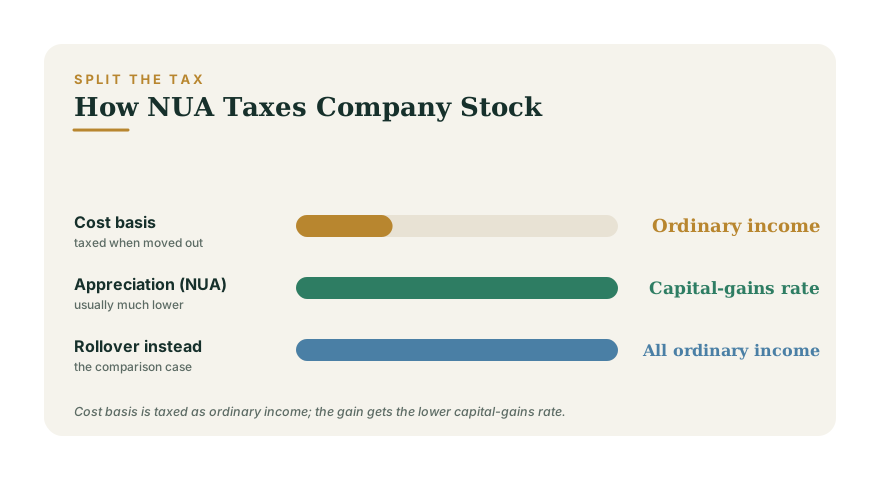
The NUA strategy works like this: instead of rolling the company stock into an IRA, you move it in kind (as actual shares) into a regular taxable brokerage account, in a single tax year, as part of a qualifying full distribution of the plan. When you do this, you pay ordinary income tax only on the cost basis — the smaller number — in the year of the move. The appreciation is not taxed then. Later, when you sell the shares, that entire gain is taxed at the long-term capital-gains rate, no matter how soon you sell.
A simple illustration
Imagine your 401(k) holds company stock with a cost basis of $30,000 that is now worth $200,000. The NUA — the appreciation — is $170,000.
- With NUA: you pay ordinary income tax on just the $30,000 basis when you move the shares out. The $170,000 of growth later gets the lower long-term capital-gains rate.
- Without NUA (a normal rollover): the full $200,000 eventually comes out of the IRA taxed as ordinary income.
Because the gain dwarfs the basis and capital-gains rates are well below ordinary rates, the NUA route can save a substantial amount. The bigger the gap between the stock's current value and its original cost, the more powerful the strategy.
When NUA beats a rollover
NUA is not always the winner. It tends to make sense when several things line up:
- The stock has appreciated a lot. A large gap between value and basis is the whole point. If the stock has barely grown, the spread between ordinary and capital-gains rates is not worth the trouble.
- The cost basis is relatively low. You pay ordinary tax on the basis up front, so a small basis means a small immediate tax bill.
- You can absorb the upfront tax. You owe ordinary income tax on the basis in the year you act, so it helps to have cash to cover it without selling the shares.
By contrast, if the stock is only modestly appreciated, a straightforward rollover (see how to roll over a 401(k)) is often simpler and keeps everything tax-deferred. There is also a diversification angle: holding a fortune in one employer's stock is risky, and NUA gives you a tax-efficient way to start selling it down.
The rules are strict — get help
NUA only works if you follow the requirements precisely. It generally requires a lump-sum distribution of the entire plan within one tax year, triggered by a qualifying event such as separation from service or reaching retirement age, with the employer stock moved in kind rather than sold or rolled over. One misstep — a partial rollover, the wrong sequence, selling the shares first — can disqualify the whole strategy and forfeit the benefit. This is a situation where a one-time consultation with a tax professional is well worth the cost, because the dollars at stake are large and the move is irreversible.
Bottom line
If you are retiring or leaving a job with a big position in appreciated company stock inside your 401(k), pause before rolling everything into an IRA on autopilot. NUA may let a large chunk of that value escape ordinary income rates. Compare the tax outcomes with the Capital Gains calculator, weigh the concentration risk inside your retirement plan, and consider professional guidance before you act. Also note: company stock you hold this way is its own taxable bucket, separate from the Roth-versus-traditional choice covered in Roth 401(k) vs Traditional 401(k).