When you compare mortgage offers, you will run into "points," and the term is used for two very different things. One is an optional way to lower your interest rate by paying cash up front. The other is simply a fee the lender charges to make the loan. Confusing them can cost you, so it helps to separate the two and then learn the one calculation that tells you whether buying down your rate is actually worth it.
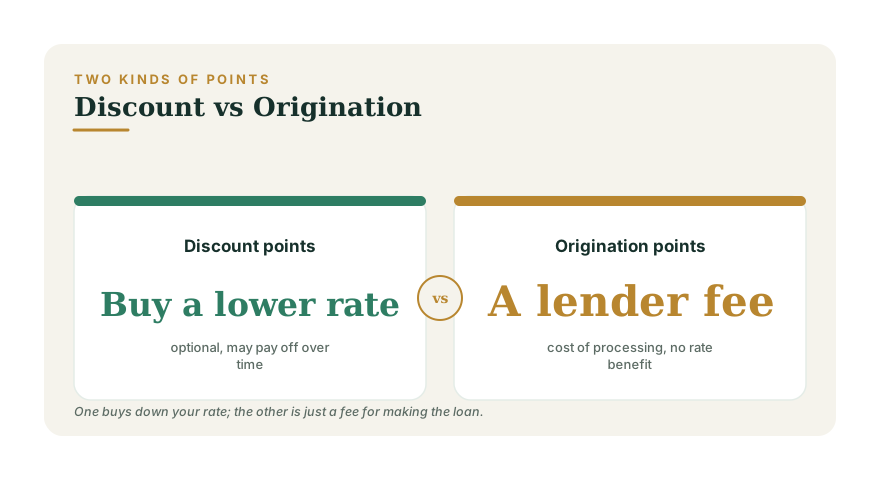
Discount points vs origination points
One point equals 1% of your loan amount. On a $300,000 mortgage, a point costs $3,000. But what you get for that money depends on the type.
- Discount points are optional. You pay them to "buy down" your interest rate. A point might lower your rate by roughly a quarter of a percent — the exact amount varies by lender and market. This is a real trade: cash now for a lower payment over the life of the loan.
- Origination points are a fee. They compensate the lender for processing and underwriting your loan. They do not lower your rate; they are just part of the cost of borrowing, and they belong in your comparison of total closing costs.
When someone talks about "paying points to get a better rate," they mean discount points. Origination charges are something to minimize and negotiate, not to buy more of.
The break-even calculation
Discount points only make sense if you keep the loan long enough to recoup their cost through the monthly savings. The math is refreshingly simple:
Break-even (in months) = cost of the points / monthly payment savings.
Say two discount points cost $6,000 and they lower your monthly payment by $90. Divide $6,000 by $90 and you get about 67 months — roughly five and a half years. If you keep the mortgage longer than that, the points paid off; every month after break-even is pure savings. If you sell or refinance before then, you lost money on the deal.
When buying down the rate is worth it
Points tend to make sense when several things line up:
- You will stay put a long time. The longer you hold the loan past break-even, the more the points earn. If you are confident this is a long-term home, points become more attractive.
- You have cash to spare after closing. Spending your last dollars on points instead of keeping an emergency fund is a poor trade. Points should come from surplus, not from your safety net or down payment.
- Rates are relatively high. When rates are elevated, the case for buying down can be stronger — though you are also more likely to refinance later, which can wipe out the benefit before you reach break-even.
When to skip them
Points usually do not pay off if you expect to move or refinance within a few years, if buying them would leave you cash-poor, or if you would earn more by investing that same money elsewhere. There is also an opportunity cost: $6,000 spent on points is $6,000 that is not invested or held in reserve. Weigh that, too.
Run the numbers before you commit
Never accept points on faith. Ask the lender for two quotes — one with points and one without — and compare the monthly savings to the up-front cost, then divide to find your break-even. Compare it honestly to how long you realistically expect to keep the loan. The Opportunity Cost Calculator can show what that up-front cash might earn elsewhere, and the Refinance Analyzer uses the same break-even logic for a future refinance. Points are neither a trick nor a freebie — they are a bet on how long you will keep the loan, and the math tells you whether the bet is good.