Medicare is not free, and for higher earners it is more expensive than the headline premium suggests. On top of the standard Part B and Part D premiums, people above certain income thresholds pay an extra amount called the Income-Related Monthly Adjustment Amount, or IRMAA. It surprises new retirees every year, partly because of how it is calculated and partly because it operates as a cliff rather than a gentle slope. Understanding it before you reach 65 — or before a big income year — can save you thousands.
What IRMAA is
IRMAA is a surcharge added to your Medicare Part B (doctors and outpatient care) and Part D (prescription drugs) premiums when your income exceeds set thresholds. The higher your income, the higher the tier, and the tiers step up in brackets. It is not a tax you file — it is billed as part of your Medicare premium, often deducted straight from your Social Security check. The official brackets and current-year amounts are published by Medicare at cms.gov and on Medicare.gov. For the ground rules of enrolling before 65, see Medicare Basics Before 65, and for a fuller treatment of the surcharge itself, Medicare IRMAA Surcharges.
The two-year lookback
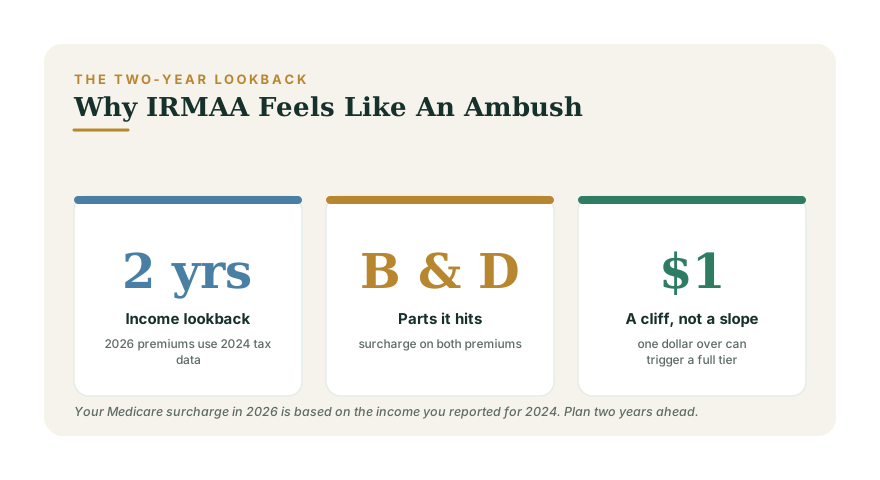
Here is the feature that catches people. Your 2026 IRMAA is based on the modified adjusted gross income you reported on your 2024 tax return — income from two years earlier. So a one-time spike in 2024 (selling a house, a large Roth conversion, a big capital gain, a final year of high salary) can raise your Medicare premiums in 2026, long after the money is spent. Retirees are frequently blindsided because the surcharge lands well after the income event that caused it. This makes IRMAA a planning problem you have to see coming two years out.
The cliff problem
IRMAA does not phase in gradually. Cross a bracket threshold by a single dollar and you pay the full surcharge for that entire tier — for both spouses if both are on Medicare. That makes income near a threshold unusually valuable to manage. Being $100 over a bracket can cost far more than $100 in surcharges across the year. Knowing where the brackets sit, published at cms.gov, lets you avoid tripping over a line you did not know was there.
What raises the income IRMAA sees
Because IRMAA keys off modified adjusted gross income, the usual retirement-income moves all feed into it:
- Required minimum distributions from traditional retirement accounts, which begin in your 70s and can be sizable — estimate yours with the RMD Calculator.
- Roth conversions, which add to income in the conversion year even though they save tax later. Time them carefully with the Roth Conversion tool.
- Capital gains from selling investments or a home.
- Even tax-exempt muni-bond interest, which counts toward the IRMAA income measure.
The lesson is that IRMAA has to be part of your broader drawdown and conversion strategy, not an afterthought.
How to manage and appeal it
Several levers help:
- Do Roth conversions earlier — ideally in the years between retirement and 65, before Medicare and before RMDs, when your income is naturally low.
- Spread large sales across tax years to avoid stacking a single huge income spike.
- Use qualified charitable distributions from an IRA, which satisfy RMDs without adding to the income IRMAA counts.
- Appeal a life-changing event. If your income dropped because you retired, lost a spouse, or stopped work, you can ask Social Security to use current income instead of the two-year-old figure by filing Form SSA-44. This is the fix when a past high year no longer reflects your reality — details at cms.gov.
Plan the surcharge two years out
IRMAA rewards people who plan ahead and ambushes those who do not. Watch the brackets, remember the two-year lookback, manage conversions and big sales around the thresholds, and appeal when a life change has cut your income. Because it is one line item inside a much larger picture of health costs in later life — laid out in Healthcare Costs in Retirement — build it into your full plan. Model your withdrawals with the Retirement Planner and check where you stand with the Retirement Readiness assessment.