It feels natural to write "everything to my children" and assume the law will sort out the details. But minors cannot legally own or manage significant property, and leaving money to a young child outright sets up problems that good planning easily avoids. The question is not whether your children inherit — it is how and when they receive it.
Why you should not leave money to a minor outright
If a minor is left a meaningful sum with no structure, a court typically steps in. It appoints a guardian of the estate (also called a conservator) to manage the money under court supervision until the child turns 18. That process is public, expensive, and rigid — the guardian must report to the court and ask permission for many decisions, and the legal and accounting costs come straight out of the inheritance.
Then comes the bigger problem: at age 18 (or 21 in some arrangements), the child receives whatever is left, free and clear, in one lump sum. Few 18-year-olds are equipped to manage a large windfall wisely. The money meant to fund college and a stable adulthood can evaporate on cars, friends, and bad decisions before the child has the judgment to know better. Avoiding both outcomes is the entire point of planning ahead.
The testamentary trust: the workhorse solution
The standard fix is a trust for the benefit of the child. You can create it inside your will (a testamentary trust, which springs into existence at your death) or as part of a living trust. Either way, the structure is the same: a trustee you choose holds and invests the money and pays it out for the child's benefit according to your instructions — typically for health, education, maintenance, and support.
This solves several problems at once. It keeps the inheritance out of court-supervised guardianship, it puts a capable adult in charge instead of a teenager, and it lets you write the rules. You decide what the money can be spent on and, crucially, when the child gains direct control. A trust also separates the money from the day-to-day caregiver: the person raising your child does not have to be the person managing the funds, which is healthier for everyone and is why families coordinate this with the guardian they name for minor children.
UTMA and UGMA custodial accounts
For smaller amounts, a simpler tool exists. Under the Uniform Transfers to Minors Act (UTMA) — and its older cousin UGMA — you can leave money to a custodian who manages it for the child without a formal trust. It is cheaper and easier to set up than a trust, which makes it attractive for modest sums.
The catch is the same lump-sum problem in a new costume: a custodial account terminates at an age fixed by state law, usually 18 or 21, at which point the child gets full control no matter how mature they are. You cannot stagger distributions or extend the timeline the way a trust allows. UTMA works well for a few thousand dollars meant for college; for a life-changing inheritance, a trust gives you the control that matters.
Staggered distributions beat a single windfall
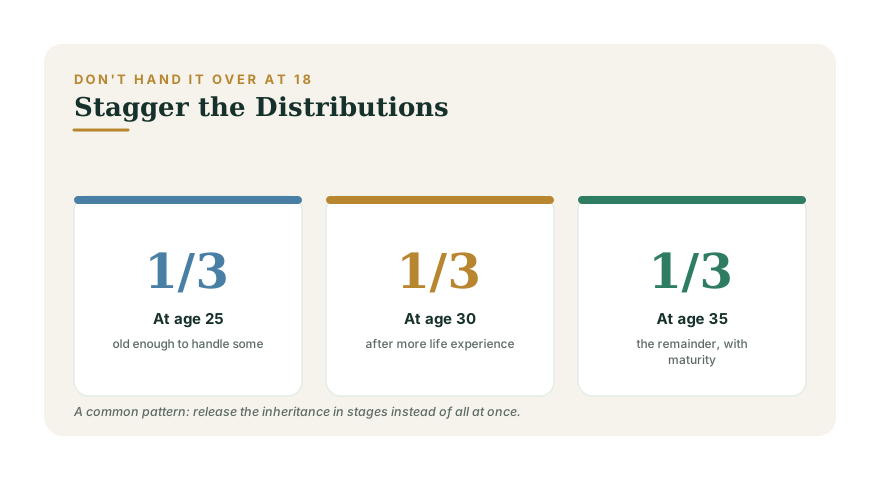
The single most useful feature of a trust is the ability to release money in stages instead of all at once. A common pattern hands over the inheritance in thirds — say one-third at 25, one-third at 30, and the rest at 35. The logic is simple: if a young adult makes a poor decision with the first installment, there are two more chances to do better, and the lessons of the first distribution inform the next.
You can also tie distributions to milestones rather than ages — finishing a degree, buying a first home, or starting a business — though pure age triggers are simpler to administer. Either way, staggering converts a dangerous windfall into a series of manageable, teachable moments.
Coordinate the whole plan
A trust for your children is only one piece. It needs to mesh with your beneficiary designations on retirement accounts and life insurance, which pass outside your will entirely and can wreck a careful plan if a minor is named directly. The broader picture for parents is laid out in estate planning for young families, and a non-binding companion to your legal documents — explaining your hopes for how the money is used — is covered in the letter of intent.
Leaving money to minor children well is mostly about control and timing, not legal exotica. Run the Estate Readiness assessment to check whether your plan keeps your children's inheritance out of court and out of a teenager's unsupervised hands.