Most people think of a Health Savings Account as a place to park a few dollars for the year's doctor visits. That is the least interesting thing it can do. Used with intention, an HSA is the single most tax-advantaged account in the US code — the only one that is tax-free going in, tax-free while it grows, and tax-free coming out. Treated as a long-term investment rather than a checking account for copays, it becomes a stealth retirement account that quietly outperforms a 401(k) on every dollar you eventually spend on health care.
The catch is small and specific: you can only contribute to an HSA while you are covered by a qualifying high-deductible health plan. If you have access to one, the strategy below is worth understanding before you spend a cent of the balance.
The triple tax advantage, briefly
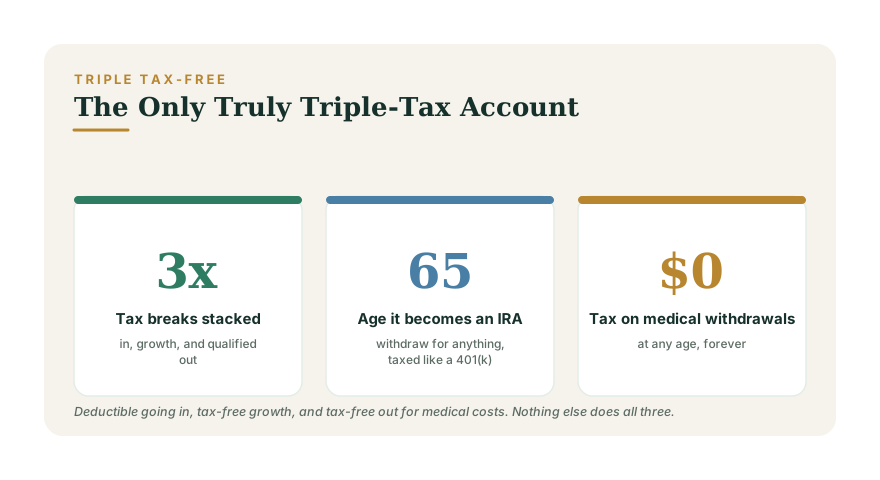
Contributions reduce your taxable income the year you make them, like a traditional 401(k). The money then grows tax-free — no tax on interest, dividends, or capital gains. And when you withdraw it for a qualified medical expense, you pay no tax on the way out either. A 401(k) gives you the deduction and the growth but taxes every withdrawal; a Roth gives you tax-free growth and withdrawals but no upfront deduction. The HSA is the only account that stacks all three, a point worth internalizing in full in The HSA Triple Tax Advantage.
The stealth part: do not spend it
The move that turns an HSA into a retirement account is counterintuitive — you pay your current medical bills out of pocket and let the HSA balance stay invested. Every dollar you leave untouched compounds tax-free for decades. The Opportunity Cost calculator makes the gap vivid: a few thousand dollars spent on a copay today is a far larger sum forgone in retirement. If cash flow allows it, treat the HSA like a Roth IRA that happens to have a health-care superpower, and invest the balance in low-cost index funds rather than leaving it in the cash sweep, as covered in How to Use an HSA as an Investment.
The receipt trick
Here is the mechanism that makes the strategy flexible. There is no deadline to reimburse yourself for a qualified expense. If you pay a $2,000 medical bill from your checking account in 2026 and keep the receipt, you can reimburse yourself from the HSA in 2046 — tax-free — after the money has grown for twenty years. In effect, every medical bill you pay out of pocket today is an IOU you can cash from your invested HSA at any future point. Keep a digital folder of every medical receipt while the account compounds untouched. The IRS lays out what counts as a qualified expense in Publication 502, available at irs.gov.
Contribution limits and the details
The IRS sets HSA contribution limits each year and adjusts them for inflation, with separate caps for individual and family coverage and an extra catch-up amount once you turn 55. Your employer's contribution counts toward the same cap. Because the exact figures change annually, confirm the current-year limits directly at irs.gov before you max out. Contributing through payroll, where available, also dodges the 7.65% FICA tax on those dollars — a bonus that even a 401(k) does not offer.
What happens at 65
The account gets even better with age. After you turn 65, you can withdraw HSA money for any reason without the 20% penalty that would otherwise apply to non-medical withdrawals. Non-medical withdrawals are simply taxed as ordinary income — exactly like a traditional 401(k). So in the worst case, your HSA behaves like another pre-tax retirement account; in the best case, you spend it on the very real health-care bills that dominate late retirement, entirely tax-free. Those costs are larger than most people expect, as detailed in Healthcare Costs in Retirement.
Where it fits in your order of operations
For someone on a qualifying plan, a sensible priority is: capture the full 401(k) match first, then fund the HSA to the max, then return to the 401(k) and IRA. The HSA's edge over the 401(k) on medical spending is what justifies slotting it that high. It only makes sense, of course, if the underlying high-deductible plan is right for you — a decision that turns on your own health and cash flow, walked through in High-Deductible Health Plans: When the Math Works.
Put the account to work
An HSA left as a spending account is a rounding error. An HSA invested, left alone, and backed by a folder of receipts is one of the most powerful wealth-building tools available. Confirm this year's limits at the IRS, invest the balance, and pay small bills from cash while you can. Map how the account fits your broader picture at the planning hub, and pressure-test your retirement readiness with the Retirement Readiness assessment.