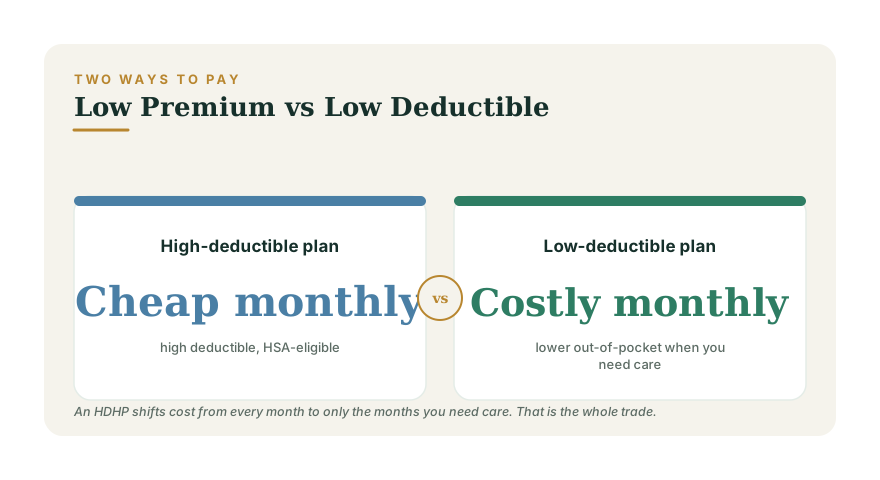
A high-deductible health plan, or HDHP, is often the cheapest option on the menu each open enrollment. Its low monthly premium is tempting, but the trade is real: you agree to pay a large deductible out of your own pocket before the insurer covers much of anything. Whether that is a smart bet or an expensive gamble depends almost entirely on your health, your cash reserves, and your discipline. The math is knowable, so let us work it out.
What actually defines an HDHP
An HDHP is not just any plan with a big deductible. It must meet minimum deductible and maximum out-of-pocket thresholds that the IRS sets and adjusts each year. Meeting that definition is what unlocks the ability to contribute to a Health Savings Account — the feature that makes the whole strategy worthwhile. Confirm the current qualifying figures at irs.gov. The broader head-to-head with a traditional PPO is laid out in HDHP vs PPO: Choosing a Health Plan, and if the vocabulary of deductibles and premiums is new, How Health Insurance Works covers the basics.
The core calculation
Comparing two plans comes down to total annual cost in a given year, not the premium alone. Add up what you would pay under each plan:
- Annual premium — the monthly cost times twelve, the part you pay no matter what.
- Expected out-of-pocket care — realistic deductible and coinsurance spending based on how much care you actually use.
- Minus the tax value of the HSA — an HDHP lets you fund an HSA with pre-tax dollars, which is a real discount on the plan's true cost.
Run this in a healthy year and a bad year. The HDHP usually wins the healthy-year comparison by a wide margin and can still hold up in a bad year because its out-of-pocket maximum caps your downside. The Insurance Calculator helps you compare total costs side by side.
When the HDHP is a clear win
The plan tends to make sense when several of these are true:
- You are generally healthy and use little routine care.
- You have enough cash to cover the full deductible without going into debt, so a bad year does not become a financial crisis.
- You will actually fund and invest the HSA rather than leave it empty — that is where much of the value lives, as explained in Maximizing an HSA as a Stealth Retirement Account.
- Your employer contributes to the HSA, which effectively shrinks the deductible you are exposed to.
When it is the wrong choice
An HDHP can backfire just as clearly. Skip it if you have a chronic condition, take expensive ongoing medication, are planning a pregnancy, or expect surgery — predictable heavy users of care usually come out ahead paying a higher premium for a lower deductible. It is also the wrong plan if you could not cover the deductible without a credit card, because the whole point of insurance is to prevent a health event from becoming a debt spiral. A high deductible you cannot afford is not savings; it is exposure.
The behavioral trap
The most common way an HDHP fails is not medical — it is behavioral. People choose it for the low premium, then never fund the HSA, and worse, avoid needed care because they dread paying the full cost before the deductible kicks in. Deferring a checkup or skipping a prescription to save money often costs far more later. The HDHP only works if you pair it with a funded HSA and the willingness to still get the care you need. If you would not do both, the plan's advantage evaporates.
Decide with numbers, not the sticker price
The HDHP is a genuinely powerful choice for a healthy person with a cash cushion who will use the HSA — and a poor one for a heavy user of care or anyone who cannot absorb the deductible. Do not choose on premium alone. Total up both scenarios, check the IRS thresholds at irs.gov, and run the comparison with the Insurance Calculator. Then check whether your emergency fund can truly absorb the deductible using the Financial Resilience assessment and map the rest at the planning hub.