Most people treat a Health Savings Account like a checking account for doctor visits: money goes in, and the same money comes right back out a few weeks later to cover a copay. That works, but it wastes the single most powerful feature of the HSA — its ability to be invested and left alone for decades. Used deliberately, an HSA can quietly become one of the best retirement accounts you own.
The catch is that you have to qualify. You can only contribute to an HSA while you are covered by a high-deductible health plan, so this strategy starts with your insurance choice.
Why the HSA is special
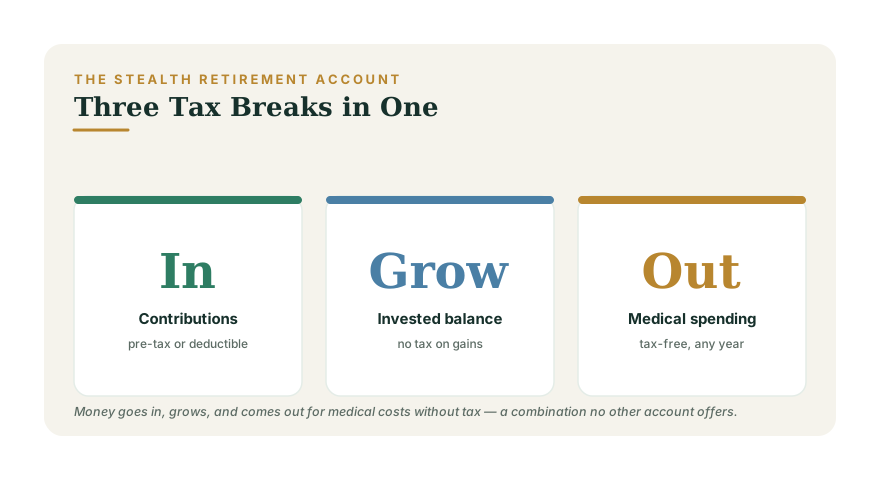
The HSA is the only account in the U.S. tax code with a triple tax advantage. Contributions reduce your taxable income, the balance grows without tax on interest or capital gains, and withdrawals for qualified medical expenses are never taxed. A traditional 401(k) gets you the first two; a Roth IRA gets you the last two; only the HSA stacks all three. The mechanics are covered in depth in The HSA's Triple Tax Advantage.
The core move: pay out of pocket, invest the HSA
Here is the strategy that turns a spending account into a wealth account. When you have a medical bill, pay it from your regular checking account or a credit card — not from the HSA. Leave the HSA money invested so it can compound. Because your medical costs are small while you are young and healthy, the balance has years, sometimes decades, to grow untouched.
This only makes sense if you can comfortably cover current medical costs from your everyday cash flow. If paying a deductible out of pocket would force you into credit card debt, then using the HSA to pay bills directly is the right call for now. The investing play is a luxury for people with a stable cash cushion, not a rule for everyone.
Save every receipt — the reimbursement trick
This is the part most people miss. The IRS does not require you to reimburse a medical expense in the same year you paid it. There is no deadline. As long as the expense happened after you opened the HSA and you never claimed it elsewhere (no double-dipping on a tax deduction), you can reimburse yourself years or even decades later.
So keep a folder — paper or digital — of every qualified medical receipt you pay out of pocket: deductibles, copays, dental work, glasses, prescriptions. Each saved receipt is essentially a tax-free withdrawal coupon you can cash anytime in the future. Imagine paying $20,000 of medical costs out of pocket over twenty years while the HSA grows. Later, you can pull $20,000 from the HSA completely tax-free by matching it to those old receipts — and that withdrawal can fund anything you want.
How to actually invest it
Many HSA providers keep your money in a cash account by default, earning almost nothing. To invest, you usually need to:
- Check whether your HSA offers an investment option — many require a small minimum cash balance (say a few hundred to a thousand dollars) before you can invest the rest.
- Move the excess into low-cost, broadly diversified funds, the same way you would in any retirement account. A simple total-market index fund is a sensible default.
- Watch the fees. Some employer HSAs charge monthly fees or offer mediocre funds. You can often move money to a better outside HSA provider with a transfer, even while keeping your employer's HSA for payroll contributions.
Treat the invested portion like long-term money, because that is what it is. The principles are no different from how to start investing in any other account.
The retirement angle
After age 65, the HSA loosens up considerably. You can withdraw money for any purpose without the 20% penalty that applies earlier — non-medical withdrawals are simply taxed as ordinary income, exactly like a traditional IRA. And medical withdrawals stay tax-free forever. Since health costs are one of the largest and most certain expenses in retirement, having a dedicated, tax-free pool earmarked for them is enormously valuable. This is why the HSA is sometimes called the best retirement account hiding in plain sight, and it pairs naturally with planning for healthcare costs in retirement.
Don't confuse it with an FSA
An HSA is not the same as a Flexible Spending Account. An FSA is generally "use it or lose it" each year and is not investable, so the long-term strategy here does not apply to it. If you are deciding between the two or have access to both, read FSA vs HSA: Which One first.
Putting it to work
The recipe is simple: choose an HDHP if it fits your health needs, max the HSA, invest the balance in low-cost funds, pay current medical bills from cash while saving every receipt, and let the account compound. Decades later you will have a flexible, tax-advantaged pool you can tap for medical costs or, after 65, for anything at all. Fold the numbers into your broader strategy with the Retirement Planner and a quick Financial Wellness check.