Prescription pricing is one of the strangest corners of American health care. The same medication can cost wildly different amounts depending on where you fill it, whether you use insurance, and whether you ask a single question at the counter. The good news is that a handful of simple habits can cut your drug spending substantially, often without sacrificing anything.
Start with generics
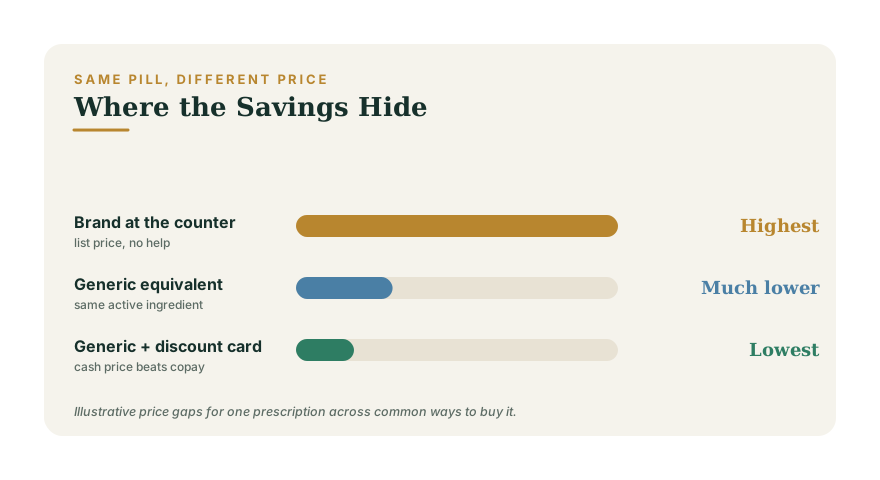
A generic drug has the same active ingredient, strength, and dosage as the brand-name version, and the FDA requires it to work the same way. It simply costs a fraction of the price because the manufacturer did not pay for the original research and marketing. For the large majority of common medications, a generic is available and is the single biggest source of savings. Always ask your doctor or pharmacist, "Is there a generic for this?" — and if there is, ask them to write the prescription for it.
Discount cards and cash prices
Services like GoodRx, SingleCare, and similar discount programs negotiate cash prices with pharmacies and let you use them for free. You show a coupon code at the counter and pay the discounted cash price instead of the pharmacy's list price. The savings can be dramatic, especially on generics.
Here is the counterintuitive part: sometimes the cash discount price is lower than your insurance copay. Pharmacies do not always volunteer this. It is worth checking a discount-card price even when you have coverage and choosing whichever is cheaper. One caution — when you pay the cash discount price instead of using insurance, that spending usually does not count toward your deductible. If you are working toward meeting a deductible, weigh that trade-off.
Mail-order and 90-day supplies
For medications you take long-term, ask whether your plan offers a mail-order pharmacy or a 90-day supply at retail. Buying three months at once typically lowers the per-dose cost and means one copay instead of three. Many plans actively reward 90-day fills for maintenance drugs like blood-pressure or cholesterol medications.
Manufacturer assistance and copay programs
For expensive brand-name drugs that have no generic, the manufacturer often runs a patient assistance program or a copay card that can cut your out-of-pocket cost sharply, sometimes to near zero. These are most common for specialty and newer medications. Search the drug name plus "patient assistance" or "copay card," or ask your prescriber's office — they often have the paperwork on hand. Income-based programs and nonprofit foundations can also help with high-cost treatments.
Understand your formulary
Your insurance plan's formulary is its list of covered drugs, usually sorted into tiers. Lower tiers (generics and preferred brands) cost you less; higher tiers cost more or may not be covered at all. If your medication sits on an expensive tier, ask your doctor whether a lower-tier alternative would work just as well — a small substitution can change your cost meaningfully. Reading your plan documents the same way you would read your Explanation of Benefits helps you spot which drugs your plan actually wants you to use.
A few more levers
- Compare pharmacies. Cash prices for the same drug vary by store. Big-box and warehouse pharmacies are often cheapest, and some offer flat low prices on a long list of common generics.
- Pill splitting. For some medications, a higher-dose tablet costs little more than a lower-dose one. If your doctor approves splitting, you can effectively halve the cost. Never do this without medical guidance, and never with capsules or extended-release pills.
- Use your HSA or FSA. Prescriptions are qualified medical expenses, so paying with pre-tax dollars lowers the real cost further — see how the account can do double duty in How to Use Your HSA as an Investment Account.
The habit that saves the most
The single most valuable habit is to ask before you pay. At the counter, ask whether there is a generic, what the cash discount price is, and whether a 90-day supply is cheaper. Pharmacists field these questions constantly and are usually glad to help. Drug costs are one of the most controllable parts of a medical budget once you know which questions to ask. For the bigger picture on trimming what you owe, see How to Lower Your Medical Bills, and use the Budget Analyzer to see where recurring prescription costs fit in your monthly plan.