An exchange-traded fund, or ETF, is a basket of investments you buy and sell on an exchange like a single stock. They are flexible, usually low-cost, and have become the default building block for modern portfolios. But "ETF" is just a wrapper — inside it you might find a rock-solid index fund or a thin, expensive, gimmicky product. Before you buy, run through six checks. None of them takes more than a minute on the fund's information page.
1. The expense ratio
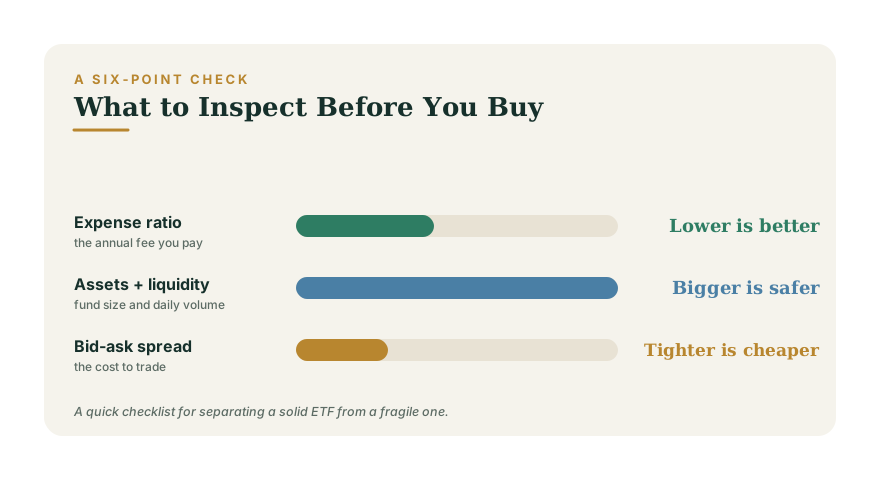
The expense ratio is the annual fee, expressed as a percentage of your investment, that the fund charges to run itself. It is deducted automatically and quietly, so it is easy to ignore — which is exactly why it deserves attention. For a broad index ETF, you should expect a very low number, often well under 0.10% a year. A niche or actively managed ETF may charge many times more. Over decades, that difference compounds into real money, as How Expense Ratios Quietly Destroy Your Wealth shows. All else equal, cheaper wins.
2. The index it tracks
Most ETFs are designed to follow a specific index. Read which one, because the index is the strategy. An ETF tracking a total-market or S&P 500 index gives you broad, diversified ownership. An ETF tracking a narrow theme — a single sector, country, or trend — gives you a concentrated bet, which behaves very differently. Two ETFs with similar names can track very different indexes. Check the tracking difference too: how closely the fund actually keeps up with its index over time. A well-run fund tracks tightly; a sloppy one lags.
3. Assets under management and liquidity
Look at the fund's assets under management (AUM) — the total amount invested in it — and its average daily trading volume. These matter for two reasons. First, a tiny fund with few assets is at greater risk of being closed and liquidated by the issuer, which can force you to sell at an inconvenient time and create a taxable event. Second, higher trading volume generally means it is easier and cheaper to buy and sell at a fair price. A large, heavily traded ETF is simply more durable and more convenient than a thinly traded one.
4. The bid-ask spread
Because an ETF trades like a stock, there are two prices at any moment: the highest price a buyer will pay (the bid) and the lowest price a seller will accept (the ask). The gap between them is the bid-ask spread, and it is a hidden cost you pay every time you trade. Large, liquid ETFs have spreads of a penny or two — negligible. Thinly traded ones can have wide spreads that quietly skim a meaningful amount off each trade. A wide spread is a tax on your impatience, and it is a strong reason to favor liquid funds and to avoid trading at the very open or close of the market.
5. Premium or discount to NAV
Every ETF has a net asset value (NAV) — the true per-share value of everything it holds. Its market price should hover right around NAV, but it can drift slightly above (a premium) or below (a discount). For broad, liquid ETFs, this gap is tiny and self-correcting thanks to the creation-redemption mechanism explained in How ETFs Work Under the Hood. But for niche funds — especially those holding hard-to-trade assets or international markets in different time zones — premiums and discounts can be larger. Buying at a premium means overpaying; selling at a discount means getting shortchanged. Check that the price is close to NAV before you trade.
6. Holdings concentration
Open the list of holdings and see how concentrated the fund is. A truly diversified ETF spreads your money across hundreds or thousands of securities, so no single one can sink you. Some ETFs, despite a broad-sounding name, are dominated by a handful of large positions — a top-ten that makes up half the fund. That is not necessarily wrong, but it is a different risk profile than you may think you are buying, and it can leave you accidentally over-exposed to one company or one industry. If diversification is your goal, concentration is the thing to watch.
ETF or index mutual fund?
Once an ETF passes these checks, a final question is whether you even need the ETF wrapper versus an equivalent index mutual fund. They often hold the same things; the differences come down to how you trade and tax treatment. That comparison is laid out in Index Funds vs ETFs: Which Should You Choose?.
Run the checklist every time
These six checks — fee, index, size and liquidity, spread, premium/discount, and concentration — take only a few minutes and reliably separate a sound ETF from a fragile one. Make them a habit before every purchase. When you are assembling several ETFs into a coherent whole, the Portfolio Builder can help you see how the pieces fit together and whether you are as diversified as you intend to be.