The single most expensive tax mistake is not aggressive accounting. It is leaving legitimate breaks unclaimed because nobody told you they existed. Tax software walks you through the common screens, but it only knows what you type in, and it rarely stops to ask whether you funded an HSA, paid student loan interest, or qualify for a credit you have never heard of. The forms are not designed to volunteer money back to you. So every year, ordinary people overpay the IRS by hundreds or thousands of dollars simply because the deduction sat one screen away and went unticked.
The honest truth: deductions and credits are not the same thing
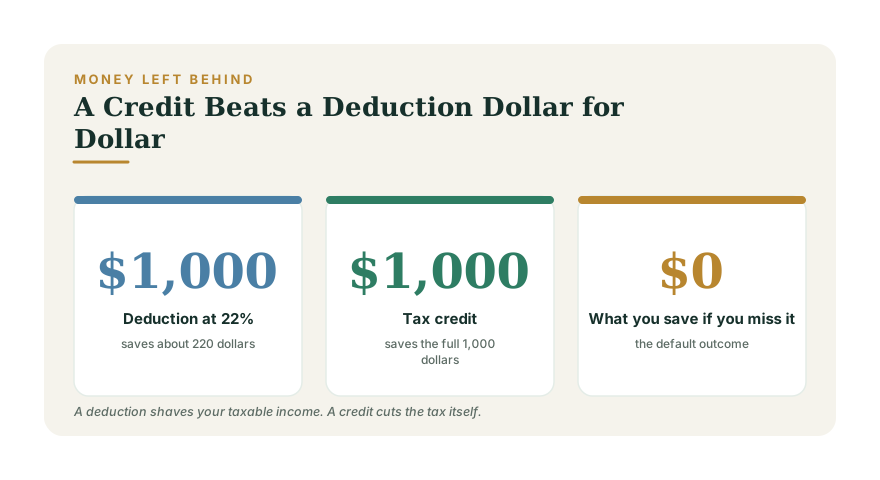
This trips up nearly everyone. A deduction lowers the income you get taxed on. If you are in the 22% bracket, a 1,000 dollar deduction saves you about 220 dollars. A credit lowers your actual tax bill dollar for dollar, so a 1,000 dollar credit saves you the full 1,000 dollars. Credits are roughly four to five times more valuable than a deduction of the same size, which is exactly why they are worth hunting for, and exactly why they are easy to miss if you do not know to look.
Above-the-line deductions: the ones you get even if you take the standard deduction
Here is the part most people misunderstand. You can take the standard deduction and still claim these, because they come off your income before the standard-versus-itemized decision even happens. They are called above-the-line adjustments, and they are the most overlooked category there is.
- HSA contributions. If you have a qualifying high-deductible health plan, money you put into a Health Savings Account is deductible, grows tax-free, and comes out tax-free for medical costs. It is the only triple-tax-advantaged account in the code, and many people never open one.
- Traditional IRA contributions. Depending on your income and whether you have a workplace plan, contributing to a traditional IRA can be deductible. Even a partial deduction is real money back.
- Student loan interest. You can deduct interest you paid on student loans, up to a per-year cap, and you do not have to itemize. It phases out at higher incomes, but most borrowers qualify.
- Self-employed health insurance. If you are self-employed and pay your own premiums, you can often deduct them directly against your income.
- Half of self-employment tax. The self-employed pay both halves of Social Security and Medicare, but the IRS lets you deduct the employer half. It is automatic on the form, but only if you are actually filing the self-employment schedule correctly.
The home-office deduction is real, and not an automatic audit
A myth has scared self-employed people away from a legitimate break for years: that claiming a home office guarantees an audit. It does not. If you use part of your home regularly and exclusively for business, you can deduct it. The simplified method gives you a flat rate per square foot up to a cap, with no receipts to track. The regular method lets you deduct a percentage of rent, utilities, and insurance based on the share of your home used for work. Note this is for the self-employed; employees working from home generally cannot claim it under current federal rules.
Credits people routinely walk past
Because credits are so valuable, missing one is the costliest error of all.
- Education credits. The American Opportunity Credit and the Lifetime Learning Credit offset tuition and fees. The first is partly refundable, meaning you can get money back even if you owe no tax.
- Child and Dependent Care Credit. If you paid for childcare so you could work, a portion of those costs comes back as a credit. Day camp during the summer can count; overnight camp does not.
- Saver's Credit. Lower- and moderate-income households who contribute to a retirement account can get a credit worth a percentage of what they put in. It is one of the most underclaimed credits in the country precisely because the people who qualify often assume credits are not for them.
Do not forget your state
Federal is only half the picture. States have their own deductions and credits that the federal forms never mention: 529 college-savings contributions, renter's credits, property-tax relief, and energy or vehicle credits that vary widely by state. Software often handles these only if you complete the state module carefully, so do not rush it.
Your pre-filing checklist
- List every account you funded last year: HSA, traditional IRA, 401(k), 529. Each may trigger a deduction or credit.
- Gather Form 1098-E for student loan interest and 1098-T for tuition.
- If self-employed, tally health premiums, home-office square footage, and confirm the self-employment-tax deduction flowed through.
- Check whether you paid for childcare so you could work, and pull the provider's tax ID.
- Run the standard deduction against your itemized total, and remember above-the-line items apply either way.
- Open your state's return and look for credits the federal form never asked about.
- Confirm this year's dollar limits and income phase-outs at IRS.gov, because every threshold changes annually.
The honest recommendation
The standard deduction is large enough now that most filers no longer itemize, and that is fine. The mistake is assuming the standard deduction means there is nothing else to claim. The above-the-line adjustments and the credits sit on entirely different lines and are yours regardless. Spend twenty minutes with the checklist above before you click submit, because that is the highest hourly rate you will earn all year. Tax rules and dollar limits change every year, so treat these as the general map, not the current-year figures.
If you want to see how funding an HSA or IRA changes your long-term picture rather than just this April's refund, run the numbers through our tools, then build the habit into your plan so the deduction happens automatically next year. For more on the moves behind these accounts, browse our articles.