You started selling your pottery, editing videos for pay, or flipping vintage finds, and now you are wondering: is this a business or just a hobby? It might sound like semantics, but the distinction carries real tax consequences. And here is the uncomfortable part — you do not get to simply declare the answer. The IRS has its own set of factors, and the label it applies changes how your money is treated.
Why the label matters so much
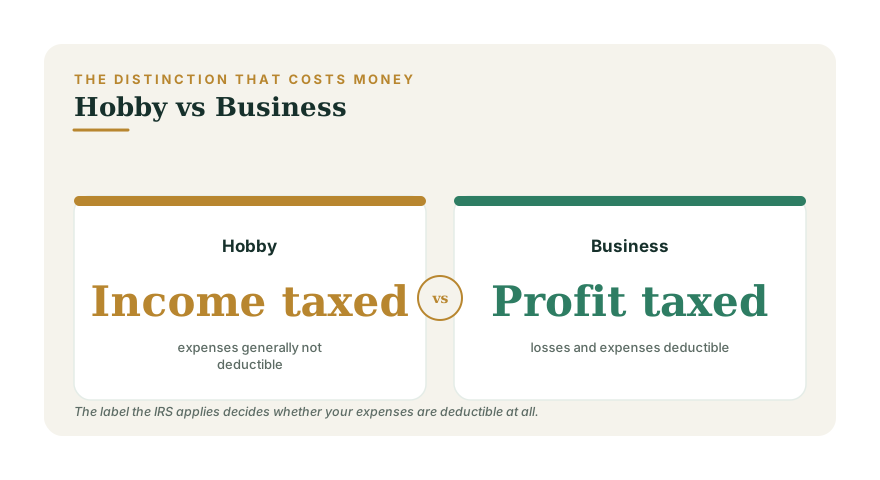
The stakes come down to deductions. If your activity is a business, you report income and subtract your expenses, so only your net profit is taxed — and if you spend more than you earn, that loss can offset other income. If it is a hobby, the rules are harsh: you must still report all the income, but you generally cannot deduct your expenses against it. So a hobbyist who grosses money and spends nearly all of it on supplies can end up taxed on the gross while getting no relief for the costs. That asymmetry is exactly why the classification is worth understanding before you file.
The factors the IRS weighs
There is no single bright-line test. Instead, the IRS looks at the overall picture, weighing factors that together signal whether you are genuinely trying to make a profit. Among them:
- Do you run it in a businesslike manner — separate books, records, and a bank account?
- Do you depend on the income, or does it just supplement a comfortable living?
- Have you made a profit, and how much, in some years?
- Do you put in the time and effort that suggests a profit motive?
- Do you have the expertise, or take steps to acquire it, to make it succeed?
- Are losses due to normal startup issues or circumstances beyond your control, rather than the nature of a pastime?
- Do you change methods to improve profitability when things are not working?
No single factor decides it; the IRS considers all of them together. An activity you love can absolutely be a business — enjoyment does not disqualify you — as long as the profit motive is real.
The profit presumption
There is one helpful rule of thumb. If your activity turns a profit in a certain number of years within a set window, the IRS generally presumes it is a business, shifting the burden onto the agency to argue otherwise. The commonly cited version is profit in three of five consecutive years (with a different ratio for some activities). Falling short of that presumption does not automatically make you a hobby — you can still qualify as a business under the factors above — but it means you should be ready to demonstrate your profit motive.
How to strengthen your business case
If your side project is a genuine attempt to make money, a few habits both help your taxes and protect you if questioned:
- Separate your finances with a dedicated bank account and card for the activity.
- Keep real records — income, expenses, receipts, and a simple ledger.
- Write a basic plan showing how you intend to earn a profit and adjust when you do not.
- Market yourself and treat clients or customers professionally.
These are the same steps that turn a casual side hustle into a real venture, walked through in Turning a Side Hustle Into a Business. Once you are clearly a business, the full deduction toolkit opens up, detailed in Self-Employed Tax Deductions.
Get the classification right
The hobby-versus-business line is one of the most consequential and misunderstood corners of the tax code for anyone earning on the side. Report all your income either way, but if you are truly pursuing profit, run the activity like a business so you can deduct like one — and keep the records to prove it. The tax treatment of your earnings once you cross into business territory is covered in Taxes for Content Creators and Online Sellers. Explore your deductions with the Self-Employed Hub and the Tax Strategies tool, check your footing with the Tax Health assessment, and organize everything at the planning hub.