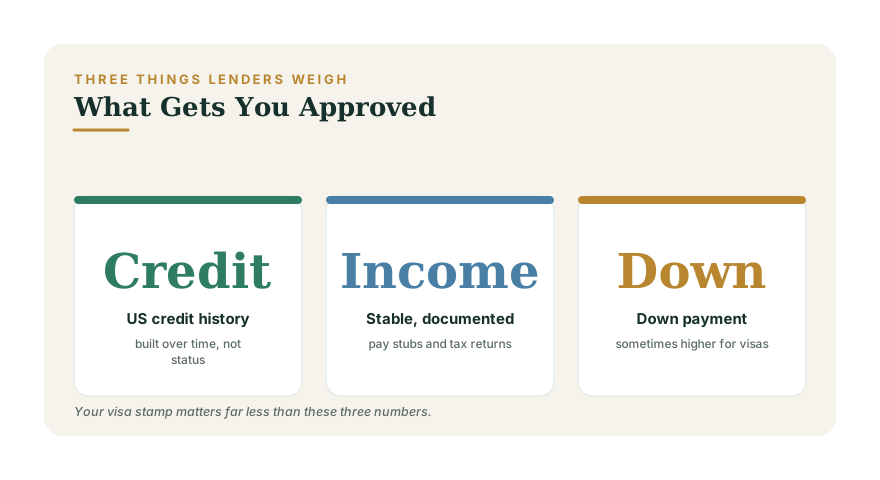
One of the most persistent myths among newcomers is that you must be a US citizen, or at least hold a green card, before a bank will give you a mortgage. It is not true. Lenders care far more about your credit, your income, and your down payment than about the specific stamp in your passport. Permanent residents, visa holders on H-1B, L-1, and similar work visas, and even people with no immigration status but a tax identification number can all qualify for home loans under the right conditions.
Mortgage eligibility by status
Your immigration status mostly affects which loan programs you can use, not whether you can borrow at all.
- Permanent residents (green-card holders) are treated almost identically to citizens. You qualify for conventional, FHA, VA (if eligible), and other standard loans with the same terms.
- Work-visa holders such as H-1B, L-1, O-1, and TN can generally get conventional and FHA loans. Lenders will typically want to see that your visa is current and that you have a reasonable history of US income. Some will ask about the likelihood of your status continuing, but a steady job and good credit usually carry the day.
- Non-residents and people without status have fewer options through traditional banks but can use specialized ITIN mortgages, described below.
Building US credit from scratch
The single biggest obstacle for most newcomers is not status — it is the absence of a US credit history. Credit scores built in your home country do not transfer. Without a US score, a lender cannot assess your reliability, and the loan stalls. The fix is to start building credit deliberately and early, ideally a year or more before you plan to buy. A secured credit card, becoming an authorized user, and paying every bill on time are the core moves. We lay out the full playbook in Building Credit as a Newcomer. The earlier you start, the better your rate when you finally apply.
What an ITIN mortgage is
If you do not have a Social Security number, you may have an Individual Taxpayer Identification Number (ITIN), which the IRS issues so you can file taxes. A growing number of lenders, especially community banks and credit unions, offer ITIN mortgages to borrowers who file taxes with an ITIN rather than an SSN. These loans let people without traditional status become homeowners, but they come with trade-offs: expect a larger down payment, often 15 to 25 percent, a somewhat higher interest rate, and stricter documentation. The reason is that these loans are not backed by the usual government programs, so the lender carries more risk and prices for it. For someone with steady income and savings but no path to an SSN, an ITIN mortgage can still be a sound route to ownership.
The down payment and reserves
How much you need down depends on your status and loan type. Conventional loans for green-card holders and many visa holders can go as low as 3 to 5 percent down, while ITIN and some non-resident loans require considerably more. Beyond the down payment, lenders often want to see cash reserves — several months of mortgage payments sitting in the bank after closing — which gives them comfort that a job change or visa hiccup will not immediately derail your payments. Building that reserve is part of the same saving discipline covered in The First-Time Homebuyer Roadmap.
The documentation lenders want
Newcomers are sometimes surprised by how much paperwork a mortgage requires, but it is the same core list for everyone, plus a few status items:
- Two years of income history where possible — pay stubs, W-2s or 1099s, and federal tax returns.
- Bank statements showing your down payment and reserves, with any large recent deposits explained.
- Your visa and, often, your I-797 approval notice or employment authorization document.
- A valid SSN or ITIN.
If part of your down payment is a gift from family abroad, expect to document its source and provide a gift letter. Money wired from overseas is fine, but lenders will trace it.
Putting it together
Buying a home as an immigrant comes down to preparation: build US credit early, save a down payment plus reserves, keep your tax filings clean, and match your status to the right loan program. If you are still weighing whether to buy at all while your status is in flux, read H-1B to Green Card: A Financial Checklist first. When you are ready to run real numbers, the Home Affordability Calculator and the Mortgage Readiness assessment will tell you where you stand before you talk to a single lender.