If you read enough financial commentary, you will run into a recurring debate: is it a growth market or a value market? The two terms get thrown around as if they were rival teams. They are really just two ways of describing stocks, and understanding what they mean — and how unpredictably they trade leadership — points most investors toward a refreshingly simple conclusion.
What the labels actually mean
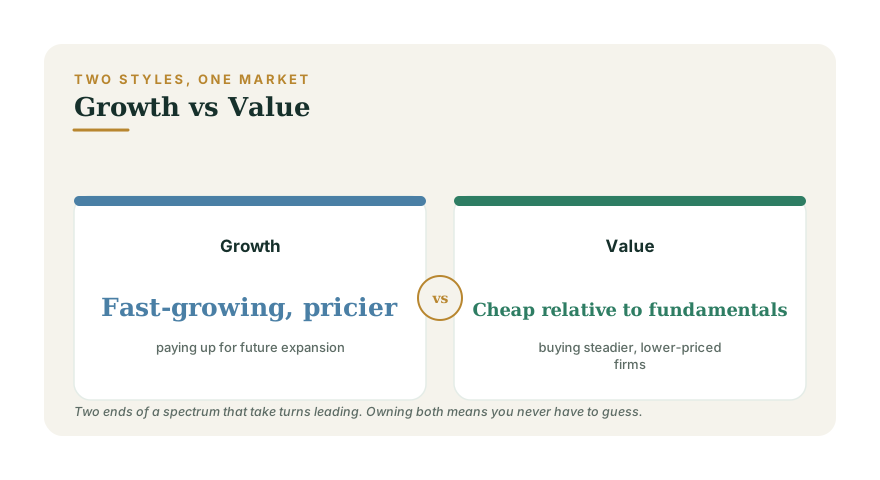
Growth stocks are companies the market expects to grow earnings quickly — think fast-expanding technology or consumer firms. Investors are willing to pay a high price relative to current profits because they are betting on much bigger profits later. These stocks tend to be more expensive on paper and can be more volatile.
Value stocks are companies that look cheap relative to their fundamentals — their earnings, assets, or dividends. They are often more established, slower-growing businesses in less glamorous industries. The bet is different: that the market has underpriced a solid company and the price will eventually catch up to its worth.
It helps to think of growth and value not as two boxes but as opposite ends of a single spectrum. Most companies fall somewhere in between, and a stock can drift from one label to the other over time.
The styles cycle in and out of favor
Here is the part that trips people up: neither style is permanently better. They take turns leading, sometimes for years at a stretch. There have been long stretches where growth crushed value, and other long stretches where value did the crushing. The handoffs are driven by interest rates, economic conditions, and investor mood — forces that are notoriously hard to forecast.
The trouble is that the style that has done well recently is the one that feels obviously right, which is exactly when people pile in — often just before leadership rotates. Chasing whichever style is hot is a reliable way to buy high and sell low. The cycle is real, but its timing is not something you or the experts can dependably call in advance.
Why guessing the cycle is a losing game
Predicting when growth will hand off to value (or back) is a special case of market timing, and it carries the same problem: you have to be right about both the turn and the timing, repeatedly, over an investing lifetime. Even the professionals whose full-time job is this kind of forecasting mostly fail to beat a simple index — a pattern explored in why professional stock pickers fail. If the pros can't reliably time the style cycle, an individual investor watching from the sidelines has even less of an edge.
The simple answer: own both
Here is the freeing part. You do not have to pick a side, because a total-market index fund already holds both. When you buy a broad US (or global) stock index, you automatically own growth and value companies in roughly their market proportions. Whichever style is winning at any given moment, you are already holding it. The leadership can rotate as many times as it likes, and you simply collect the market's overall return without ever placing a bet.
This is the quiet genius of broad indexing: it sidesteps a debate you cannot reliably win. There is no need to read the tea leaves on rates and economic cycles, no temptation to chase last year's winner. You own the whole spectrum, rebalance occasionally, and move on with your life. If this approach is new to you, the beginner's guide to index funds walks through how a single fund delivers this kind of broad ownership.
When tilting might make sense — and the caveat
Some experienced investors deliberately tilt toward value (or small-cap value) based on long-run academic evidence that these factors have historically earned a premium. That is a legitimate strategy, but it comes with real conditions: you must commit to it for decades, tolerate long stretches of underperformance without bailing, and accept that past patterns may not repeat. For the overwhelming majority of investors, the added complexity and behavioral risk are not worth it. The simpler choice — owning the whole market — captures both styles with none of the second-guessing.
The bottom line
Growth and value are useful descriptions, not a choice you are required to make. Because the two styles swap leadership unpredictably and nobody times the swaps reliably, the smart default is to own both through a broad, low-cost index — the heart of a simple three-fund portfolio. To see how a whole-market approach fits your timeline and risk tolerance, explore the model portfolios tool and skip the guessing game entirely.