The FIRE movement (Financial Independence, Retire Early) gets a lot right. Save aggressively, keep your expenses low, invest in cheap index funds, and buy back your time decades before the traditional finish line. That core message is genuinely good, and it has helped a lot of people take control of their money. But the headline math FIRE is built on, the famous 4% rule, gets stretched well past what it was designed to do, and the oversimplified version can quietly set people up to run out of money in their seventies. The movement deserves respect and a more honest set of numbers.
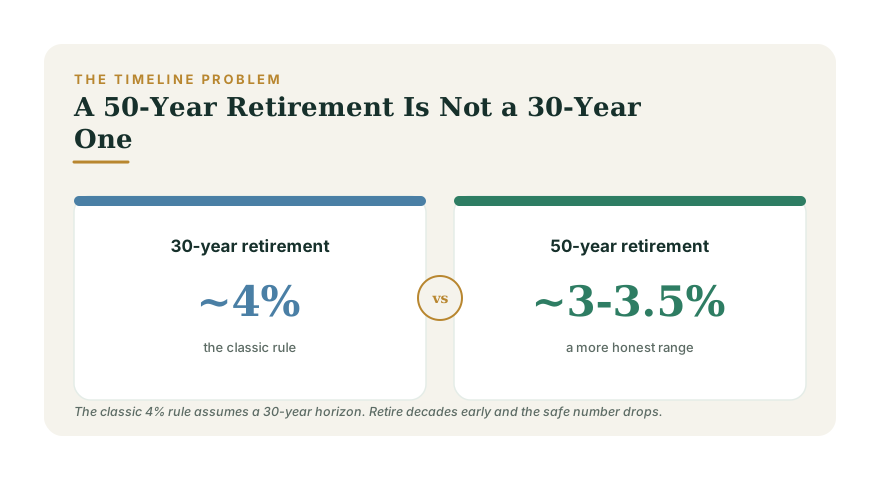
The honest truth: the 4% rule was built for 30 years
The 4% rule comes from research showing that a retiree could withdraw 4% of their portfolio in year one, adjust that dollar amount for inflation each year, and very likely not run out over a 30-year retirement. That is the load-bearing assumption: thirty years. A traditional retiree leaving work at 65 is well served by it.
But FIRE is, by definition, about retiring early, often at 45 or even 40. That is not a 30-year retirement; it is a 45-to-50-year one. The 4% rule was never tested for that, and the longer your money has to last, the more years there are for a bad stretch to do permanent damage. Applying a 30-year rule to a 50-year problem is the central oversimplification.
Sequence-of-returns risk
This is the quiet killer. Two retirees can earn the exact same average return over their retirement and end up wildly different, depending on when the bad years hit. If a market crash lands in your first few years of retirement, you are selling shares at low prices to fund living expenses, permanently shrinking the base that is supposed to recover and compound for the next four decades. The same crash twenty years in does far less damage. A 30-year plan has some buffer to ride this out; a 50-year plan that takes an early hit can be crippled before it ever gets going.
Healthcare before Medicare
Retire at 45 and you have roughly two decades before Medicare eligibility at 65. In the US, that gap is expensive and often underestimated in FIRE spreadsheets. Marketplace premiums, deductibles, and out-of-pocket costs for a family can run many thousands of dollars a year, and that bill tends to rise faster than general inflation. A plan that assumes today's modest healthcare line for twenty years is a plan built on a number that is almost certain to grow.
Inflation does not take a vacation
Over a 30-year retirement, inflation roughly doubles your cost of living. Over 50 years, it can more than triple it. The withdrawal needs to keep pace, which puts more strain on the portfolio for longer. Stretches of higher inflation, especially early, combine viciously with sequence risk: you are withdrawing more dollars to keep up with prices at the very moment your portfolio can least afford it.
The "what will you actually do" problem
This one is not about math, but it wrecks plans anyway. People underestimate how much a 50-year retirement costs in lived reality. Boredom leads to spending. New interests, travel, helping family, and lifestyle creep all push the budget up. The ultra-lean spending that made early retirement possible in year one is hard to sustain for half a century. A plan built on permanent frugality is fragile if your actual life turns out to be longer and fuller than the spreadsheet assumed.
A more honest withdrawal range
None of this means FIRE is broken. It means the safe withdrawal rate for a very long retirement should be more conservative. Much of the research on multi-decade horizons points toward something closer to 3-3.5% rather than a flat 4% for retirements stretching 45-50 years. The difference is not trivial. A 3.25% rule means you need roughly 30 times your annual spending saved, versus 25 times for the 4% rule, so a 60,000-dollar lifestyle implies a target nearer 1.8 million than 1.5 million dollars. That is a meaningful amount of extra runway, and for a half-century retirement it is worth building.
Just as important as the starting number is flexibility. The most resilient FIRE plans use guardrails: spend a bit less in down years, allow yourself a bit more in strong ones, and keep a cash buffer so you are not forced to sell stocks into a crash. A willingness to earn some income in the early years, even part-time, dramatically de-risks the whole thing. Rigid plans break; flexible ones bend.
A FIRE reality-check list
- Plan around your real horizon (45-50 years), not a 30-year rule of thumb.
- Use a more conservative withdrawal rate, often 3-3.5%, for very long retirements.
- Build a real pre-Medicare healthcare line and assume it grows faster than inflation.
- Hold a cash buffer and use spending guardrails to blunt sequence risk.
- Stress-test against an early-crash scenario, not just an average return.
- Keep flexibility: part-time income early on is a powerful safety margin.
The honest recommendation
Keep the good core of FIRE: the high savings rate, the low fees, the bias toward freedom over status. Just refuse to run a 50-year plan on 30-year assumptions. Build in a more conservative withdrawal rate, a real healthcare budget, a cash buffer, and the flexibility to adjust, and early retirement goes from a fragile bet to a durable plan. The goal is not to scare anyone out of it; it is to make sure the freedom you worked so hard for actually lasts.
Before you pull the trigger, pressure-test your plan against the scenarios that actually break it: an early crash, high inflation, a long life. Run those on the wealth simulator, see where you stand on your scores, or read the companion overview in our articles library. Honest math is what turns a brave decision into a safe one.