Deciding that one parent will leave paid work to raise children is one of the biggest financial decisions a family makes — and it is often made on emotion and a rough mental estimate rather than real numbers. That is understandable, but the choice deserves a clear-eyed analysis, because it reshapes income, retirement, insurance needs, and the careers of both partners. Done thoughtfully, a single-earner household can thrive. Done on autopilot, it can quietly leave the non-earning spouse exposed.
The true cost-benefit of leaving work
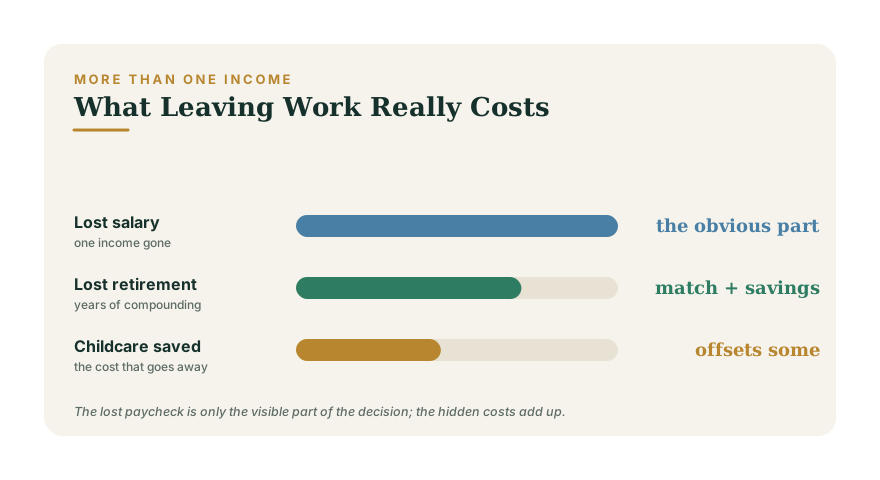
The obvious cost is the lost salary, but a full analysis includes more. On the cost side: forgone retirement contributions and employer match, lost Social Security earnings credits, stalled career growth, and the long-term wage penalty that often follows a gap. On the benefit side: the childcare you no longer pay for (which can be enormous), commuting and work expenses that disappear, possibly a lower tax bill, and the harder-to-price value of a parent at home.
Run the real numbers rather than assuming. Sometimes the second salary, after childcare and taxes, nets far less than it appears — making staying home a smaller financial sacrifice than feared. Other times the long-term cost is larger than expected. The point is to decide with eyes open. Fold this into your wider family planning alongside preparing finances for a baby, and use the opportunity-cost calculator to weigh the long-term trade-off.
Protect the non-earning spouse — this is where families slip
A stay-at-home parent has no paycheck, but they are doing work that would cost a fortune to replace — childcare, household management, and more. Two protections are essential and routinely forgotten:
- Life insurance on the stay-at-home parent. If they were gone, the working spouse would face huge new costs for childcare and household help. A term life policy on the non-earner is not optional; it is one of the clearest needs in the whole plan.
- Disability and adequate coverage on the earner. With the family relying on a single income, protecting that income is critical — robust life and disability insurance on the working spouse, sized to support the whole household for years.
Insuring only the breadwinner is the classic half-finished version of this plan. Cover both lives.
Keep the non-earner's retirement growing with a spousal IRA
One quiet casualty of leaving work is the non-earner's retirement savings, which would otherwise just stop. The fix is the spousal IRA: even if one spouse has no earned income, the working spouse can contribute to an IRA in the non-earner's name, as long as the couple files jointly and the worker earns enough to cover it. This keeps the stay-at-home parent building their own retirement assets, in their own name, through the gap years.
Whether to use a Roth or traditional version follows the usual logic in Roth vs Traditional IRA. Pair it with awareness of Social Security: a spouse with little earnings record can still claim benefits based on the working spouse's record, as explained in spousal and survivor Social Security. Together, the spousal IRA and spousal benefits keep the non-earner from reaching retirement empty-handed.
Plan for re-entry from the start
Many stay-at-home parents return to paid work eventually, and the families who plan for it fare best. Re-entry is easier when the parent keeps a foot in the door — maintaining professional licenses and certifications, staying lightly networked, taking occasional contract or part-time work, or refreshing skills before the gap grows long. Financially, building the household around the single income (rather than stretching to its limit) preserves flexibility for the transition back. Treat the at-home years as a chapter with an exit plan, not a permanent erasure of one career.
Make the single income resilient
A one-income family can absolutely build wealth, but it runs with less slack, so the fundamentals matter more: a larger emergency fund, disciplined spending, both spouses' retirement growing, and full insurance on both lives. Decide the whole thing deliberately — cost-benefit, protection, the spousal IRA, and a re-entry path — and revisit it as the kids grow. Check that your single-income plan holds together with the Financial Wellness Score.