Most people think of Social Security as a benefit they earn individually, based on their own work record. For married couples, that is only half the story. Spousal and survivor benefits can meaningfully increase a household's lifetime income, and the rules reward couples who coordinate their claiming decisions rather than each person deciding in isolation.
How spousal benefits work
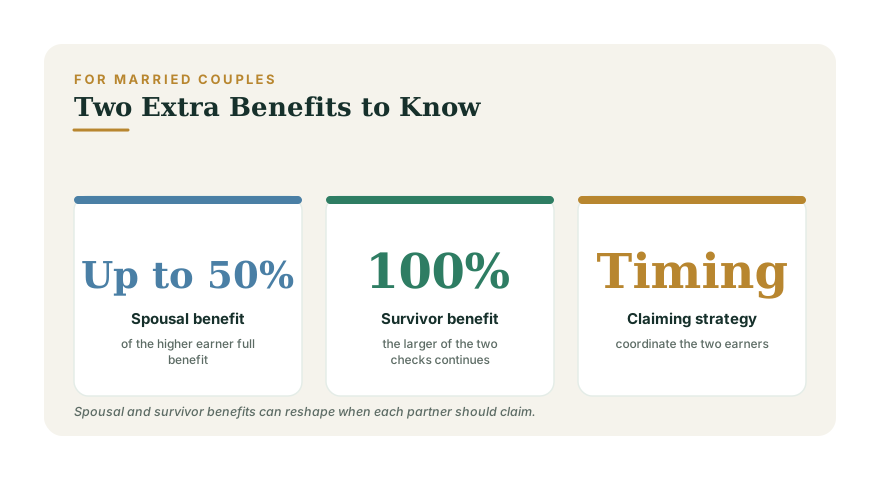
A spousal benefit lets a husband or wife receive a benefit based on their partner's earnings record instead of their own. At full retirement age, a spousal benefit can be worth up to 50% of the higher earner's full benefit. You receive the larger of your own benefit or the spousal amount — not both stacked together.
This matters most when one spouse earned far more than the other, or when one spent years out of the paid workforce raising a family. If your own benefit would be smaller than half of your spouse's, the spousal benefit fills the gap. A few details: the higher earner generally must have already filed for the spousal benefit to be available, and claiming a spousal benefit before your own full retirement age permanently reduces it. Unlike your own benefit, a spousal benefit does not grow past full retirement age, so there is no advantage to delaying a purely spousal benefit beyond that point.
How survivor benefits work
When one spouse dies, the survivor does not keep both checks. Instead, the household keeps the larger of the two benefits and loses the smaller one. A surviving spouse who is at least full retirement age can step up to 100% of what the deceased spouse was receiving (or entitled to receive).
This single rule has a powerful implication: the higher earner's decision to delay does not just boost their own check while alive — it sets the floor for whatever the surviving spouse will live on, potentially for many years. Delaying the larger benefit is, in effect, buying inflation-protected longevity insurance for the survivor.
Claiming strategies for married couples
Because the rules interlock, couples generally do best when they treat claiming as a joint decision. A common framework:
- The lower earner can claim earlier. Their benefit is smaller and will likely be replaced by a survivor benefit eventually, so claiming it sooner provides income now with less long-term cost.
- The higher earner often delays. Pushing the larger benefit toward age 70 maximizes both the couple's income while both are alive and the survivor benefit afterward. Each year of delay past full retirement age adds roughly 8% to the benefit.
- Mind health and longevity. If the higher earner is in poor health, the math can shift. But because survivor benefits hinge on the larger check, delaying it usually pays off as long as one spouse expects a long life.
These ideas build directly on the general timing question covered in Social Security: when to claim and the deeper trade-offs in Social Security claiming strategies.
A few situations with special rules
- Divorced spouses: if you were married at least 10 years and are currently unmarried, you may be able to claim on an ex-spouse's record — without affecting their benefit or needing their permission.
- Working while claiming: if you claim before full retirement age and keep working, an earnings test may temporarily reduce benefits, though the amount is later restored.
- Remarriage: remarrying can affect divorced-spouse and survivor benefits, so the timing of a new marriage is worth checking.
Putting it together
For couples, the headline is simple: claim the smaller benefit earlier, delay the larger one to protect the survivor, and decide together rather than separately. Social Security is one piece of retirement income alongside savings and any pension — and if you face a pension election too, weigh it with the same longevity lens described in pension: lump sum or monthly annuity. To model how different claiming ages change your household's lifetime income, run your numbers through the Social Security Optimizer and check your overall standing with the Retirement Readiness assessment.