If your federal student loans feel like they are stuck in limbo, you are not imagining it. The Saving on a Valuable Education (SAVE) plan, launched as the most generous income-driven repayment option, was challenged in court and blocked, leaving millions of enrolled borrowers in an administrative forbearance while the litigation played out. That means many people who thought they were making progress toward payoff or forgiveness have been sitting in a plan that is not counting their payments. Untangling where you actually stand is the first job of 2026.
Program details in this area change frequently and sometimes abruptly. Treat everything here as a map, not a guarantee, and confirm your own status directly at the US Department of Education's studentaid.gov before making decisions.
What happened to SAVE
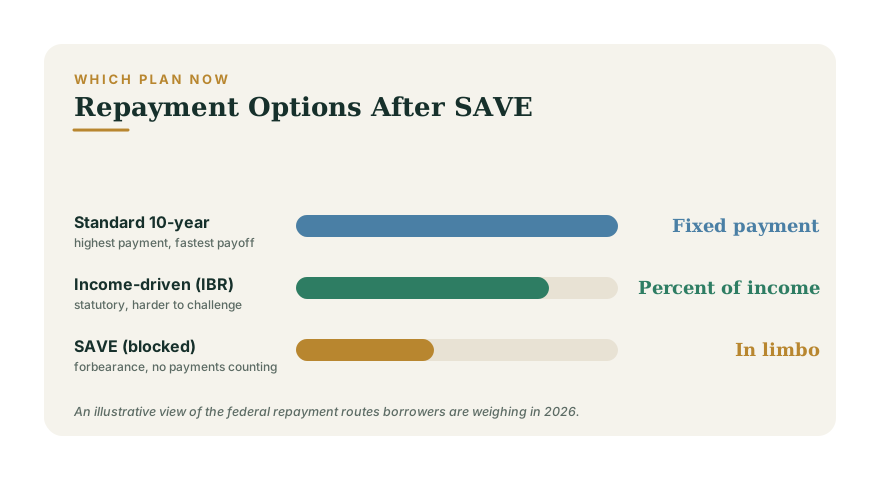
SAVE was designed to lower monthly payments and shorten the road to forgiveness for many borrowers. Legal challenges argued the plan exceeded the Department of Education's authority, and courts blocked it. While the case worked through the system, enrolled borrowers were placed in a forbearance: no payments were due, but that time generally did not count toward income-driven forgiveness or, in most cases, Public Service Loan Forgiveness. For anyone counting on those months, the pause was a setback disguised as relief. Because the outcome and timing kept shifting, the only reliable move is to check your loan servicer's messages and your studentaid.gov account rather than rely on headlines.
The plans that remain
Even with SAVE blocked, several repayment options remain on firmer legal footing:
- Standard 10-year plan. Fixed monthly payments that pay the loan off in ten years. It has the highest monthly cost but the lowest total interest, and it is the simplest to reason about.
- Income-Based Repayment (IBR). A statutory income-driven plan written into law, which makes it harder to challenge in court than a regulation-based plan. Payments are a percentage of discretionary income, with forgiveness after a set number of years.
- Other income-driven plans. Older options such as PAYE and ICR may still be available to some borrowers, though the Department has periodically restricted new enrollment. Availability changes, so verify current eligibility.
- Graduated and extended plans. Useful in narrow cases, but they usually raise total interest paid.
The mechanics of each plan and who they suit are laid out in Student-Loan Repayment Plans, Explained.
How to figure out where you stand
Before choosing anything, establish the facts. Log in to studentaid.gov and confirm which plan you are actually on, whether you are in a forbearance, your current balance and interest rate, and how many qualifying payments you have made toward any forgiveness track. The Consumer Financial Protection Bureau (consumerfinance.gov) publishes borrower guidance and a complaint process if your servicer gives you inaccurate information, which has been a recurring problem during these transitions.
Choosing a plan you can rely on
In an environment where a plan can be blocked mid-stream, predictability has real value. If your goal is simply to get out of debt and your budget can handle it, the standard plan removes all uncertainty. If you need lower payments or you are pursuing forgiveness, a statutory plan like IBR is generally more durable than a newer regulatory one. Run both the payment and the total-interest picture with the Debt Payoff Planner so you are comparing lifetime cost, not just the monthly number. If you are also carrying credit-card or other high-rate debt, sequence it using Debt Avalanche vs Snowball.
Watch the interest and the paperwork
Two quieter risks deserve attention. First, interest: during some forbearances interest still accrues, and when payments restart your balance may be higher than you remember. Second, recertification: income-driven plans require you to recertify your income each year, and missing that deadline can spike your payment or knock you off the plan. Set a calendar reminder and keep copies of everything you submit.
Put a plan in place
The theme of 2026 is uncertainty, so build a repayment approach that survives it: confirm your real status, favor durable plans, keep recertifying on time, and model the full cost before you commit. If forgiveness is part of your plan, read PSLF in 2026: Where It Stands, and if you are weighing leaving the federal system entirely, see Refinance or Stay Federal?. Then map your full debt-and-savings picture at the planning hub and pressure-test it with the Financial Resilience assessment.