If you have federal student loans, you are not stuck with one payment. The Department of Education offers a menu of repayment plans, and the difference between them can be hundreds of dollars a month and tens of thousands of dollars over the life of the loan. The catch is that the "best" plan is not universal — it depends on your income, your balance, and whether you are aiming for forgiveness or for the lowest total cost. This is a map of the options.
The standard plan: lowest cost, highest payment
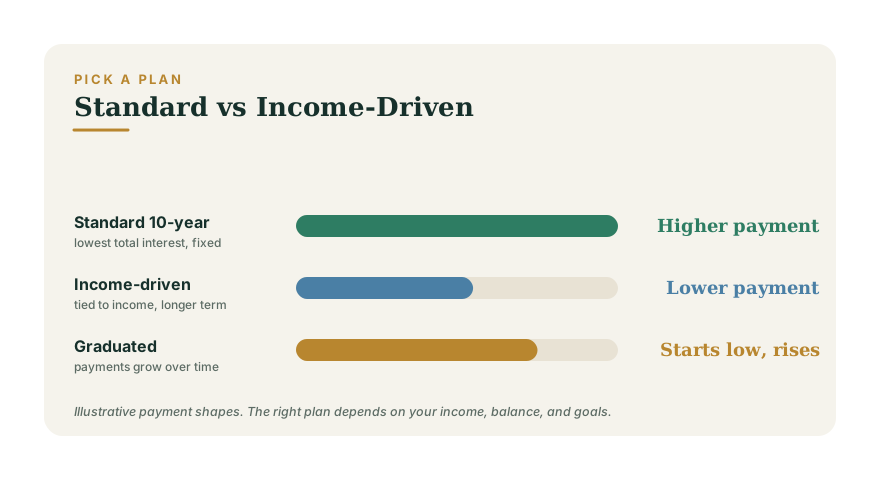
The standard repayment plan spreads your federal loans over a fixed term — typically ten years — with equal monthly payments. Because you pay it off relatively quickly, you pay the least total interest. If you can comfortably afford the standard payment, it is usually the cheapest way to clear federal debt. Everyone starts here by default unless they choose otherwise.
There is also a graduated plan, where payments start lower and rise every couple of years, and an extended plan that stretches the term out for larger balances. Both lower the early payment but raise the total interest you pay.
Income-driven repayment: payments tied to what you earn
Income-driven repayment (IDR) plans set your monthly payment as a percentage of your discretionary income rather than your balance. If your income is low relative to your debt, the payment drops — sometimes dramatically, occasionally to near zero. The specific IDR plans and their formulas change over time as federal rules are updated, so check the current options on the official Federal Student Aid site rather than relying on older summaries.
IDR exists to keep payments survivable, and that is its great strength. But there is a tradeoff: lower payments over a longer term usually mean more total interest. On some plans, if your payment does not even cover the monthly interest, the balance can grow. IDR is the right call when affordability is the immediate problem, or when you are pursuing forgiveness — not necessarily when your goal is to pay the least overall.
Forgiveness, in plain terms
Several federal programs can cancel remaining loan balances after you meet certain conditions:
- Public Service Loan Forgiveness (PSLF) can forgive the remaining federal balance after a number of years of qualifying payments while working full time for a government or eligible nonprofit employer. The rules are strict — qualifying loan type, qualifying plan, qualifying employer, qualifying payments — so certifying your employment regularly matters.
- IDR forgiveness can cancel a remaining balance after a long repayment period (often 20–25 years) on an income-driven plan, even without public-service work.
Forgiveness can be valuable, but it rewards staying inside the federal system and following the rules precisely. Program details shift with policy, so verify the current terms before you build a decade-long plan around them.
Why refinancing federal loans is risky
Private lenders advertise refinancing your student loans at a lower interest rate, and for high-rate private loans that can be a smart move. But refinancing federal loans into a private loan is a one-way door, and you give up a long list of protections that are easy to undervalue until you need them:
- You lose access to income-driven repayment and its safety net of income-based payments.
- You lose eligibility for PSLF and other federal forgiveness programs — permanently.
- You lose generous federal deferment and forbearance options if you lose your job or hit hardship.
A slightly lower rate is rarely worth surrendering all of that, especially early in a career when income is uncertain. The full case is in The Student Loan Refinancing Trap. As a rule: refinance private loans if the rate is better; think very hard before refinancing federal loans out of the federal system.
How student loans fit your bigger picture
Once your payment is manageable, a common question is whether to attack the loans aggressively or invest instead. The answer hinges on your interest rate and a few other factors — work through it with Pay Off Debt or Invest? A Framework. And if you are also carrying high-rate credit card balances, those almost always come first; see How to Actually Pay Off Credit Card Debt.
Choose deliberately, then revisit
Your repayment plan is not permanent — you can switch as your income and goals change. A standard payment that felt heavy at your first salary can become comfortable after a few raises, at which point moving off an income-driven plan saves you interest. Conversely, a job loss is a reason to step onto an income-driven plan, not to default. Treat the plan as a dial you adjust each year, not a setting you choose once. Pick the plan that fits this chapter of your life, and fold the payment into your overall plan at the planning hub so your loans, savings, and investing are all pulling in the same direction.